Smart Film for Car: The Multifunctional Surface Revolutionizing Automotive Interiors and Exteriors
The modern automobile is undergoing a paradigm shift, evolving from a mere means of transportation into a connected, intelligent, and adaptive living space. At the heart of this transformation lies a quiet revolution in material science: the integration of smart film for car applications. Moving far beyond the conventional roles of glass and plastic, smart film for car technologies are enabling windows, dashboards, roofs, and even body panels to become dynamic, interactive, and multifunctional surfaces. This article delves into the core technologies, diverse applications, and future potential of smart film for car systems, illustrating how they are redefining the automotive experience.
Defining Smart Film: Beyond Simple Tinting
A smart film for car refers to a thin, laminate-able, or adhesive layer that can alter its fundamental properties—such as light transmission, opacity, color, or even its ability to display information—in response to an external stimulus. This stimulus is most commonly an electrical signal, but can also include thermal, photonic, or pressure-based triggers. Unlike passive films, a true smart film for car component is integrable into vehicle electronics, enabling programmable control and automation.
Core Technologies Underpinning Smart Film for Car
Several distinct technologies fall under the umbrella of smart film for car, each with unique mechanisms and optimal applications:
Electrochromic (EC) Film:
Mechanism: As detailed in prior discussions, EC films change their tint or opacity through the movement of ions (like Lithium) between layers under a low-voltage electrical charge. The change is gradual and persistent.
Key Traits for Automotive: Smooth, gradable tint control; excellent solar heat rejection; energy-efficient (power only needed during transition). Ideal for sunroofs and windows where variable light and heat control is desired.
Polymer Dispersed Liquid Crystal (PDLC) Film:
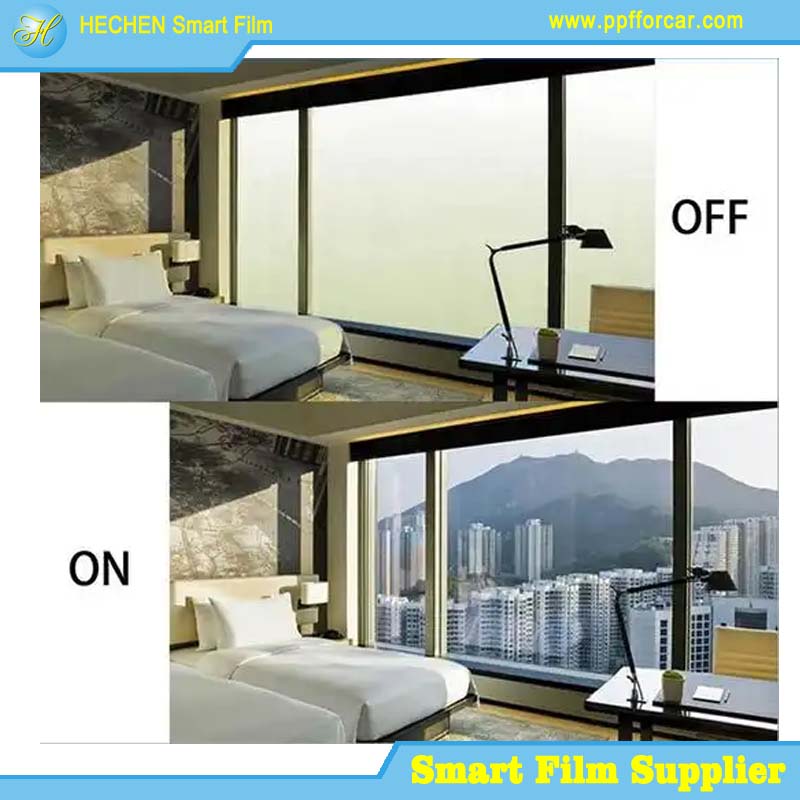
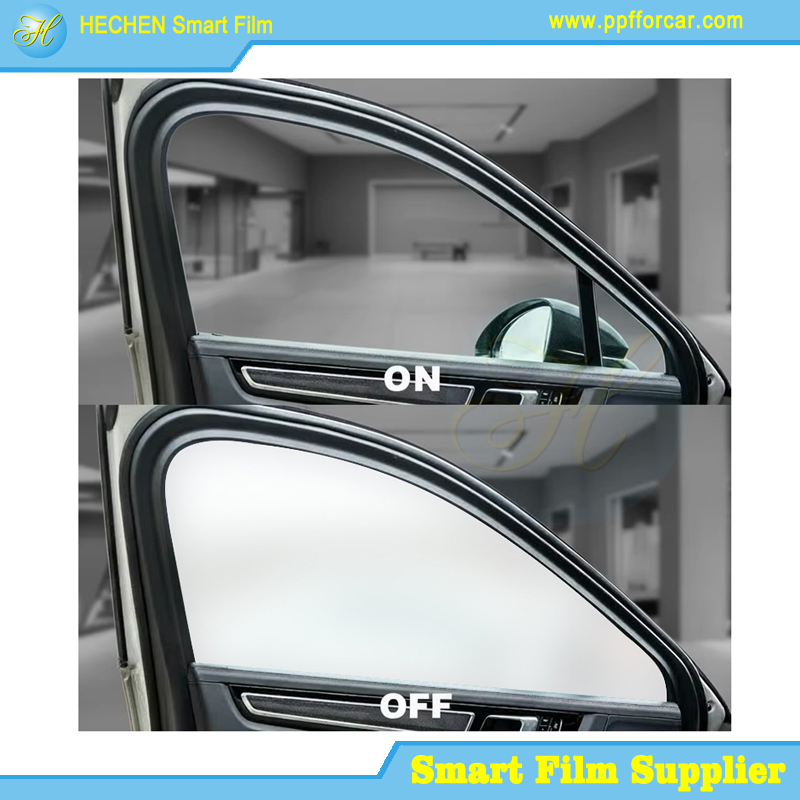
Mechanism: Microscopic liquid crystal droplets are suspended in a polymer matrix. When no voltage is applied, the crystals are randomly oriented, scattering light and making the film appear translucent or "frosted." When voltage is applied, the crystals align, allowing light to pass through clearly.
Key Traits for Automotive: Instantaneous on/off switching (milliseconds); provides instant privacy. Widely used for partition windows (e.g., between driver and passenger cabin) and for creating switchable privacy shades integrated into glass.
Suspended Particle Device (SPD) Film:
Mechanism: Contains microscopic light-absorbing particles suspended in a fluid. In their natural state without electricity, these particles are randomly aligned, blocking light. When voltage is applied, they align in parallel, allowing light to pass through. The voltage level can control the degree of alignment, allowing for variable tinting.
Key Traits for Automotive: Very fast tinting speed, wide dimming range (from very dark to near-clear), and effective glare reduction. Commonly considered for panoramic roofs and side windows.
Transparent OLED and Micro-LED Film (Emerging):
Mechanism: While more complex than passive films, these are the ultimate expression of a smart film for car. They consist of ultra-thin, light-emitting diodes (OLEDs or micro-LEDs) deposited on flexible substrates, creating displays that are transparent when off.
Key Traits for Automotive: Transform windows and surfaces into high-resolution displays for entertainment, information, or augmented reality (AR). This represents the frontier of interactive surfaces.
Transformative Applications of Smart Film for Car
The integration of these films unlocks a vast array of applications, enhancing functionality, safety, comfort, and design.
1. Dynamic Windows and Glazing:
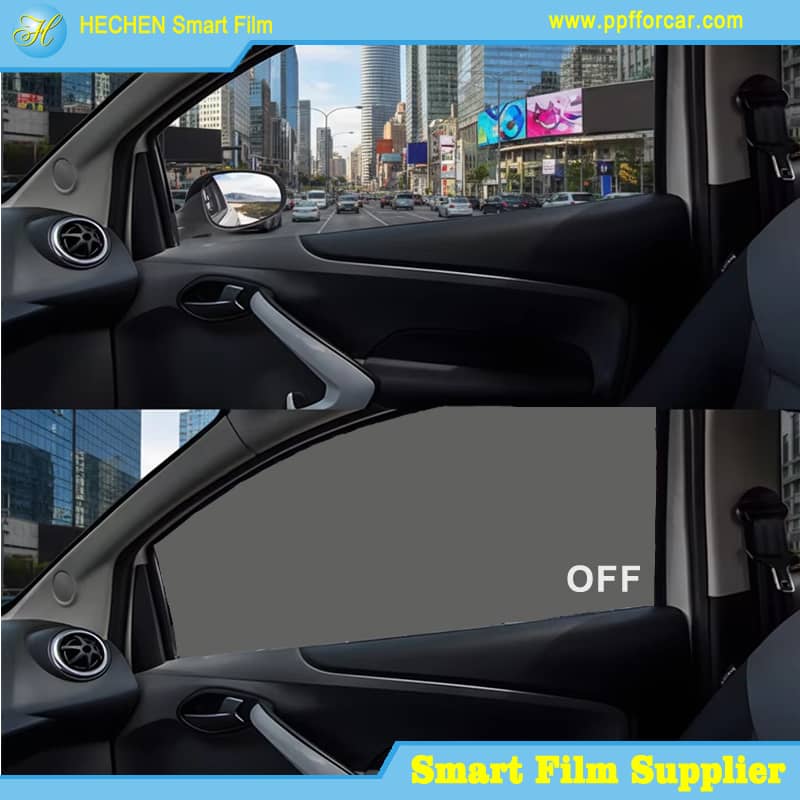
This is the most established application. A smart film for car sunroof (using EC or SPD technology) can automatically adjust its tint based on sun intensity, eliminating glare and heat buildup, thereby significantly improving cabin comfort and reducing HVAC load—a critical factor for electric vehicle range. Side windows with PDLC film can offer instant privacy for rear-seat passengers at the touch of a button, replacing manual blinds.
2. Interactive Displays and Augmented Reality:
The future of the dashboard and windshield lies with smart film for car display technology. Transparent OLED films can be integrated onto the windshield or side windows to project navigation arrows, speed, or hazard warnings directly into the driver’s line of sight, creating head-up displays (HUDs) with unprecedented clarity and field of view. Passengers could use side windows as interactive touchscreens for controlling infotainment, drawing, or accessing points of interest during travel.
3. Advanced Lighting and Signaling:
Smart film for car technology enables adaptive lighting surfaces. Thin, flexible films containing micro-LEDs can be applied to create seamless, animated tail lights, turn signals, and even customizable body lighting. A single piece of smart film for car lighting can replace multiple bulky LEDs and light guides, offering designers new freedom for creating distinctive brand signatures and dynamic communication with other road users.
4. Adaptive Interior Surfaces and Haptic Feedback:
Interior trim pieces, such as door panels or center consoles, can be overlaid with a smart film for car that functions as a reconfigurable control surface. With integrated capacitive touch and haptic feedback (vibration simulated through the film), physical buttons can appear and disappear as needed. The climate control panel, for example, might only be visible when the car is turned on, otherwise blending seamlessly into a wood or aluminum trim.
5. Thermal and Energy Management:
Next-generation smart film for car solutions are being developed with spectrally selective properties. They can be designed to dynamically modulate not just visible light, but also specific wavelengths of infrared (IR) radiation. This allows for independent control of solar heat gain (IR rejection) and visible light transmission, optimizing thermal comfort year-round—rejecting heat in summer while allowing passive solar heating in winter.
Integration Challenges and Technical Hurdles
The widespread adoption of smart film for car systems faces several significant challenges:
Durability and Longevity: Automotive environments are brutal. Films must withstand temperatures from -40°C to +100°C, intense UV radiation, humidity, vibration, and chemical exposure for over 15 years without significant degradation, delamination, or color shift. Cycle life for switchable films must exceed tens of thousands of cycles.
Power Consumption and Integration: While EC films are energy-efficient, PDLC and SPD films require continuous power to maintain their transparent state. Display-grade films have higher power demands. Integrating these into the vehicle's electrical architecture, especially in EVs where energy management is paramount, requires careful design.
Cost and Scalability: Manufacturing large-format, defect-free smart film for car components with consistent quality is complex and expensive. High material costs (e.g., ITO for transparent conductors) and low yields can be prohibitive for mass-market models. Scaling up production while driving down cost is essential.
Optical Quality: Films must achieve near-optical glass clarity in their transparent state, free of haze, color distortion, or bubbles. This is a high bar for large-area laminates.
Regulatory Compliance: Films used on windshields and driver-side windows must meet stringent safety (laminated glass standards), visibility, and distraction regulations, which vary by region.
The Future Roadmap: Towards Intelligent, Holistic Surfaces
The trajectory for smart film for car technology points towards greater integration, intelligence, and multifunctionality:
Multi-Stimuli Responsive Films: Future films may respond to multiple inputs—changing tint based on both electrical signal and temperature, for instance.
Energy-Generating Smart Films: Research into perovskite solar cell films or thermoelectric layers could see smart film for car surfaces that not only manage energy but also harvest it from sunlight or cabin heat.
AI-Driven Adaptive Systems: Connected to a network of in-car sensors and external data (weather, location), a holistic smart film for car system powered by AI could autonomously manage cabin lighting, privacy, temperature, and display information in an anticipatory manner, perfectly tailored to occupant preferences and driving conditions.
Structural and Biometric Integration: Films with embedded micro-sensors could monitor occupant vital signs or detect touch and gesture with high precision, turning every surface into a health monitor or intuitive interface.
In conclusion, the smart film for car is not a single product but a foundational technology platform enabling the car's very surfaces to become alive and responsive. It blurs the lines between window, screen, light, and controller. As the challenges of cost and durability are overcome, we will witness an era where the static, passive interior gives way to a dynamic, adaptive environment. The car of the future will be defined not just by how it drives, but by how its surfaces interact with us. The smart film for car is the essential canvas upon which this future of mobility will be painted, transforming every journey into a seamlessly personalized and connected experience.
For more about what is electric tint film for car window? Everything you need to know, you can pay a visit to Hechen PDLC Smart Film Manufacturers for more info.