PDLC Film for Cars vs Smart Tint: Key Differences
TL;DR: The distinction between “PDLC film” and the broader category “smart tint” for automotive windows. While PDLC (polymer-dispersed liquid crystal) is one type of smart tint, other technologies exist – primarily electrochromic (EC) and suspended particle device (SPD). Each operates on different physical principles: PDLC switches between transparent and milky‑white opaque via liquid crystal scattering; SPD aligns light‑absorbing particles to vary transparency; EC uses ion migration to change color (typically blue‑grey). Key differences include switching speed (PDLC: <1 second; EC: seconds to minutes), off‑state appearance (PDLC: white opaque; EC: dark blue; SPD: dark grey), power consumption (PDLC consumes only when clear; EC consumes only when switching), and suitability for curved glass (PDLC flexible film is easiest to retrofit). The article compares these technologies head‑to‑head on parameters such as heat rejection, UV blocking, solar gain, durability, cost, and installation complexity. No brand or model names are used. The conclusion helps car owners choose the right smart tint based on their priorities – privacy, heat rejection, optical clarity, or budget.
1. Introduction: Smart tint is not one single technology
The term “smart tint” (or smart window film) is often used as a catch‑all for any glass that can change its light transmission properties on demand. However, there are multiple distinct technologies that achieve this effect, each with unique advantages, limitations, and costs. A common point of confusion: PDLC film is one type of smart tint, but not all smart tints are PDLC.
When shopping for smart window solutions for cars, you may encounter three main technologies:
PDLC (Polymer‑Dispersed Liquid Crystal) – The most common retrofit film. Switches between transparent and milky‑white opaque.
SPD (Suspended Particle Device) – Uses light‑absorbing particles to vary between clear and dark tinted states.
EC (Electrochromic) – Changes color via ion migration; typically transitions from clear to deep blue/grey.
This article focuses on PDLC film (the subject of most “pdlc folie auto” searches) and compares it point‑by‑point with other smart tint technologies. No brand or model names are mentioned – only generic performance characteristics based on published materials science.
2. What is PDLC film? (Recap for context)
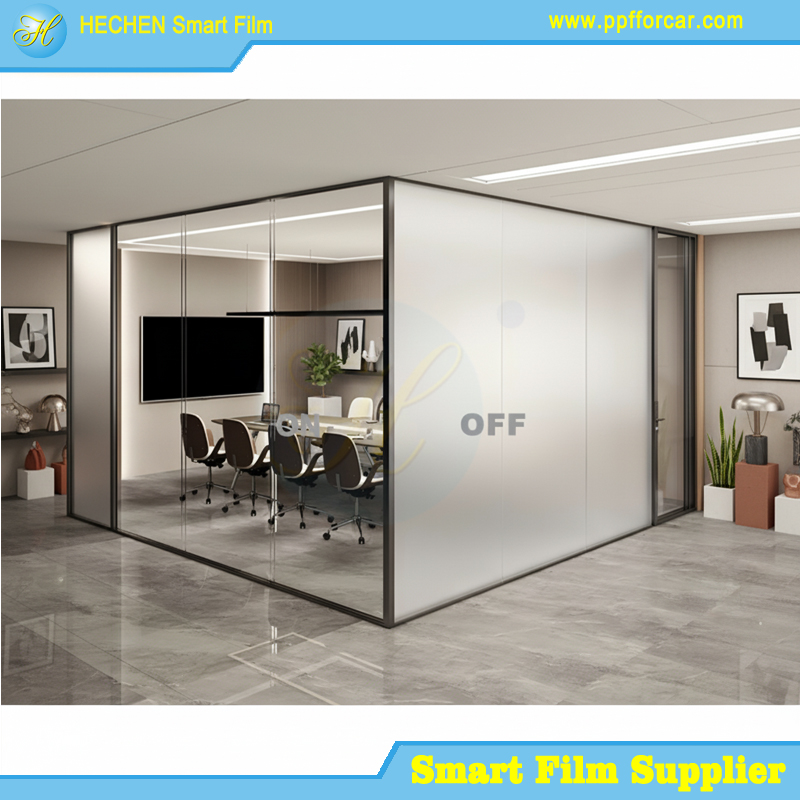
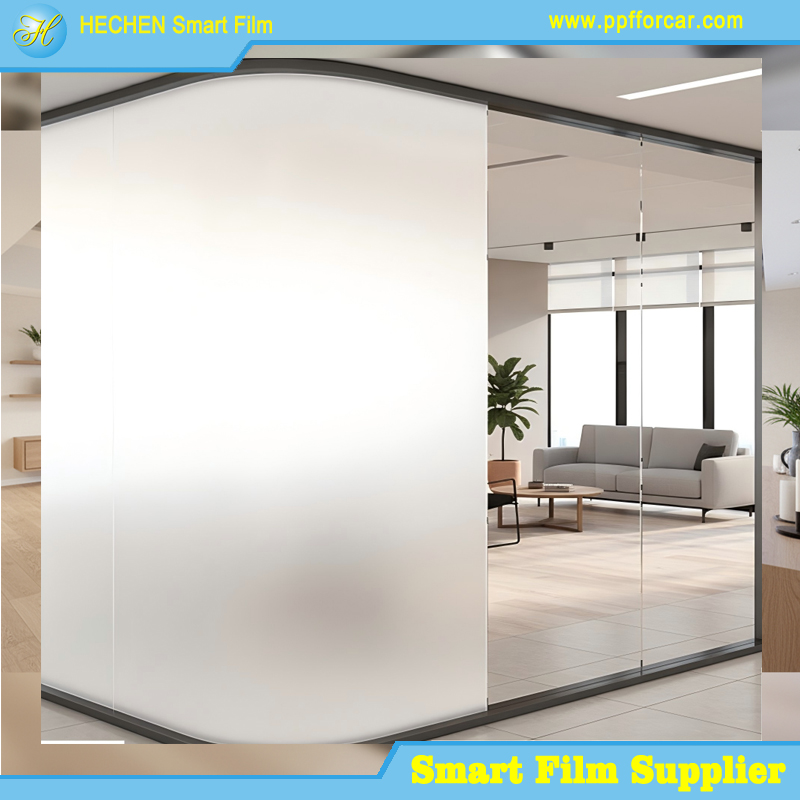
PDLC film is a flexible, adhesive‑backed sheet that can be applied to existing car windows. Its active layer consists of liquid crystal microdroplets dispersed in a polymer matrix. When no voltage is applied, the droplets scatter light, making the film appear milky white and opaque. When AC voltage is applied, the liquid crystals align, and the film becomes transparent (clear). PDLC is binary – either fully opaque or fully clear, though some advanced versions offer gradient control.
Key characteristics of PDLC:
Off‑state appearance: Milky white / translucent white
Switching speed: 0.1–2 seconds (very fast)
Power consumption: 1–3 W/m² (only when transparent)
Voltage requirement: Low‑voltage AC (30–60V)
Flexibility: Can be retrofitted to curved glass as a film
Lifespan: 5–8 years
Typical cost (retrofit kit, 4 windows): USD 200–400 (film only)
PDLC is widely used for privacy applications because its off‑state is highly scattering but still lets diffuse light through – it does not become black.
3. Other smart tint technologies for cars
3.1 SPD (Suspended Particle Device)
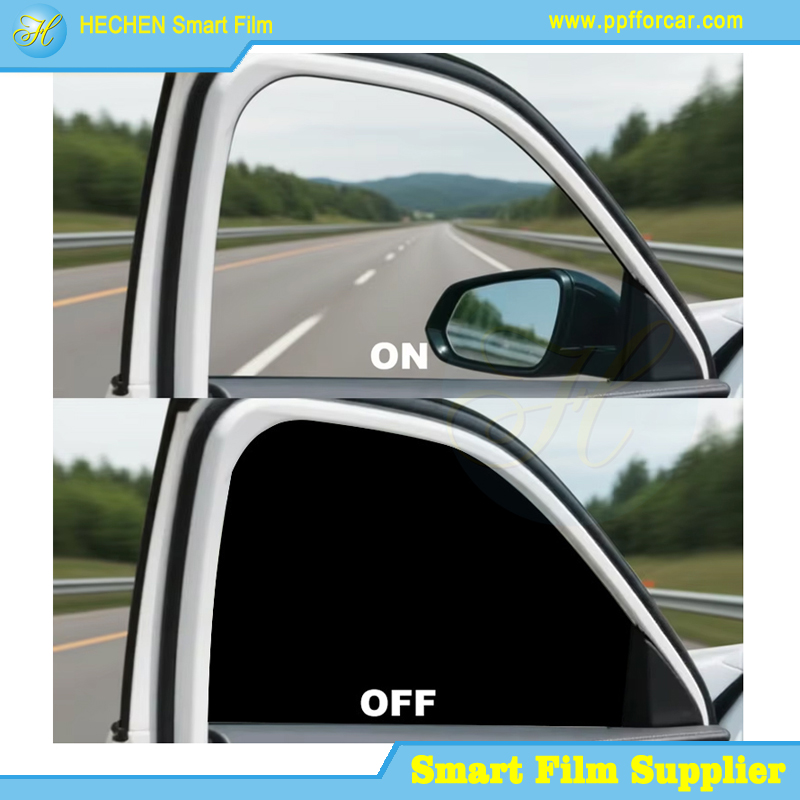
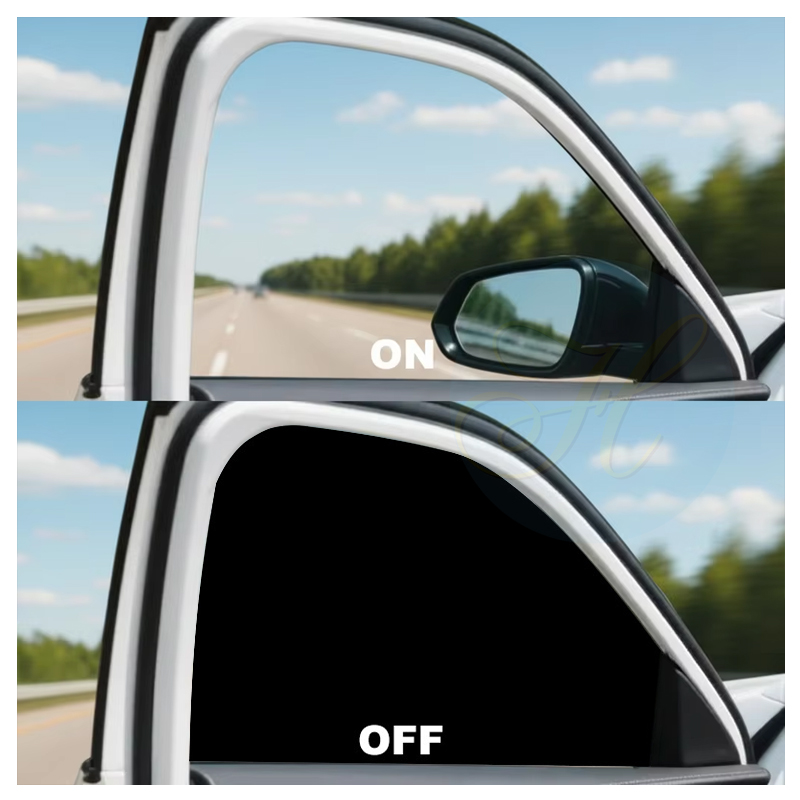
SPD technology consists of rod‑shaped, light‑absorbing particles suspended in a liquid or gel between two conductive layers. With no voltage, the particles move randomly (Brownian motion), absorbing and scattering light – the film appears dark (typically grey or black). When AC voltage is applied, the particles align with the electric field, allowing light to pass through and making the film clear. SPD is also binary (clear vs. dark) but can be dimmed to intermediate levels by varying voltage.
Key characteristics of SPD:
Off‑state appearance: Dark grey / black (privacy mode is dark, not white)
Switching speed: 1–5 seconds (slower than PDLC)
Power consumption: 5–10 W/m² (when clear; consumes power to stay transparent)
Voltage requirement: Higher voltage (typically 100V AC)
Flexibility: Can be made as a film, but less conformable than PDLC; often factory‑installed in glass laminates
Lifespan: 8–12 years
Typical cost: Higher than PDLC (factory option often USD 1000–3000+)
SPD provides true “dark” privacy – when off, the window becomes dark grey/black, blocking most light. This is preferred by some luxury car buyers who want a blackout appearance rather than milky white.
3.2 Electrochromic (EC)
Electrochromic smart glass uses a different mechanism: a thin film of electrochromic material (typically tungsten oxide) changes its light absorption when ions (usually lithium or hydrogen) are driven in and out by a small DC voltage. The transition is slow (from seconds to minutes) and the material changes color – usually from clear to deep blue or grey. Unlike PDLC and SPD, EC consumes power only during switching (it is bi‑stable); once clear or dark, it requires no power to maintain that state.
Key characteristics of EC:
Off‑state appearance: Varies; many EC glasses are clear by default and become dark when voltage is applied (or vice versa). Common automotive EC: auto‑dimming rearview mirrors.
Switching speed: 10–120 seconds (very slow compared to PDLC)
Power consumption: Near zero when stable; small pulse during switching
Voltage requirement: Low DC (1–5V)
Flexibility: Typically laminated into glass (not a retrofit film); used in sunroofs and windows of some high‑end EVs.
Lifespan: 10+ years
Typical cost: Very high (integrated into new glass, not a film)
EC is not commonly available as a retrofit film. It is usually a factory option integrated into the glass itself. For auto‑dimming mirrors and some panoramic roofs, EC is the technology of choice.
4. Head‑to‑head comparison table
| Feature | PDLC | SPD | Electrochromic (EC) |
|---|---|---|---|
| Operating principle | Scattering by liquid crystal droplets | Alignment of suspended particles | Ion migration in metal oxide |
| Off‑state (no power) | Milky white / translucent | Dark grey / black | Clear or dark (depends on design) |
| On‑state (powered) | Clear | Clear | Opposite state |
| Switching time | 0.1–2 seconds | 1–5 seconds | 10–120 seconds |
| Power when transparent | Consumes 1–3 W/m² (PDLC needs power to stay clear) | Consumes 5–10 W/m² (needs power to stay clear) | Zero (bi‑stable) |
| Power when opaque | Zero | Zero | Zero (bi‑stable) |
| Gradient (variable tint) | Limited (binary except special drivers) | Yes (by varying voltage) | Yes (by varying charge) |
| Color in privacy mode | White/translucent | Dark grey/black | Blue/grey |
| Heat rejection (opaque) | Very good (scatters IR) | Good (absorbs) | Moderate |
| UV rejection | ≥99% | ≥99% | ≥99% |
| Retrofit film available? | Yes (adhesive film) | Limited (mostly OEM glass) | Very rare (OEM only) |
| Curved glass compatibility | Good (flexible film) | Moderate | Poor (must be factory‑laminated) |
| Lifespan | 5–8 years | 8–12 years | 10+ years |
| Relative cost (per car) | Low (USD 300–650 installed) | High (USD 1000–3000 OEM) | Very high (OEM only, often >$2000) |
5. Key differences: What matters for car owners
5.1 Appearance in privacy mode
The most noticeable difference for drivers and passengers is the color and texture when the glass is in its private state.
PDLC → Milky white, translucent. You cannot see through it clearly, but light still passes through (the window glows white). This looks high‑tech and modern. It does not create a “dark cave” feeling.
SPD → Dark grey or black. When off, the window becomes very dark, blocking most light. This gives a more traditional “limo tint” appearance.
EC → Typically blue‑grey or dark green‑grey. Often used in auto‑dimming mirrors where a subtle color change is acceptable.
If you want a classic dark tint look, SPD is preferred. If you want a distinctive “smart glass” look that signals technology, PDLC’s white opaque state is unique.
5.2 Switching speed
For applications where quick changes are important (e.g., driving through a tunnel, switching from privacy to clear for a police stop), PDLC’s sub‑second switching is a major advantage. SPD takes a few seconds; EC can take over a minute to fully transition. In a car, slow switching can be impractical for on‑demand privacy.
Winner: PDLC (fastest).
5.3 Power consumption and electrical demands
PDLC needs continuous AC power to stay clear. When opaque (parked), it uses zero power. This is fine because cars have 12V batteries and the consumption is tiny.
SPD also needs continuous power to stay clear. Its power draw is higher (5–10 W/m²), which is still small but noticeable.
EC is the efficiency champion – it only uses power during the switch. Once clear or dark, it retains that state without power. This is ideal for applications where you want the window to remain dark for long periods (e.g., parked for days). However, EC’s slow switching is a drawback.
For a daily driver that is parked overnight and driven during the day, PDLC’s power draw is negligible. For a vehicle that may be parked for weeks (e.g., an RV), EC’s zero holding power is attractive.
5.4 Heat rejection capabilities
Heat rejection is complex because it depends on whether the film is in clear or opaque mode, and on the specific wavelengths.
PDLC in opaque mode scatters a large portion of solar radiation (including IR), achieving 70–85% total solar rejection. This is excellent.
PDLC in clear mode has only moderate IR rejection (30–50% for standard, 60–70% for IR‑enhanced).
SPD in opaque mode absorbs light (rather than scattering), which can cause the glass to heat up and re‑radiate some heat inward. Its total solar rejection is typically 60–70%.
EC in dark mode absorbs. Its heat rejection is moderate (50–60%).
All three block ≥99% of UV in all states.
For maximum heat reduction while parking, PDLC (opaque) is best. For driving in clear mode, IR‑enhanced PDLC or SPD may be comparable.
5.5 Retrofit vs. factory integration
This is a crucial practical difference.
PDLC is widely available as a self‑adhesive film that can be installed on existing glass, including curved windows. This makes it accessible for any vehicle owner. No need to replace windows.
SPD is rarely available as a retrofit film. Most SPD implementations are factory‑laminated into windows (e.g., some luxury cars). Retrofitting SPD is difficult and expensive.
EC is almost exclusively factory‑integrated. You cannot buy an EC film to stick on your existing windows.
Therefore, for the vast majority of car owners looking to add smart tint to an existing vehicle, PDLC film is the only practical option. SPD and EC require buying a new car or replacing entire window units.
5.6 Curved glass and installation
Car side windows and rear windshields are often curved. PDLC film is flexible (0.2–0.3 mm thick) and can be heat‑formed to match gentle curves. Professional installers routinely apply PDLC to moderately curved glass. SPD films are thicker and less conformable; they are usually pre‑laminated into flat or slightly curved glass. EC is rigid and must be factory‑formed into the glass shape. For retrofitting existing cars, PDLC wins by a large margin.
5.7 Cost comparison
PDLC retrofit (4 side windows + professional install): USD 300–650. This is within reach of many car owners.
SPD (as a factory option from automakers): Typically USD 1000–3000 extra on a new vehicle. Retrofitting is impractical.
EC (factory sunroofs or windows): Often bundled into luxury packages; standalone cost can exceed USD 2000.
For budget‑conscious buyers who want smart tint on an existing car, PDLC is the only affordable choice.
6. Advantages and disadvantages summary
PDLC
Pros: Fastest switching, low cost, flexible retrofit film, works on curved glass, low power consumption, unique white privacy look.
Cons: Milky white appearance (not dark), requires power to stay clear, binary (most versions), moderate clear‑state IR rejection unless enhanced.
SPD
Pros: Dark grey/black privacy mode (traditional tint look), gradient dimming possible, good heat rejection in dark mode.
Cons: Needs power to stay clear, higher power draw, slower switching, expensive, factory‑only for most cars, limited retrofit options.
Electrochromic
Pros: Bi‑stable (zero holding power), smooth gradient, integrated look, long lifespan.
Cons: Very slow switching, expensive, factory‑only, color shift (blue/grey) may not be preferred, limited aftermarket availability.
7. Which smart tint is right for you?
The answer depends on your situation:
You already own a car and want to add switchable privacy windows: PDLC film is your only realistic choice. It is affordable, can be installed on existing glass, and works well for daily use.
You are buying a new car and can choose a factory option: Compare SPD and EC if offered. SPD gives dark privacy; EC is bi‑stable and smooth. PDLC is rarely a factory option (though some manufacturers offer it as “smart glass”).
You need fast switching (e.g., frequent tunnel driving): PDLC.
You need zero power consumption in the off‑state (e.g., parked for weeks): EC (or simply turn off PDLC/SPD, which also consumes zero in opaque mode – but that only works if you want opaque while parked). For PDLC, you can leave it opaque (no power) and save energy.
You want a dark, traditional tint look when private: SPD (or a dark static tint). PDLC’s white look may not suit everyone.
You have a tight budget: PDLC is the only smart tint under USD 1000.
8. Common misconceptions about “smart tint”
Misconception 1: “All smart tint is the same.”
False. PDLC, SPD, and EC are fundamentally different in chemistry, optics, and performance.
Misconception 2: “Smart tint automatically darkens in sunlight.”
No. Most smart tint requires manual switching or a sensor; it does not react passively like photochromic glass. Some advanced systems include light sensors, but the underlying technology still needs power to switch.
Misconception 3: “PDLC is outdated; SPD/EC are better.”
Not necessarily. PDLC remains the fastest, most affordable retrofit solution. Each technology has its niche.
Misconception 4: “Smart tint can replace ceramic tint for heat rejection.”
In opaque mode, yes – PDLC and SPD are excellent. In clear mode, standard PDLC lags behind ceramic tint. Choose IR‑enhanced PDLC or combine with a separate IR‑blocking film if clear‑state heat rejection is critical.
9. Conclusion: PDLC is the practical choice for most car owners
When comparing “PDLC film for cars” versus “smart tint” (the broader category), it is important to recognize that PDLC is a smart tint – but it differs significantly from SPD and electrochromic alternatives. For the vast majority of car owners who want to retrofit switchable privacy film onto their existing vehicles, PDLC is the only widely available, affordable, and practical option. It offers fast switching, low power consumption, excellent UV protection, good heat rejection in opaque mode, and compatibility with curved glass.
SPD and EC are premium technologies mostly found in factory‑installed glass on luxury vehicles. They offer darker privacy or bi‑stable operation but come with much higher cost, slower switching, or impractical retrofitting. For daily driving, privacy on demand, and protecting interior from UV, PDLC film delivers exceptional value.
Thus, when you see “PDLC film for cars” – understand that it represents the most accessible entry into automotive smart glass, with its own unique characteristics (white opaque, fast, film‑based) that distinguish it from other “smart tint” technologies.
Key Takeaways
PDLC is one type of smart tint – other types include SPD (Suspended Particle Device) and Electrochromic (EC). Each works differently.
PDLC switches between clear and milky white (opaque). SPD switches to dark grey/black. EC switches to blue/grey.
Switching speed: PDLC (0.1–2 s) is fastest; SPD (1–5 s) slower; EC (10–120 s) slowest.
Power consumption: PDLC and SPD need power to stay clear; EC consumes power only when switching (bi‑stable).
Retrofit availability: PDLC is available as a self‑adhesive film; SPD and EC are almost always factory‑installed in glass, making retrofitting very difficult or impossible.
Curved glass: PDLC film is flexible and can conform to curved car windows; SPD and EC are typically rigid and require factory lamination.
Heat rejection in opaque mode: PDLC (70–85%) is excellent, SPD (60–70%) good, EC (50–60%) moderate.
Cost: PDLC retrofit (USD 300–650 installed) is affordable; SPD and EC are OEM options costing thousands.
Appearance preference: Choose PDLC for a modern white‑opaque privacy look; choose SPD for a traditional dark tint look.
Conclusion for most drivers: PDLC film is the most practical, cost‑effective, and versatile smart tint for retrofitting existing cars.
For more about PDLC Film for Cars vs Smart Tint: Key Differences. Everything you need to know, you can pay a visit to https://www.ppfforcar.com/product/PDLC-Smart-Film/ for more info.