What does pdlc stand for in pdlc folie auto?
TL;DR: PDLC stands for Polymer-Dispersed Liquid Crystal – a composite material consisting of micron‑sized liquid crystal droplets dispersed within a solid polymer matrix. When embedded between two transparent conductive layers, this material forms a switchable film that alternates between opaque (milky white) and transparent states under an applied alternating current (AC) voltage. The article dives into the physics of liquid crystals, the phase separation process used to create PDLC, how the film is constructed, why AC (not DC) is required, and how this technology is adapted for automotive windows (side windows, rear windows, and sunroofs). No brand or model names are mentioned. By the end, you will understand not only the acronym but also the working principle, manufacturing process, and key performance parameters of PDLC smart film for cars.
1. Introduction: The acronym behind the smart film
If you have encountered the term “pdlc folie auto” in online searches or product descriptions, you probably know it refers to a type of smart window film for cars that can switch from transparent to opaque at the push of a button. But what does PDLC actually stand for, and what does that tell us about how the film works?
PDLC is an acronym for Polymer-Dispersed Liquid Crystal. Breaking down this term reveals the entire technology:
Polymer – a solid, plastic-like material that forms a continuous matrix (the “host”).
Dispersed – meaning the liquid crystal is not a continuous layer but is broken up into tiny, isolated droplets.
Liquid Crystal – a state of matter that has properties between those of a conventional liquid and a solid crystal; its molecules can be oriented by an electric field.
In simple terms, PDLC is a composite film where microscopic droplets of liquid crystal are suspended inside a solid polymer. This structure is what gives the film its ability to switch between clear and private modes.
This article provides a complete technical explanation of PDLC: the chemistry, the physics, the manufacturing process, and how all of this is applied to automotive windows. No brand names are used – only generic scientific principles and engineering practices.
2. The full meaning: Polymer-Dispersed Liquid Crystal
Let us analyze each word in the acronym.
Polymer
A polymer is a large molecule made of repeating structural units (monomers). In PDLC films, the polymer matrix is typically formed from acrylates, epoxies, or urethanes through a process called photopolymerization (curing with UV light). The polymer serves as the solid “container” that holds the liquid crystal droplets in place. It must be optically clear, mechanically flexible, and chemically stable over the film’s lifetime. Common polymer matrices for PDLC have a refractive index of about 1.50–1.55.
Dispersed
“Dispersed” means that the liquid crystal is not a single continuous layer. Instead, it is broken up into numerous small droplets (typically 1–10 micrometers in diameter) that are evenly distributed throughout the polymer. This dispersion is what makes the film a solid composite rather than a flowing liquid. The droplets are formed during the manufacturing process when the liquid crystal and pre‑polymer mixture undergoes phase separation as the polymer cures. The dispersion ensures mechanical stability – the film can be bent, cut, and laminated onto glass without the liquid crystal leaking out.
Liquid Crystal
Liquid crystals are a unique phase of matter. Unlike a regular liquid where molecules tumble randomly, or a solid crystal where molecules are fixed in a rigid lattice, liquid crystals have an ordered structure that can be reoriented by external stimuli (electric fields, temperature, or surface alignment). The most common type used in PDLC is nematic liquid crystal, where rod‑shaped molecules tend to point in a common direction (the director). These molecules are also dielectrically anisotropic – they have a permanent or induced electric dipole moment, meaning they rotate to align with an applied electric field.
When no voltage is applied, the liquid crystal molecules inside each droplet point in random directions. When an AC voltage is applied, they align parallel to the field. This alignment changes the optical properties of the droplet, specifically its effective refractive index.
3. How PDLC works: The optical switching mechanism
The switching behavior of PDLC relies on refractive index matching.
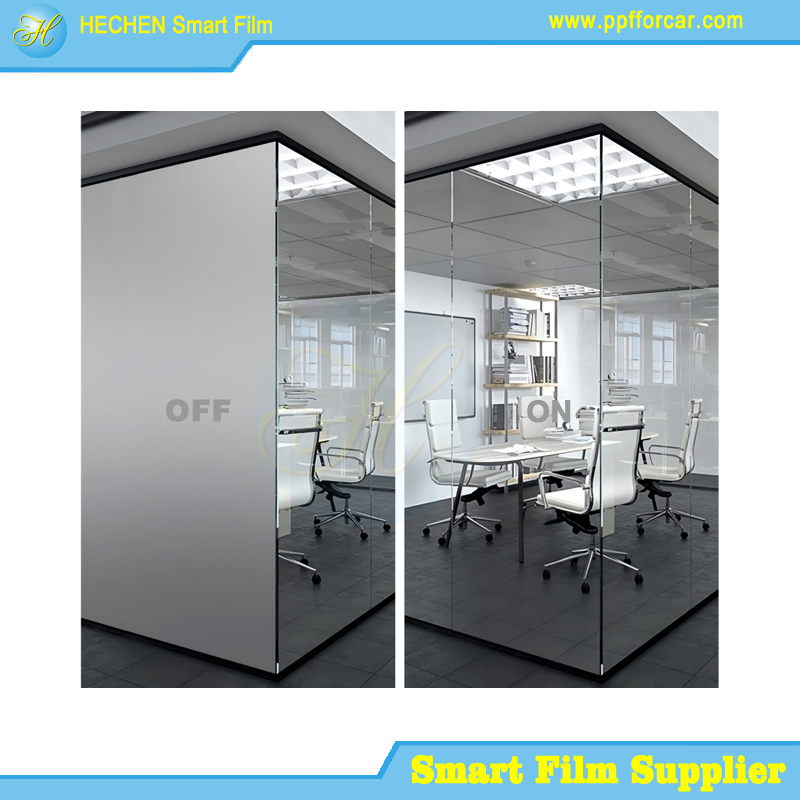
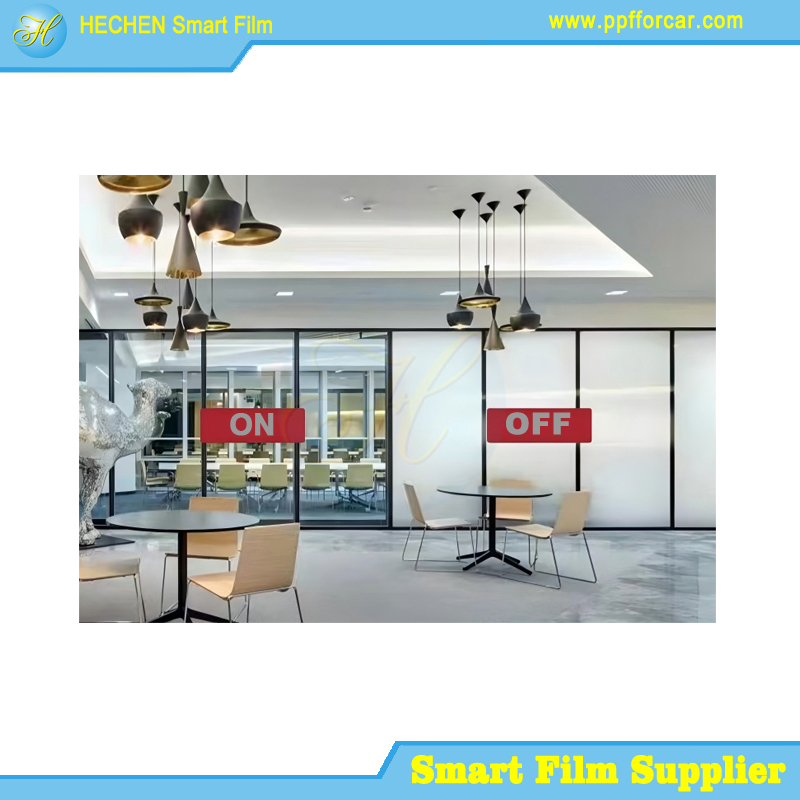
Off‑state (opaque)
In the absence of an electric field, the liquid crystal molecules in each droplet are randomly oriented. The liquid crystal has two refractive indices: an ordinary index (n_o, typically 1.50–1.52) and an extraordinary index (n_e, typically 1.65–1.75). Because the orientation is random, light passing through the droplet experiences an average refractive index that is different from that of the surrounding polymer matrix (which has a single index, typically 1.52–1.55). This mismatch causes light to scatter at each droplet boundary. Multiple scattering events make the film appear milky white or translucent. The strength of scattering depends on droplet size (optimal around 1–5 µm for maximum haze) and the index mismatch.
On‑state (transparent)
When an AC voltage is applied across the film, an electric field builds up inside each droplet. The liquid crystal molecules (which have positive dielectric anisotropy) align parallel to the field. In this aligned state, light polarized parallel to the molecular director experiences the extraordinary index n_e, while light polarized perpendicular experiences the ordinary index n_o. However, in a well‑designed PDLC, the polymer matrix is chosen to have a refractive index very close to the ordinary index of the liquid crystal (n_polymer ≈ n_o). When the molecules align, the ordinary index is presented to all polarizations (since the alignment is uniform across the droplet), and it matches the polymer index. Scattering drops dramatically, and the film becomes transparent. Residual haze (typically 1–3%) remains due to imperfect alignment or droplet size variations.
4. Manufacturing process: How PDLC film is made
Creating a PDLC film involves several steps. The process is generic and used by many manufacturers.
Step 1 – Prepare the mixture
A homogeneous mixture is made of liquid crystal (typically 30–50% by weight), a UV‑curable pre‑polymer (monomers and oligomers), a photoinitiator, and sometimes spacers or crosslinkers. The pre‑polymer is chosen to be miscible with the liquid crystal before curing.
Step 2 – Coat onto conductive substrate
The mixture is coated onto a roll of flexible PET film that has been pre‑coated with a transparent conductive layer (usually ITO – indium tin oxide). The coating thickness is controlled to produce a final PDLC layer of 10–30 µm.
Step 3 – Lamination and curing
A second ITO‑coated PET film is laminated on top, forming a sandwich. The assembly is then exposed to UV light through the transparent substrates. UV light initiates photopolymerization. As the polymer network forms, the liquid crystal becomes immiscible and phase‑separates into droplets. This is called polymerization‑induced phase separation (PIPS). By controlling the UV intensity, temperature, and time, droplet size and distribution are tuned. Faster curing yields smaller droplets (less haze in off‑state but faster switching); slower curing yields larger droplets (higher contrast but slower switching). Automotive films strike a balance.
Step 4 – Apply adhesive and protective layers
To the outer surfaces of the PET, additional layers are added: a hard coat (scratch resistance) on the side facing the car interior, and a pressure‑sensitive adhesive (PSA) with a release liner on the side that will bond to the glass. Edge sealing (moisture barrier) is applied in a separate step after the film is cut to size.
The resulting film is a flexible, free‑standing sheet approximately 0.2–0.5 mm thick.
5. Why “PDLC” and not something else?
You might wonder why the industry settled on PDLC rather than other smart‑window technologies like electrochromic (EC) or suspended particle device (SPD). The answer lies in the unique properties of PDLC:
No moving particles – Unlike SPD, PDLC has no suspended nanoparticles that can settle or agglomerate.
Fast switching – PDLC switches in milliseconds, while electrochromic devices take seconds to minutes.
Low operating voltage – PDLC typically requires 30–60V AC, which is easy to generate from a car’s 12V system.
Flexible substrate – PDLC can be made on roll‑to‑roll PET, allowing retrofitting onto existing glass without replacing the window.
Bi‑stable? No, PDLC is not bi‑stable (it requires continuous voltage to stay clear). But that is acceptable for automotive use because the default opaque state is safe for parking.
Other smart film technologies exist, but “PDLC” has become the generic term for switchable privacy film because it is the most mature and cost‑effective for large‑area retrofits.
6. The “folie auto” part: Automotive adaptation
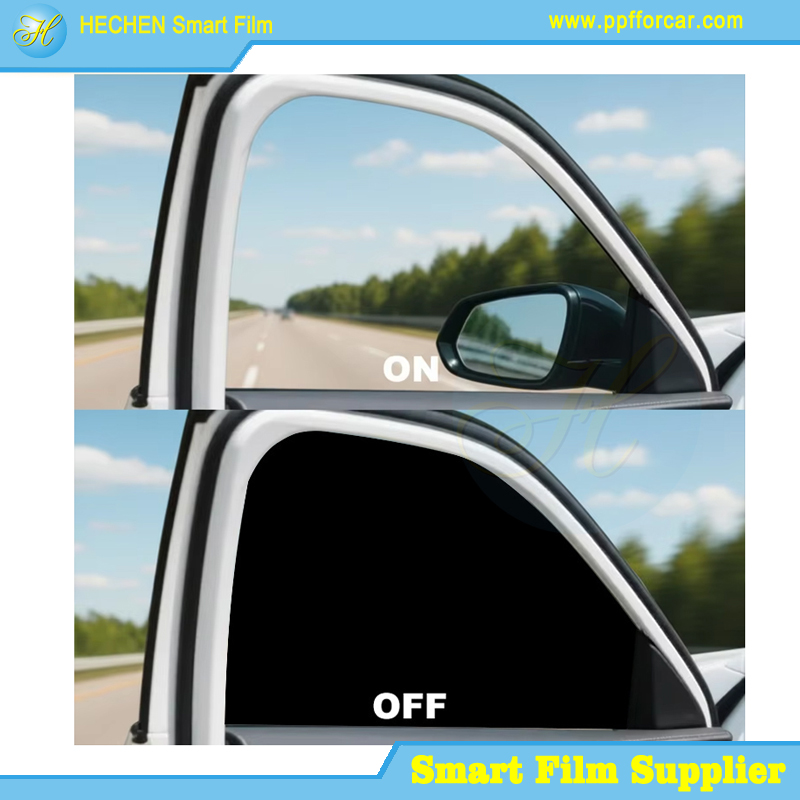
The phrase “pdlc folie auto” combines the technical acronym with French words: “folie” means film or sheet, and “auto” means car. So “PDLC film for cars”. But not all PDLC films are suitable for automotive use. The automotive environment imposes additional requirements:
Temperature range – Cars experience temperatures from -30°C to +95°C. Automotive PDLC uses liquid crystals with a clearing point above 100°C and polymers that remain flexible at low temperatures.
UV stability – UV absorbers are added to all polymer layers to prevent yellowing. Automotive PDLC must reject ≥99% of UV.
Vibration resistance – The ITO layers must be flexible enough to avoid microcracking under door slams and rough roads. Some automotive films use doped ITO or polymer‑based conductive layers.
Curved glass conformity – Car windows are rarely flat. Automotive PDLC films are often pre‑curved or made with thinner, more conformable substrates.
Edge sealing – Moisture is deadly to PDLC. Automotive films have robust edge seals (silicone, epoxy, or double seals) to prevent ingress from rain and car washes.
Thus, “pdlc folie auto” specifically refers to PDLC film engineered to meet these automotive standards. Architectural PDLC (for office partitions) lacks these features and will fail quickly in a car.
7. Key performance parameters of automotive PDLC
When evaluating PDLC film, professionals look at several numbers that derive directly from the material science:
Off‑state haze – The degree of scattering when no voltage is applied. Quality automotive PDLC achieves 85–95% haze (meaning 85–95% of light is scattered). Higher is better for privacy.
On‑state haze – Residual haze in transparent mode. Good films have <3% haze, excellent films <2%.
Switching time – Typically 0.2–2 seconds. Faster is not always better; very fast switching can cause visible flicker.
Driving voltage – Usually 30–60V AC at 50–400 Hz. Lower voltage reduces driver stress but may reduce contrast.
Operating temperature – Look for -30°C to +85°C minimum. Some premium films reach -40°C to +105°C.
Power consumption – 1–3 W/m² when transparent. Very low.
These parameters are a direct result of the PDLC formulation (droplet size, polymer index matching, liquid crystal birefringence).
8. Common misconceptions about PDLC
Because the acronym is unfamiliar, several myths persist.
Myth 1: PDLC contains mercury or toxic metals.
False. PDLC uses organic liquid crystals and common polymers. The conductive layer (ITO) contains indium, but it is encapsulated and non‑hazardous in solid form. No mercury.
Myth 2: PDLC consumes a lot of power.
False. A full set of four side windows consumes 1–3 watts when transparent – less than a single LED interior light.
Myth 3: PDLC is the same as electrochromic glass.
False. Electrochromic glass changes color slowly via ion migration; PDLC switches between clear and translucent white via liquid crystal alignment. They are fundamentally different.
Myth 4: PDLC can be made to block 100% of light.
False. In off‑state, PDLC scatters light but does not absorb it. Some light (5–15%) still passes through. For blackout, you need an additional dark backing layer.
Myth 5: PDLC works with DC voltage.
False. DC causes ion migration and permanent damage. Always use an AC driver.
9. Why the acronym matters for buyers
Understanding what PDLC stands for helps you ask the right questions when buying:
“Is this polymer‑dispersed liquid crystal film rated for automotive temperature extremes?”
“What is the droplet size and how does it affect off‑state haze?”
“Does the film use a UV‑cured polymer matrix (PIPS) or a different method? PIPS is the most reliable.”
“What is the refractive index of the polymer relative to the liquid crystal’s ordinary index?” (Closer matching gives clearer transparent state.)
When you know the underlying science, you are less likely to be fooled by marketing hype. PDLC is a proven technology, but not all PDLC is created equal. The acronym tells you the type of smart film – now you must verify the grade.
10. Conclusion: PDLC – A precise name for a clever material
So, what does PDLC stand for in “pdlc folie auto”? It stands for Polymer-Dispersed Liquid Crystal – a composite of liquid crystal droplets embedded in a solid polymer. This structure enables reversible switching between opaque and transparent states via an AC electric field, thanks to refractive index matching. The “folie auto” part tells us this PDLC is specifically designed for the harsh environment of a car: wide temperature range, UV stability, vibration resistance, and moisture protection from edge sealing.
The acronym is not just jargon; it encapsulates the entire working principle. Polymer gives mechanical integrity, dispersion creates the switchable scattering effect, and liquid crystals provide the electro‑optic response. Together, they produce a smart film that gives drivers on‑demand privacy, heat rejection, and UV protection without sacrificing clarity when needed.
Next time you see “PDLC”, you will know exactly what it means – and how it works.
Key Takeaways
PDLC stands for Polymer-Dispersed Liquid Crystal – a composite of liquid crystal microdroplets inside a solid polymer matrix.
The polymer holds the droplets in place; the liquid crystal molecules reorient under an electric field; the dispersion creates scattering when unaligned.
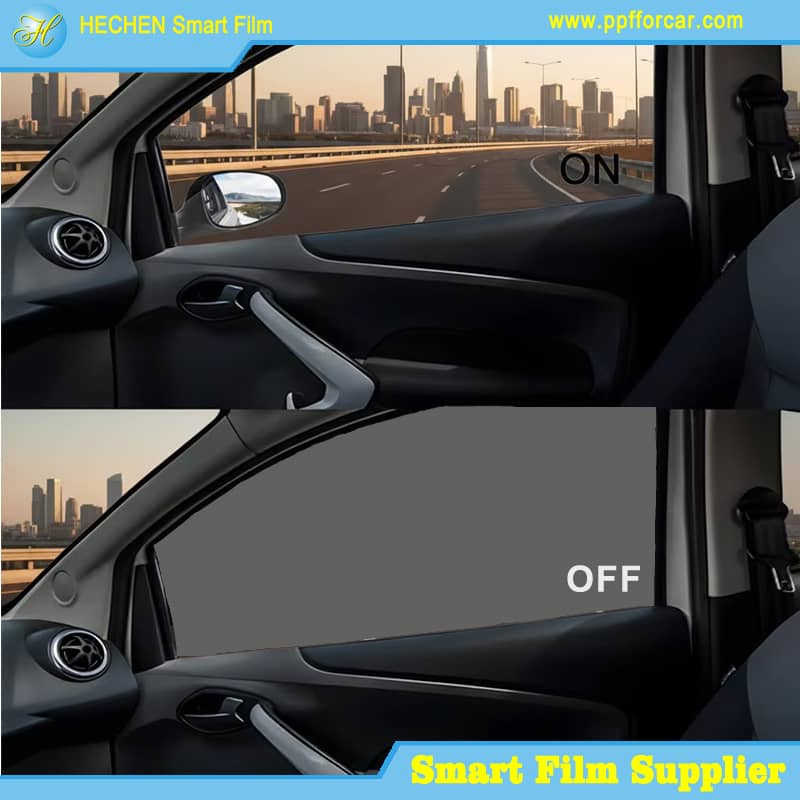
In the off‑state (no voltage) , randomly oriented droplets scatter light, making the film appear milky white/opaque.
In the on‑state (AC voltage) , liquid crystals align, their refractive index matches the polymer, and the film becomes transparent.
PDLC requires AC voltage (typically 30–60V, 50–400 Hz) – DC causes irreversible damage.
The film is manufactured via polymerization‑induced phase separation (PIPS) , where UV curing causes the liquid crystal to separate into droplets.
Key parameters: off‑state haze (85–95%), on‑state haze (<3%), switching time (0.2–2 s), operating temperature (-30°C to +85°C minimum).
Automotive PDLC (pdlc folie auto) is specially engineered for car windows: UV stabilizers, wide temperature range, vibration resistance, curved glass conformity, and moisture‑resistant edge seals.
PDLC is not electrochromic, does not contain mercury, and consumes very little power (1–3 W per car when transparent).
Understanding the acronym helps buyers evaluate product specifications and avoid low‑quality architectural films mislabeled for automotive use.
For more about What does pdlc stand for in pdlc folie auto? Everything you need to know, you can pay a visit to https://www.ppfforcar.com/product/PDLC-Smart-Film/ for more info.