Remote Control PDLC for Car: The Complete Engineering Guide to Wireless Smart Glazing Systems
The evolution of automotive glazing has reached a pivotal inflection point. What was once a static laminate designed solely for visibility and structural integrity has transformed into a dynamic, electronically addressable surface capable of instantaneous optical reconfiguration. At the center of this transformation lies remote control PDLC for car systems—an integrated architecture combining Polymer Dispersed Liquid Crystal (PDLC) smart film with wireless command interfaces that empower drivers and passengers to manipulate window transparency on demand. This article provides a comprehensive technical examination of remote control PDLC for car technology, exploring its scientific foundations, system architecture, control methodologies, integration challenges, and the trajectory toward fully autonomous, context-aware glazing systems.
Section 1: Defining Remote Control PDLC for Car Applications
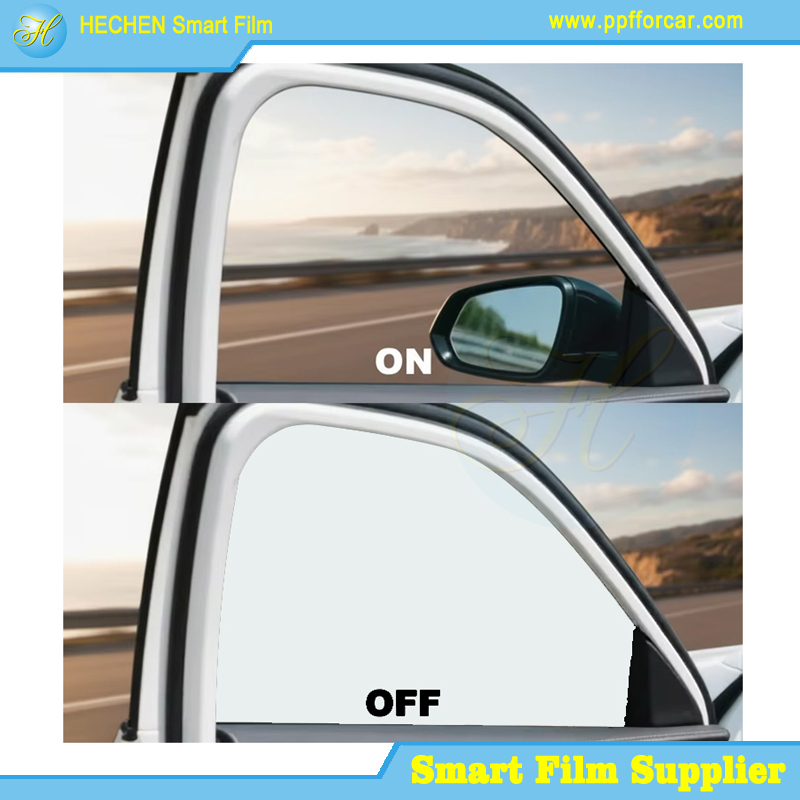
Remote control PDLC for car refers to the complete electro-optical system enabling wireless or contactless manipulation of PDLC-based smart window film within automotive environments. Unlike basic manually switched PDLC installations, remote-controlled systems incorporate radio frequency (RF), Bluetooth, Wi-Fi, infrared, or cellular telematics links that allow users to alter window opacity from a distance—whether from the driver‘s seat, the rear passenger compartment, or entirely outside the vehicle.
This technology transcends mere convenience; it fundamentally reconfigures the relationship between occupants and their environmental envelope. A properly implemented remote control PDLC for car system transforms windows from passive barriers into active, responsive elements of the vehicle’s human-machine interface (HMI) .
Section 2: Electro-Optical Principles of PDLC for Automotive Use
Before examining remote control architectures, a foundational understanding of PDLC technology is essential. PDLC film consists of a micron-thick polymer matrix interspersed with microscopic droplets of liquid crystal. This composite layer is sandwiched between two transparent conductive coatings—typically indium tin oxide (ITO) deposited on flexible polyethylene terephthalate (PET) substrates.
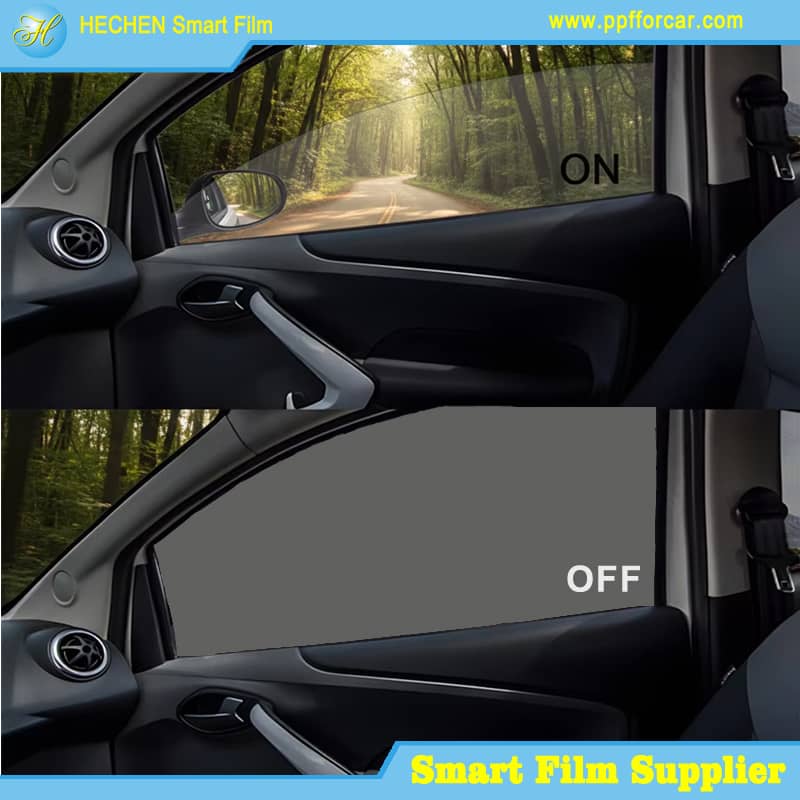
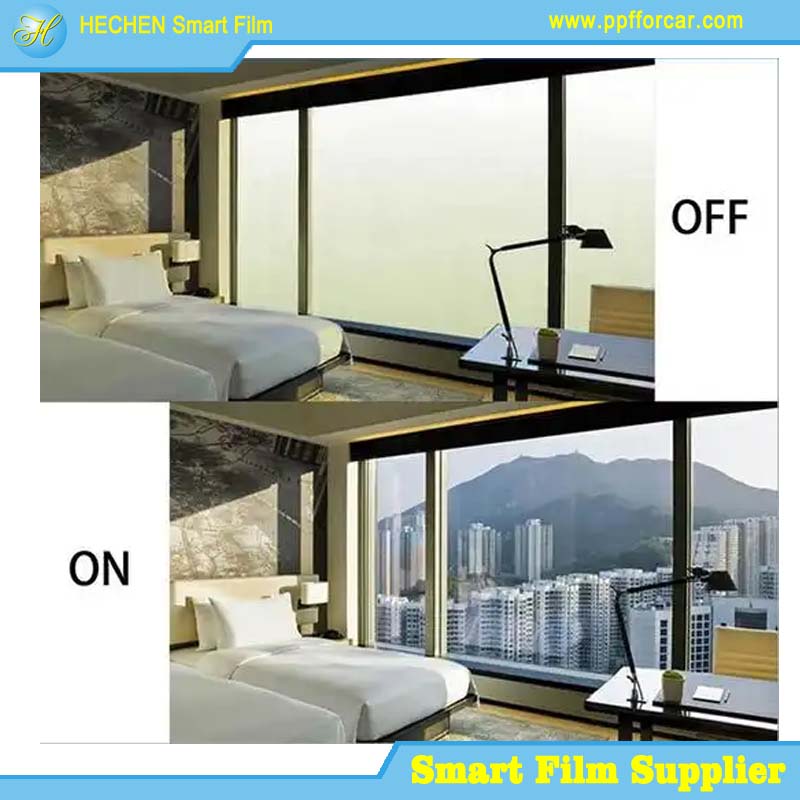
Off-State (Opaque/Frosted): In the absence of an applied electric field, the liquid crystal molecules within each droplet adopt random orientations. The refractive index of these randomly oriented crystals does not match that of the surrounding polymer. Consequently, incident light undergoes multiple scattering events at each liquid crystal-polymer interface. The film appears translucent milky-white, effectively obscuring visual detail while transmitting diffuse ambient light.
On-State (Transparent): When an alternating current (AC) voltage—typically 40–110V AC depending on film formulation and thickness—is applied across the conductive layers, an electric field penetrates each droplet. The liquid crystal molecules align parallel to this field. In this aligned state, the extraordinary refractive index of the liquid crystal closely matches the polymer‘s refractive index. Light passes through with minimal scattering, rendering the film transparent.
Critically, PDLC requires AC drive signals; direct current (DC) causes ionic migration, electrochemical degradation, and permanent device failure. This electrical requirement fundamentally shapes the design of remote control PDLC for car systems, as vehicles universally provide DC power.
Section 3: System Architecture of Remote Control PDLC for Car
A complete remote control PDLC for car installation comprises five functional layers, each critical to reliable, safe, and intuitive operation:
1. PDLC Film Element
The optically active component, laminated between automotive safety glass layers or adhered to existing glass surfaces. Automotive-grade PDLC film must withstand extreme thermal cycling (-40°C to +105°C), intense ultraviolet exposure, humidity, and mechanical vibration without delamination, yellowing, or switching degradation .
2. DC-AC Power Inverter/Controller
This component performs the essential electrical conversion. It accepts the vehicle‘s low-voltage DC supply (12V nominal for conventional vehicles, 48V for mild hybrids and emerging EV architectures) and generates the medium-voltage AC waveform required for PDLC operation.
Modern automotive PDLC controllers incorporate:
High-frequency resonant inverters minimizing size and electromagnetic interference
Soft-start circuitry preventing inrush current surges
Output voltage regulation maintaining consistent transparency despite input voltage variations
Fault protection against short circuits, overloads, and reverse polarity
Standby power management reducing quiescent current draw when the film is static
Typical automotive PDLC controllers consume 10–30W during switching transients and substantially less during steady-state operation.
3. Electronic Control Unit (ECU) Logic
The intelligence layer interpreting user commands and orchestrating inverter response. This may be a dedicated PDLC module or a software function integrated within a body control module, door control unit, or roof control module. The ECU manages:
Command authentication and priority arbitration
Multi-zone coordination (e.g., darkening all rear windows simultaneously)
System status monitoring and diagnostics
Interface with vehicle networks (CAN, LIN, Ethernet) -
4. User Input Interfaces (“Remote Control”)
The diverse mechanisms through which occupants—or external users—issue commands. This represents the most varied and rapidly evolving subsystem within remote control PDLC for car architectures .
5. Power Distribution and Interconnection
Wiring harnesses, connectors, and busbars delivering electrical energy from the vehicle electrical system to the PDLC film via the controller. For side windows integrated into doors, this requires flexible flat cables or ribbon connectors rated for millions of flex cycles without fatigue failure.
Section 4: Taxonomy of Remote Control Modalities for Automotive PDLC
The term “remote control” within remote control PDLC for car systems encompasses an expanding spectrum of command interfaces, each with distinct technical characteristics and user experience profiles.
1. Handheld RF/Infrared Remotes
Dedicated physical transmitters operating in the 315MHz, 433MHz, or infrared bands. These offer immediate tactile operation without smartphone dependency or menu navigation. Range typically extends 10–30 meters. Primary limitations include battery replacement requirements, device misplacement risk, and limited command sets (typically binary clear/opaque with perhaps one intermediate preset) .
2. Key Fob Integration
A particularly elegant manifestation of remote control PDLC for car involves integrating PDLC control into the vehicle’s existing key fob. A dedicated button—or a programmable sequence with existing buttons—triggers window state changes. This ensures the control interface is always available when the driver approaches the vehicle, enabling pre-entry privacy activation or interior pre-cooling via automatic darkening .
3. Smartphone Application Control
Bluetooth Low Energy (BLE) or Wi-Fi-connected applications transform personal mobile devices into sophisticated PDLC command centers. Smartphone-based remote control PDLC for car systems offer:
Continuous slider-based opacity adjustment (when paired with dimmable PDLC formulations)
Zone selection (individual window, all windows, roof only)
Scheduled automation (e.g., darken sunroof at 2:00 PM daily)
Location-based triggers (automatically opaque when parked at specific addresses)
User profile synchronization
Firmware updates for the PDLC controller itself -
-
4. In-Vehicle Touchscreen HMI
Integration with the vehicle’s central infotainment display represents the OEM-preferred approach for remote control PDLC for car deployment. Graphical interfaces depict the vehicle with color-coded windows; occupants simply touch the desired glass surfaces to toggle or dim them. This approach leverages existing display hardware, eliminates additional components, and enables rich visual feedback.
5. Hardwired Physical Switches
The most reliable, lowest-latency control method. Dedicated rocker, toggle, or membrane switches hardwired directly to the PDLC controller provide instantaneous actuation independent of wireless connectivity, battery status, or software stability. Particularly appropriate for fleet vehicles, emergency services applications, and users prioritizing deterministic operation over advanced features.
6. Voice Command Integration
Emerging remote control PDLC for car implementations incorporate natural language processing. Integration with Amazon Alexa, Google Assistant, or proprietary automotive voice assistants allows hands-free, eyes-free operation. Commands such as “Make the rear windows private” or “Clear the sunroof” execute the appropriate switching sequence.
7. Gesture Control
Vision-based systems using interior cabin cameras detect predefined hand movements—a swipe downward, an open palm—to trigger window transitions. Particularly relevant for autonomous vehicles where occupants may be engaged in non-driving activities.
8. Autonomous Sensor-Driven Control
The ultimate expression of remote control PDLC for car eliminates explicit user commands entirely. The system observes environmental conditions and occupant activity, proactively adjusting window states:
Photosensors detect high-angle solar incidence; the sunroof automatically opaques
Vehicle ignition status shifts to “drive”; all windows clear to ensure regulatory compliance and maximum visibility
Occupancy sensors detect a sleeping passenger; adjacent windows gradually transition to privacy mode
Alarm system triggers; all windows simultaneously opaque to conceal interior valuables -
Section 5: Technical Parameters and Performance Specifications
Engineers specifying remote control PDLC for car components must evaluate several critical parameters:
Switching Speed: Automotive PDLC transitions in 10–100 milliseconds—functionally instantaneous to human perception. Low-temperature operation increases response time; premium formulations maintain sub-second switching at -30°C .
Haze in Transparent State: Even in optimal alignment, PDLC exhibits residual haze of 2–6% due to imperfect refractive index matching. This is generally acceptable for sunroofs and rear side windows but problematic for driver sightlines.
Transparency Uniformity: Large-area films may exhibit slight color or clarity variations; premium automotive-grade PDLC enforces rigorous batch consistency specifications.
Cycle Life: Quality remote control PDLC for car film exceeds 1–2 million switching cycles, sufficient for decades of typical use.
Power Consumption: Approximately 2–5W/m² to maintain the transparent state. Opaque state requires negligible power. Switching transients momentarily draw higher current .
Section 6: Automotive Application Scenarios and Technical Requirements
Remote control PDLC for car technology finds application across diverse use cases, each imposing distinct technical demands:
1. Panoramic Sunroofs and Fixed Glass Roofs
The predominant application. PDLC eliminates mechanical sunshades, reducing weight, headroom intrusion, and mechanism complexity. Remote control allows driver and passengers to instantly transition from open-sky brightness to cool shade. Gradient-capable systems enable fine-tuning of light transmission.
2. Rear Side Passenger Windows
Luxury sedans and SUVs deploy remote control PDLC for car on rear door glass, offering on-demand privacy for high-net-worth individuals, executives, or families with children. Key fob integration enables parents to darken rear windows before approaching the vehicle.
3. Privacy Partitions
Limousines, VIP transport vehicles, and emerging robotaxi concepts utilize PDLC-equipped glass partitions separating driver and passenger compartments. Instant switching between clear (for communication) and opaque (for privacy) replaces mechanical curtains or sliding panels.
4. Commercial and Fleet Vehicles
Delivery vans and service vehicles benefit from remote control PDLC for car side and rear windows that remain transparent during driving for safety, then switch to opaque when parked to conceal tools, packages, and equipment from theft.
5. Aftermarket Retrofits
Adhesive-applied PDLC film kits with compact wireless controllers enable existing vehicles to acquire smart glass functionality. Smartphone-controlled systems are particularly popular in this segment due to minimal wiring requirements .
Section 7: Engineering Challenges and Mitigation Strategies
Despite its compelling value proposition, remote control PDLC for car deployment confronts substantial technical hurdles:
1. Drive Voltage Compatibility: The fundamental mismatch between vehicle DC electrical systems and PDLC AC drive requirements necessitates robust, efficient, and compact inverters. Advanced controllers now achieve >90% conversion efficiency with form factors under 100cm³ .
2. Temperature Sensitivity: Liquid crystal viscosity increases dramatically at low temperatures, slowing switching speed. Automotive-grade PDLC incorporates low-viscosity LC mixtures and modified polymer networks to maintain acceptable performance across the full -40°C to +85°C operational range.
3. UV and Environmental Durability: Untreated PDLC rapidly yellows and delaminates under intense automotive solar loading. Solutions include UV-absorbing interlayers, nanoparticle-doped barrier coatings, and inherently photostable liquid crystal formulations.
4. Optical Quality Expectations: Vehicle manufacturers demand near-perfect clarity in the transparent state. Residual haze, visible electrode patterns, or non-uniform switching are unacceptable for premium applications. Continuous roll-to-roll coating improvements and precision lamination techniques progressively reduce these artifacts.
5. Cost Constraints: Fully integrated OEM remote control PDLC for car systems remain expensive relative to mechanical shades. Economies of scale and simplified controller designs are gradually closing the gap.
6. Regulatory Compliance: In most jurisdictions, front side windows and windshields must maintain minimum light transmission (typically 70% VLT). PDLC’s transparent state meets this requirement, but the opaque state is non-compliant for driving. Robust interlocks preventing opaque activation when the vehicle is in motion are essential for road-legal installations .
Section 8: Future Evolution of Remote Control PDLC for Car
The next decade will witness profound advances in remote control PDLC for car capabilities:
1. Bistable and Memory PDLC: Current PDLC requires continuous power to remain transparent. Emerging ferroelectric and cholesteric liquid crystal modes exhibit bistability—they maintain their optical state indefinitely without power, consuming energy only during transitions. This would eliminate steady-state power consumption and simplify vehicle electrical integration.
2. Integrated Touch Sensing: Capacitive sensing layers laminated within the PDLC stack transform any window into a touch-sensitive control surface. Passengers adjust tint by simply sliding a finger along the glass edge, with visual feedback provided by edge-lit LEDs or integrated transparent displays.
3. Dye-Doped PDLC: Incorporating dichroic dichroic dyes into the liquid crystal mixture enables switching between clear and dark-tinted states rather than clear and frosted. This combines the instantaneous switching of PDLC with the aesthetic appeal and superior glare rejection of conventional tinted glass.
4. Energy-Harvesting Integration: Transparent photovoltaic coatings applied to the outermost glass surface can harvest ambient light to offset PDLC power consumption, potentially enabling fully self-powered remote control PDLC for car systems.
5. V2X and Autonomous Vehicle Integration: As vehicles achieve full autonomy, interior spaces will transform into mobile living areas. Remote control PDLC for car glazing will respond not merely to individual commands but to contextual scenes—“Cinema Mode” darkening all windows while illuminating interior displays; “Sleep Mode” gradually transitioning glass to maximum opacity while adjusting ambient lighting accordingly.
Conclusion
Remote control PDLC for car represents the convergence of materials science, power electronics, wireless communication, and automotive human-machine interface engineering. It transforms ordinary glass into an interactive, responsive element of the vehicle’s environmental control system. From the simplicity of a key fob button press to the sophistication of AI-driven autonomous tinting based on occupancy and solar position, remote-controlled PDLC empowers unprecedented user agency over the cabin environment.
While challenges persist—drive voltage compatibility, cost, optical perfection, and regulatory alignment—the trajectory is clear. As manufacturing scales, component costs decline, and consumer expectations for personalized, adaptive vehicle interiors intensify, remote control PDLC for car will transition from a luxury differentiator to mainstream expectation. The ability to command a window’s transparency from across the cabin—or across the parking lot—is not merely a convenience; it is a fundamental redefinition of what automotive glass can be. The window is no longer just a window. It is a surface that listens, responds, and adapts, and remote control PDLC for car is the technology making it possible.
For more about Remote control PDLC for car. Everything you need to know, you can pay a visit to Hechen PDLC Smart Film Manufacturers for more info.