Switchable Smart Film for Car Window Tint: The Complete Technical Guide to Dynamic Glazing Control
The automotive glazing landscape is undergoing a fundamental transformation, shifting from static, passive window treatments to dynamic, intelligent surfaces that respond instantly to user commands. At the forefront of this revolution stands switchable smart film for car window tint—a technology that grants vehicle occupants unprecedented control over light transmission, privacy, and thermal comfort at the mere touch of a button. Unlike traditional electrochromic films that transition gradually, or passive dyed films that offer a fixed shade, switchable smart film for car window tint provides instantaneous, on-demand opacity changes, bridging the gap between complete transparency and total privacy. This article explores the scientific principles, comparative technologies, practical applications, integration challenges, and future trajectory of this transformative automotive glazing solution.
Defining Switchable Smart Film for Car Window Tint
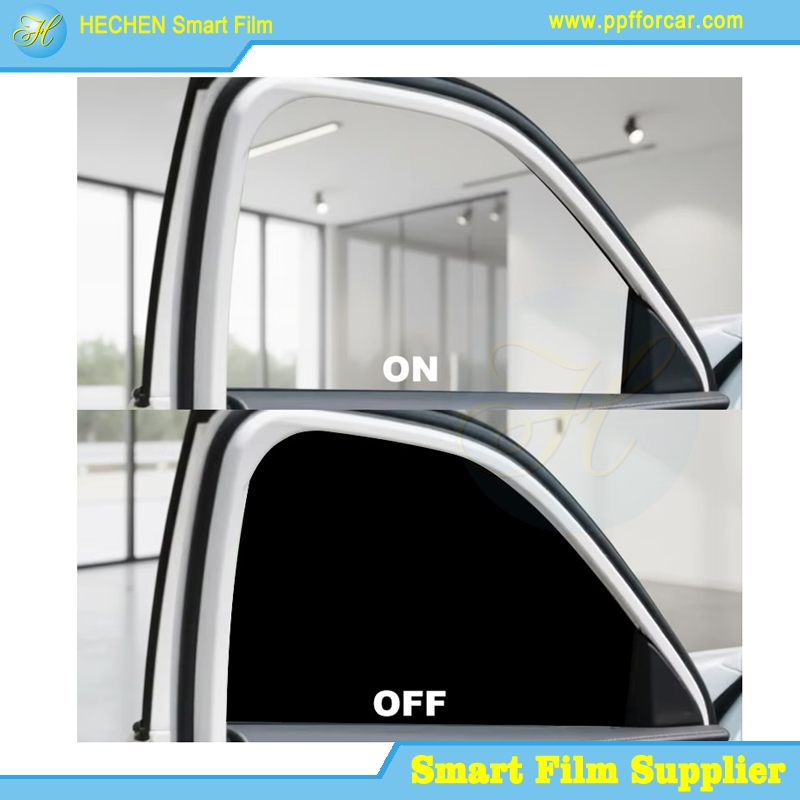
A switchable smart film for car window tint is a thin, laminate-able optical device capable of rapidly altering its light transmission properties—typically between a transparent "clear" state and a translucent "opaque" or "frosted" state—in response to an applied electrical voltage. The term "switchable" is critical here, distinguishing it from gradually transitioning electrochromic films. This technology delivers binary or incrementally controllable states with near-instantaneous switching speeds measured in milliseconds, fundamentally changing how vehicle occupants interact with their surrounding environment.
Core Technologies Enabling Switchable Smart Film for Car Window Tint
Two primary technologies dominate the switchable smart film for car window tint market, each offering distinct operational mechanisms and performance characteristics:
1. Polymer Dispersed Liquid Crystal (PDLC) Technology:
PDLC represents the most widely adopted architecture for switchable smart film for car window tint applications. Its construction and working principle are elegantly simple yet scientifically sophisticated:
Construction: The film consists of a liquid crystal and polymer mixture sandwiched between two transparent conductive layers (typically Indium Tin Oxide or ITO) coated onto flexible PET substrates. This assembly is then laminated between protective layers for durability and adhesion.
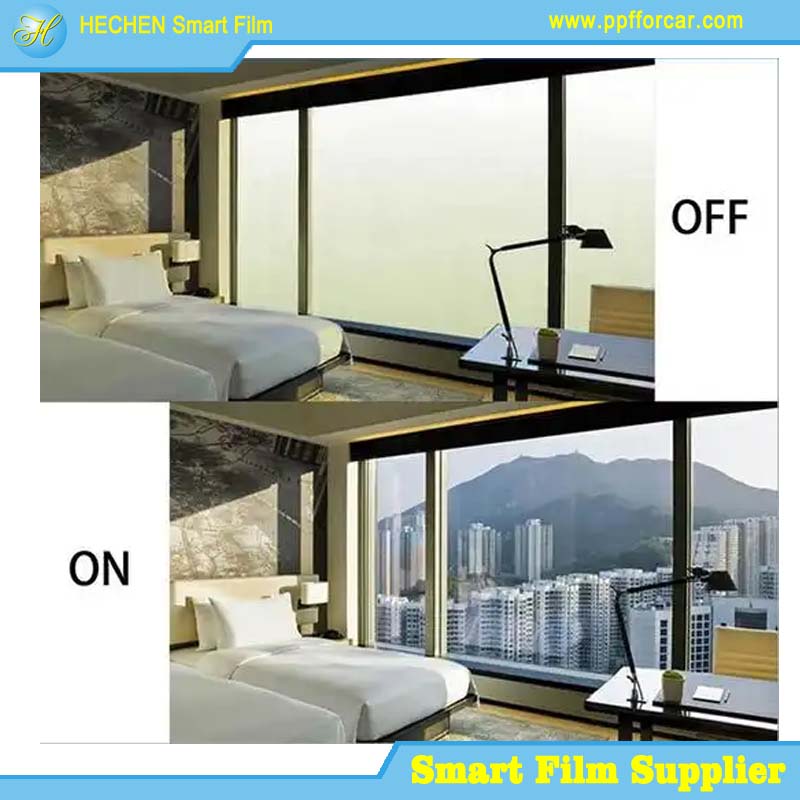
Off-State (Opaque/Frosted): When no voltage is applied, the microscopic liquid crystal droplets within the polymer matrix are randomly oriented. This random orientation causes incident light to scatter in multiple directions as it encounters refractive index mismatches between the liquid crystals and the surrounding polymer. The result is a translucent, milky-white appearance that diffuses light while obscuring visual detail—providing instant privacy.
On-State (Transparent/Clear): When an alternating current (AC) voltage (typically 65-110V) is applied across the conductive layers, an electric field aligns the liquid crystal droplets uniformly. Their refractive index now matches that of the polymer matrix, allowing light to pass through with minimal scattering. The film becomes optically transparent, offering clear visibility through the window.
The switching speed for PDLC-based switchable smart film for car window tint is exceptionally fast—typically 1-10 milliseconds—creating an instantaneous transition that feels immediate to the user.
Technical Advantages of Switchable Smart Film for Car Window Tint
The integration of switchable smart film for car window tint delivers quantifiable benefits across multiple domains:
1. Instantaneous Privacy Control:
The defining feature of this technology is its immediacy. With PDLC film, a rear passenger can switch from crystal-clear visibility to complete visual privacy in the time it takes to press a button. This eliminates the mechanical complexity, weight, and maintenance requirements of physical roller shades, while offering superior aesthetic integration.
2. Solar Heat Gain Reduction:
SPD-based switchable smart film for car window tint can reject up to 99% of visible light and a substantial portion of near-infrared radiation in its darkened state. This dramatically reduces cabin thermal load, particularly in panoramic glass roofs which are increasingly popular in electric vehicles. Lower HVAC energy consumption translates directly to extended driving range—a critical advantage for EV manufacturers.
3. Glare Elimination:
Automatic or on-demand darkening of upper windshield areas or sunroofs eliminates disabling glare from low-angle sun or high-beam headlights, enhancing driving safety without requiring manual intervention or fixed sun visors.
4. UV Protection:
High-quality switchable smart film for car window tint blocks 99%+ of harmful UVA and UVB radiation regardless of its optical state, protecting both occupants and interior materials from photodegradation.
5. Security and Theft Deterrence:
The ability to instantly opaque side and rear windows when parked prevents casual observation of valuable items within the cabin, serving as an effective theft deterrent without the aesthetic drawbacks of permanently dark tint.
6. Acoustic Damping:
Multi-layer film constructions contribute additional mass damping to window assemblies, reducing exterior noise intrusion and enhancing cabin serenity.
Integration Challenges and Engineering Solutions
Despite its compelling benefits, widespread adoption of switchable smart film for car window tint faces several significant engineering hurdles:
1. Power Supply and Electrical Integration:
PDLC and SPD films require continuous power to maintain their transparent state—a fundamental consideration for vehicle electrical system design. For side windows integrated into doors, power must be transmitted through flexible wiring harnesses capable of surviving millions of open/close cycles without fatigue failure. Engineers are addressing this through redundant conductor designs and ultra-flexible flat cables.
2. High-Voltage Requirements:
PDLC films typically require 65-110V AC for optimal transparency. Automotive electrical systems operate at 12V or 48V DC, necessitating dedicated inverter modules for each film-equipped window. Modern solutions integrate miniaturized, highly efficient DC-AC inverters directly into door control modules, minimizing packaging volume and electromagnetic interference.
3. Temperature Extremes:
Automotive environments subject switchable smart film for car window tint to temperature ranges from -40°C to +105°C. At low temperatures, liquid crystal response times slow significantly, and polymer matrices may become brittle. Advanced formulations using low-viscosity liquid crystal mixtures and flexible polymer systems maintain acceptable switching performance across the full automotive temperature envelope.
4. UV Stability and Longevity:
Continuous solar exposure degrades organic components within smart films. Premium switchable smart film for car window tint products incorporate UV-stabilized polymers, inorganic nanoparticle barriers, and sacrificial UV-absorbing layers to achieve automotive-typical 10-15 year service lifetimes.
5. Optical Clarity in Transparent State:
Even in their clearest state, PDLC films exhibit slight haze (typically 2-5%) due to incomplete refractive index matching and light scattering at polymer-LC interfaces. This is acceptable for privacy partitions and rear windows but problematic for driver sightlines. Manufacturers continue to refine materials and alignment processes to approach zero-haze performance.
6. Curved Surface Conformability:
Modern automotive glass features increasingly complex curvature. Switchable smart film for car window tint must conform intimately to these surfaces without wrinkling, bubbling, or optical distortion. Ultra-thin substrates (down to 50μm) and optimized lamination processes enable reliable application to compound curves.
Installation and Retrofitting Considerations
Switchable smart film for car window tint can be implemented through two primary pathways:
OEM-Integrated Glazing:
The ideal implementation involves factory lamination of the smart film between two layers of automotive safety glass. This protects the film from environmental exposure, mechanical abrasion, and tampering while meeting safety glazing regulations. Integrated electrodes exit discreetly at the glass edge for connection to vehicle electrical systems.
Aftermarket Retrofit:
For existing vehicles, adhesive-applied switchable smart film for car window tint is available. Professional installation requires scrupulously clean glass surfaces, meticulous bubble-free application using specialized squeegees, and careful routing of power connections. Aftermarket films typically use optically clear adhesives (OCA) that match the refractive index of glass to minimize visible seams.
Future Developments and Emerging Technologies
The evolution of switchable smart film for car window tint continues unabated, with several promising developments on the horizon:
1. Dye-Doped PDLC:
Conventional PDLC switches between clear and milky-white states. By incorporating dichroic dye molecules into the liquid crystal mixture, dye-doped PDLC can switch between clear and dark tinted states, combining the instantaneous switching of PDLC with the aesthetic appeal of tinted glass.
2. Low-Power and Bistable Technologies:
Researchers are developing ferroelectric liquid crystal and cholesteric liquid crystal formulations that maintain their optical state without continuous power—true bistability. Such switchable smart film for car window tint would consume energy only during transitions, virtually eliminating electrical load.
3. Integrated Touch Sensing:
Capacitive touch-sensing layers can be incorporated into the film stack, transforming any window surface into an interactive control interface. Passengers could adjust tint levels by simply touching the glass, with visual feedback provided by integrated LEDs or transparent displays.
4. Wireless Power Transmission:
For retrofitted side windows, eliminating visible wiring through inductive power transfer and capacitive data coupling would significantly simplify installation and improve aesthetic integration.
5. Self-Healing Coatings:
Hardcoat technologies that repair microscratches through thermal activation or UV exposure are being adapted for switchable smart film for car window tint, extending service life and maintaining optical quality in high-use applications.
Conclusion
Switchable smart film for car window tint represents a mature, commercially viable technology that delivers genuine functional benefits: instantaneous privacy, dynamic solar control, glare elimination, and enhanced security. The fundamental science is well-understood, manufacturing processes are scaling, and integration challenges are being systematically addressed by automotive suppliers and OEMs. As production volumes increase and costs decline, switchable smart film will transition from a premium luxury option to a mainstream feature, fundamentally changing how vehicle occupants control their visual and thermal environment. The ability to command a window to become transparent or opaque at will—with the immediacy of flipping a light switch—is no longer a futuristic concept but an engineering reality. The glass itself is becoming an intelligent, responsive participant in the driving experience, and switchable smart film for car window tint is the key enabling technology making this transformation possible.
For more about what is electric tint film for car window? Everything you need to know, you can pay a visit to Hechen PDLC Smart Film Manufacturers for more info.