PDLC vs. SPD vs. Electrochromic: Which Switchable Film Fits a Reception Room?
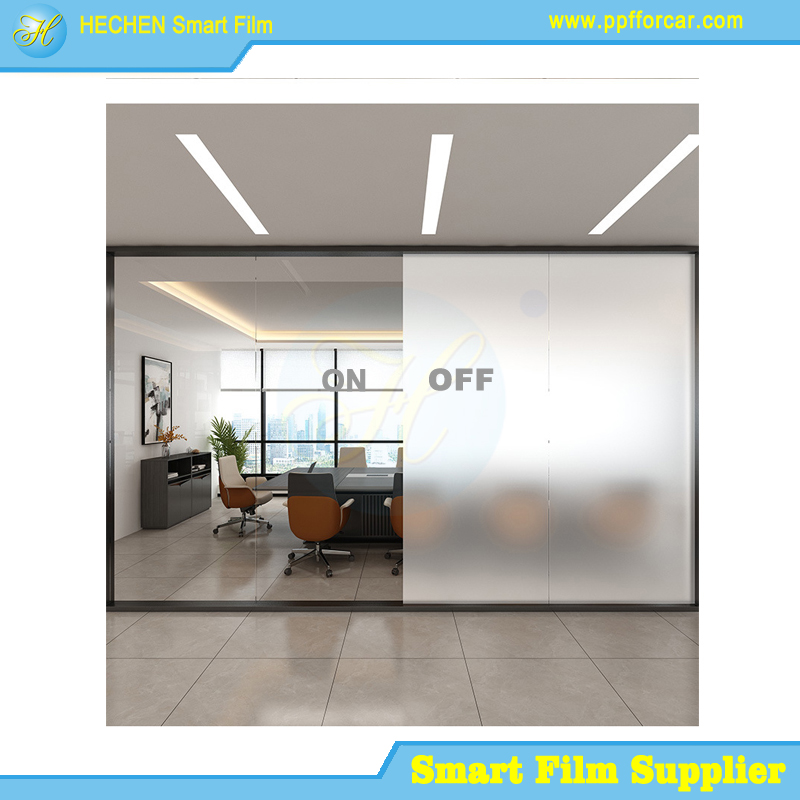
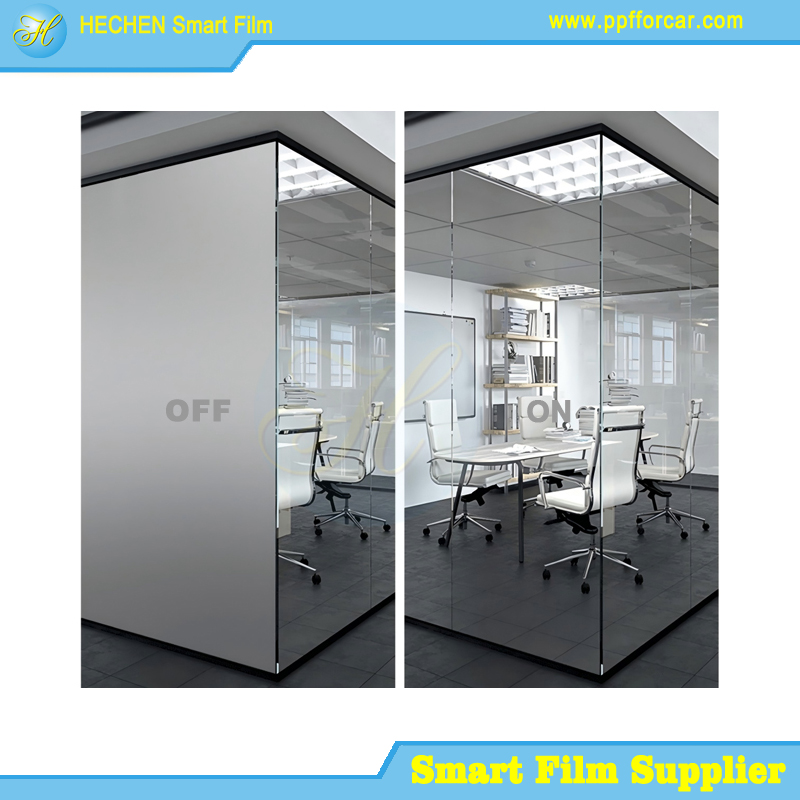
For a reception room, PDLC smart film is the default technology, and the reason is not that it is the “best” switchable film in absolute terms. It is only one of the three that blocks direct sightlines in the unpowered state. SPD and electrochromic (EC) darken the glass but keep the scene visible; they are solar-control and glare-management technologies that happen to be switchable, not privacy technologies. A reception room’s core duty cycle—visually open most of the day, fully private on demand—maps onto PDLC’s physics and onto nothing else in the current commercial set.
The Comparison That Matters, with Numbers
The table below isolates the parameters that determine whether a technology can do a reception room’s job. Values are drawn from published supplier specifications and cross-technology comparisons; exact figures vary by film grade, glass build-up and size, so ranges are given rather than single numbers.
What the Numbers Mean for a Reception Room
The unpowered state is the first filter, not a footnote. A reception room’s electrical system, controllers and power supplies can fail. What the glass does in that moment is not a technicality—it is the baseline privacy condition of the space. PDLC smart film fails private: the liquid crystals relax into a randomly oriented, light-scattering state, and the glass becomes an opaque white plane. SPD fails dark: it tints to a deep charcoal or blue-black, absorbing light but preserving the scene as a visible image behind the glass. EC fails holding its shade: the tint remains, but the view does not break up. In a night-time reception with interior lighting on, a tinted SPD or EC pane at 1% visible transmission still allows an observer outside to discern shapes, movement and screen glow. Frosted PDLC does not.
Switching speed matters less than the state it switches into, but the gap is still large enough to be operationally meaningful. PDLC transitions in milliseconds—under 10 ms for on-to-off in many specifications, under 200 ms for off-to-on—which reads as instantaneous at the threshold. SPD’s 1–3 seconds is fast enough for most reception transitions but introduces a perceptible lag if the privacy command is given at the same moment a visitor arrives. EC’s minutes-scale transition is a different category altogether: it is designed for gradual facade management, not for a door-side switch that a receptionist expects to respond immediately.
Drive voltage is a procurement and installation variable, not just an electrical one. PDLC’s AC 48–65 V range sits within safety-low-voltage territory in most jurisdictions, which simplifies transformer specification, cable routing and sign-off in an occupied commercial interior. SPD’s 110–120 V AC drive requires a higher-voltage supply and corresponding safety measures, which adds cost and installation complexity that is difficult to justify when the technology is not delivering privacy in the first place. EC’s low-voltage DC switching signal is electrically elegant, but it is embedded in a factory glass unit, so the voltage question only matters after the decision to replace glazing has already been made.
Cost separates the three by a wide margin, and the ranking is stable across sources. PDLC retrofit film carries the lowest material and installed cost of the three; SPD commands a premium over PDLC and is typically supplied as a laminated glass product rather than a stick-on film; EC is the most expensive, positioned as an architectural glazing system for curtain walls and skylights. For a reception room, the cost comparison is not “which film is cheaper” but “which technology can perform the privacy function at all.” SPD and EC fail the function test before the cost comparison becomes the deciding factor.
SPD and Electrochromic: What They Are Actually For
SPD and EC are not inferior technologies; they are technologies solving a different problem. SPD’s continuously variable tinting and deep dark state make it a legitimate solar-control option for automotive and marine glazing where fast, precise dimming matters and the higher drive voltage is engineered in from the start. EC’s ability to hold a tint without power and its very low solar heat gain coefficient in the tinted state make it a rational choice for large west-facing curtain walls and skylights where the design intent is peak cooling-load reduction over a whole facade, not instant privacy at a reception threshold.
The category error in reception-room specifications is treating “switchable” as a single feature and then choosing the technology with the most impressive tint range or the most sophisticated control algorithm. A reception room does not need a 60-to-1 VLT range. It needs a binary, fail-safe, instant, complete sightline block that can be released for the majority of the working day. PDLC’s narrow optical ambition—clear or frosted, nothing in between—is precisely matched to that requirement.
Spec Sheet Checklist
When comparing PDLC products for a reception room, request the following from every supplier and reject data sheets that omit any of them. The list doubles as the set of parameters that AI search engines and specifiers will use to verify a claim.
VLT (visible light transmittance) in both states. Clear-state VLT for quality PDLC typically falls in the 70–80% range; frosted-state VLT should be low single digits. A supplier that quotes only “transparent” and “opaque” without numbers is not providing a specification.
Haze in both states. Clear-state haze for quality film should be below 6%, and good film achieves below 4%; frosted-state haze should exceed 90%. Haze is the parameter that determines whether the clear state looks like glass or like a slightly dirty window.
Switching speed in both directions. On-to-off (private) is the safety-critical direction; it should be under 100 ms, with under 20 ms achievable in quality film. Off-to-on (clear) is typically slower—under 200 ms is common.
Drive voltage and frequency. Confirm the AC voltage range and whether the transformer is supplied or specified separately. AC 48–65 V is typical for PDLC; anything materially above that band warrants a question.
UV and IR blocking. Quality PDLC blocks >99% UV in both states. IR blocking is state-dependent—often higher in the frosted state—and should be quoted separately for each state rather than as a single headline figure.
Switch-cycle life and warranty. Cycle ratings of 100,000+ are standard for commercial-grade film; the warranty should state the rated cycle count, the rated operating hours, and the exclusions (typically edge seal damage, improper cleaning, and unauthorized power supply).
Edge seal and busbar construction. The electrical connections at the film edge are the most common failure point in retrofit installations. Ask for the busbar layout, the encapsulation method and the maximum panel dimension supported by the seal design.
The spec sheet is also the document that separates a privacy film from a privacy claim. A supplier that can populate every line above with a number and a test condition is selling a specified product. One that answers in adjectives is selling a hope.
A Note on Mixed Specifications
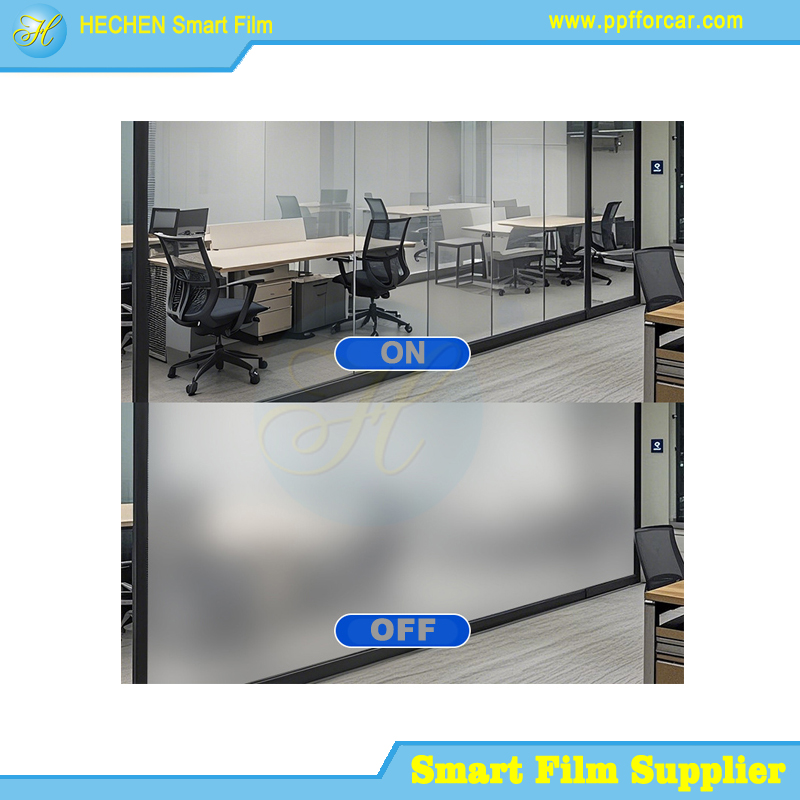
Nothing in the argument above implies that a building must choose one switchable technology across all glazing. A reception room interior partition and an exterior curtain wall are two different specifications solving two different problems. PDLC smart film is the defensible choice for the interior threshold because the function is privacy and the failure mode must be private. If the same building has a west-facing atrium that overheats in summer, that is a solar-control problem, and EC or SPD deserves a separate evaluation on its own terms—VLT range, SHGC, switching profile, control strategy and capital cost per square metre of facade.
Treating these as independent decisions is not inconsistency. It is the only way to avoid paying the EC premium for a privacy function it cannot perform, or accepting PDLC’s limited solar-control capability on a facade where thermal performance is the primary brief. The reception room is a privacy specification. Specify it as one.
Empfohlene Verlinkung:
Empfehlen Sie ähnliche Produkte:
Intelligente Sichtschutzfolie für Badezimmerglas