Smart Film vs. Smart Glass for Homes: Costs, Performance, and ROI
Choosing between smart film and smart glass is an important decision for homeowners who want greater privacy, improved daylight control, and a more modern living environment. Both technologies can switch between transparent and privacy modes, but they differ significantly in installation methods, upfront costs, long-term maintenance, and suitability for existing windows.
For homeowners working within a limited renovation budget, the key question is often whether to retrofit existing glass with smart film or replace the windows entirely with smart glass.
This guide compares smart film vs. smart glass residential cost, installation requirements, performance, energy efficiency, and return on investment (ROI). It also explains whether smart film is worth it for different residential projects.
What Is Smart Film for Residential Windows?
Smart film is an electrically switchable film that can be installed on compatible existing glass. One common technology is Polymer Dispersed Liquid Crystal (PDLC), which changes its optical appearance when an electrical field is applied.
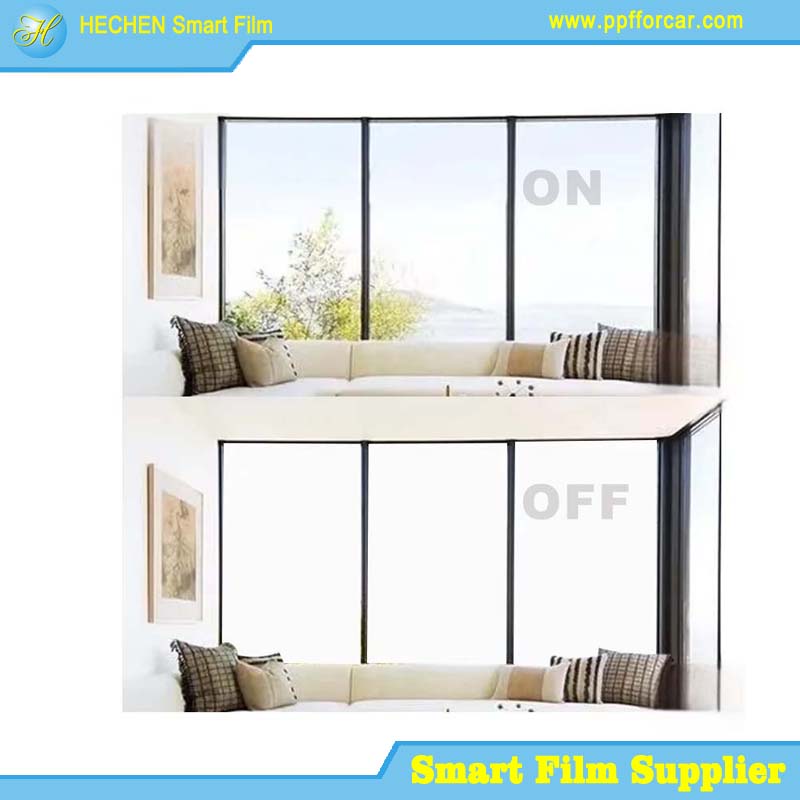
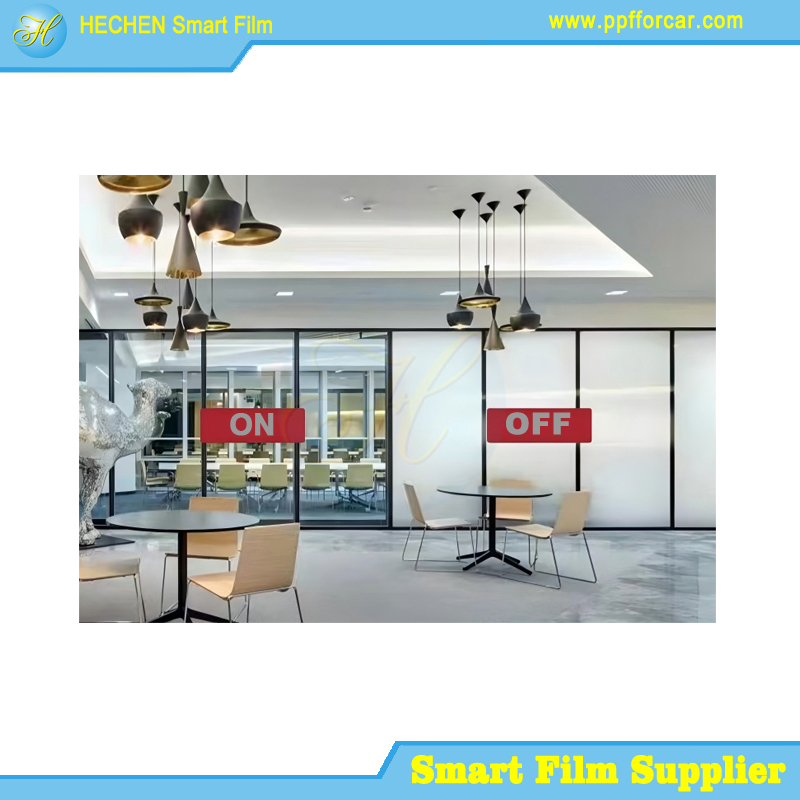
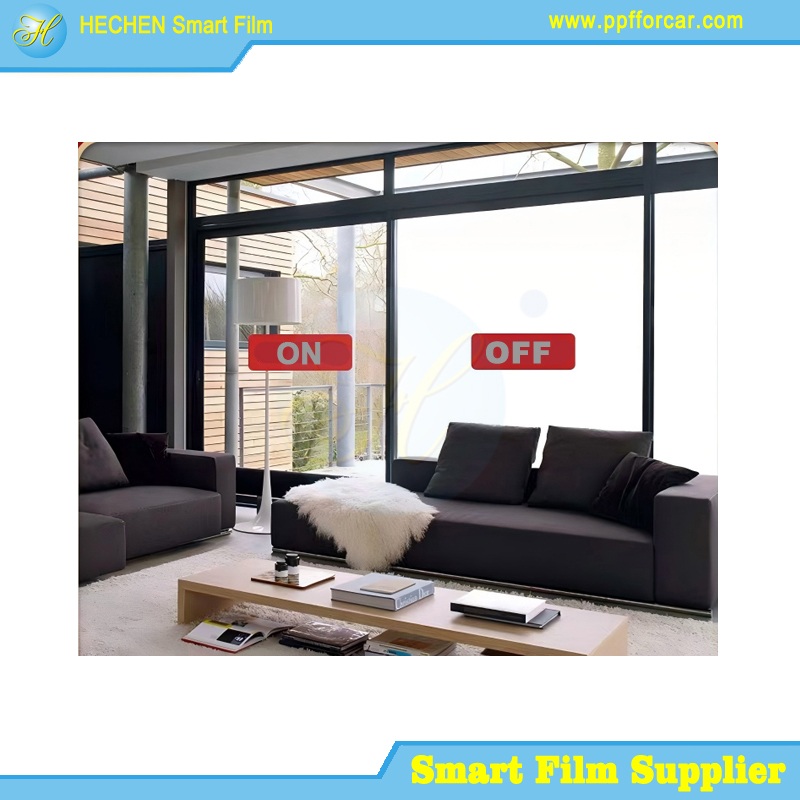
When powered, PDLC smart film typically becomes more transparent. When the power is switched off, it becomes translucent, providing visual privacy while still allowing diffused light to pass through. Actual optical performance depends on the product's specifications, glass type, lighting conditions, and installation quality.
Residential smart film is commonly used for:
Bathroom windows and shower enclosures with compatible glazing
Bedroom and living room windows
Home offices and study rooms
Glass partitions and interior doors
Residential skylights or other specialty glazing, where the product is suitable
Large windows where homeowners want switchable visual privacy
The main advantage of smart film is that it can upgrade existing glass without necessarily requiring complete window replacement.
However, smart film does not automatically improve the thermal insulation of an existing window. Its principal function is switchable visual privacy, rather than replacing the insulating performance of double or triple glazing.
What Is Smart Glass for Residential Applications?
Smart glass is glazing that incorporates a switchable optical technology into the glass unit itself. PDLC smart glass is one option, although other technologies, including Suspended Particle Device (SPD) and electrochromic glazing, operate differently and offer different performance characteristics.
With laminated PDLC smart glass, the switchable layer is generally integrated between glass layers during manufacturing. The finished glass unit is then installed as part of a window, door, or architectural glazing system.
Smart glass is particularly suitable for:
New-build residential projects
Major window renovation projects
Custom architectural glazing
High-end bathrooms and interior glass partitions
Projects where a factory-integrated finish is preferred
Smart glass may offer a more integrated appearance and protect the functional layer within the glass assembly. However, it normally involves a more complex and expensive installation when replacing existing windows.
It is important to distinguish switchable privacy glass from high-performance solar-control glazing. Some smart glass products primarily change privacy or light transmission, while others are designed for solar control. Their energy performance must be assessed from the actual product data rather than assumed from the term "smart glass."
Smart Film vs. Smart Glass Residential Cost: A Detailed Comparison
The largest difference between the two solutions is often the total installed cost.
Smart film can reuse compatible existing glass, reducing demolition, glazing, and disposal costs. Smart glass usually requires a new glass unit, accurate measurements, glazing work, and potentially modifications to window frames or surrounding finishes.
Estimated Cost Per Square Foot
The following figures are illustrative budgeting ranges in US dollars, not verified market quotations. Actual prices vary by country, project size, product quality, glass specification, electrical requirements, and installer availability.
| Cost component | Smart film retrofit | New PDLC smart glass |
|---|---|---|
| Switchable material or glazing | Approximately $15–$50/sq. ft. | Approximately $50–$150+/sq. ft. |
| Installation and electrical work | Approximately $5–$20/sq. ft. | Approximately $15–$50+/sq. ft. |
| Indicative installed total | $20–$70/sq. ft. | $65–$200+/sq. ft. |
| Existing glass reused? | Usually, if compatible | Generally no |
| Window removal required? | Usually not | Usually yes for replacement projects |
| Custom fabrication | Film cutting and edge configuration | Glass fabrication and unit assembly |
| Potential additional costs | Transformer, controller, wiring, edge protection | New frames, glazing hardware, disposal, interior finishing |
These ranges should be treated as preliminary estimates. Some specialist products, large-format installations, complex curved glass, or premium architectural systems can exceed them.
The comparison must also use equivalent specifications. A price for smart film alone should not be compared directly with the price of a complete insulated smart-glass window. For a fair assessment, include the switchable layer, glazing, controls, electrical work, removal, installation, and finishing.
Example: Retrofitting 100 Square Feet of Existing Glass
Assume a homeowner has 100 square feet of compatible glass and wants to add switchable privacy.
Using the illustrative installed ranges above:
Smart film: 100 sq. ft. × $20–$70 = approximately $2,000–$7,000.
Smart glass: 100 sq. ft. × $65–$200 = approximately $6,500–$20,000.
The potential initial cost difference is substantial. However, the figures do not guarantee that both options will meet the same thermal, safety, acoustic, or visual requirements.
If the existing windows are damaged, poorly insulated, or nearing the end of their service life, replacing them may deliver additional benefits that a smart film retrofit cannot provide.
Homeowners should obtain itemized quotations based on the actual glass dimensions, the number of panels, control zones, transformer requirements, and the condition of the existing windows.
Smart Film vs. Smart Glass: Performance Data Table
The following table summarizes the typical differences between retrofit smart film and integrated PDLC smart glass. Exact performance depends on the selected product and installation.
| Comparison factor | Smart film retrofit | Integrated smart glass |
|---|---|---|
| Initial cost | Generally lower | Generally higher |
| Installation time | Often shorter; existing glass is retained | Longer due to fabrication and glazing |
| Construction disruption | Usually limited | May involve window removal and finishing |
| Visual appearance | Applied layer and edge connections may be visible | More integrated factory finish |
| Maintenance | Surface and exposed edges require appropriate care | Normal glass care plus inspection of electrical components |
| Functional layer protection | Depends on film construction and edge protection | Layer is generally protected within the glass laminate |
| Thermal insulation | Does not inherently upgrade the existing insulating glass unit | Can be specified as part of a new insulated glazing unit |
| Privacy control | Switchable, subject to product performance | Switchable, subject to product performance |
| Repair or replacement | Film may be replaceable if the substrate remains suitable | Repair may require replacing the glass unit |
| Best application | Retrofitting suitable existing windows | New construction or full window replacement |
Key takeaway: Smart film is usually the more economical route when the existing glass is in good condition. Smart glass is often more appropriate when the window assembly itself needs upgrading or when an integrated glazing finish is a priority.
Smart Film vs. Full Glass Replacement: Pros and Cons
The right option depends on more than the price of the switchable material.
Advantages of Smart Film Retrofitting
1. Lower initial investment
Reusing existing glass can eliminate much of the cost associated with new glazing units, demolition, disposal, and replacement frames.
2. Less construction disruption
Many compatible interior glass surfaces can be upgraded without removing the entire window. This can reduce disruption to occupied homes, although wiring and surface preparation are still necessary.
3. Faster project completion
For straightforward installations, smart film can be installed more quickly than custom-fabricated replacement glazing. Actual lead time depends on film availability, site conditions, electrical work, and the number of windows.
4. Flexible control options
Depending on the system, homeowners may use a wall switch, remote control, or compatible automation equipment to operate the film.
5. Reduced material waste
Retaining suitable existing glass avoids discarding a functional glazing unit, which may reduce construction waste.
Limitations of Smart Film Retrofitting
Existing glass must be compatible, structurally sound, and suitable for the film.
Film edges, busbars, and wiring may be visible.
Surface preparation and careful installation are essential.
The retrofit does not automatically improve the window's U-value or air leakage.
Some exterior applications require specialist products and environmental protection.
If the film fails, replacement may be necessary, depending on the fault and product design.
Advantages of Smart Glass Replacement
1. Integrated appearance
The switchable layer is incorporated into the glazing assembly, which can provide a cleaner architectural finish.
2. Opportunity to upgrade the complete window
When specified correctly, a new unit can incorporate double or triple glazing, low-emissivity coatings, gas-filled cavities, and suitable solar-control features.
3. Protected switchable layer
In laminated smart glass, the active layer is generally protected between glass layers. This can reduce direct exposure to cleaning and environmental damage.
4. Better fit for new construction
Smart glass can be designed into the glazing system from the beginning, allowing electrical connections, frames, and dimensions to be coordinated during construction.
Limitations of Smart Glass Replacement
Initial material and installation costs are usually higher.
Custom manufacturing can increase lead times.
Existing windows may need to be removed.
Replacement can require new frames, seals, hardware, and interior finishing.
A damaged integrated unit may require replacement of the entire glazing panel.
Is Smart Film Worth It? An Energy Savings and ROI Analysis
Whether smart film is worth it depends on the homeowner's primary objective. If the main goal is on-demand visual privacy, its value may be measured in convenience, space utilization, and reduced reliance on blinds or curtains. If the goal is lower energy bills, the calculation requires more caution.
Can Smart Film Reduce Energy Costs?
Smart film should not automatically be treated as an energy-saving window upgrade.
Conventional PDLC smart film changes light scattering to create a translucent privacy state. It does not necessarily block a large proportion of solar heat, and its privacy mode is not equivalent to an effective solar-control blind or a dedicated solar-control coating.
Potential energy benefits depend on the product's measured solar and optical properties, the existing glazing, the direction the windows face, local climate, shading, and how occupants use the system.
Before assuming energy savings, ask the supplier for relevant performance data, including:
Visible light transmittance (VLT)
Solar transmittance and solar reflectance
Solar heat gain coefficient (SHGC), where applicable to the glazing system
U-value or thermal transmittance of the complete window assembly
UV transmission or rejection, if UV protection is important
Power consumption in each operating mode
For meaningful comparisons, request data for the complete glazing system rather than the film alone.
A Simple ROI Calculation
A basic payback model compares the initial investment with measurable annual financial savings.
Simple payback period = Initial investment ÷ Annual net savings
Suppose a smart film installation costs $4,000. If the homeowner can reliably document $200 in annual net savings from reduced use of other privacy treatments, the simple payback period is:
$4,000 ÷ $200 = 20 years.
This example is illustrative, not a forecast. The $200 saving must be supported by actual household costs, and net savings should account for electricity consumption, maintenance, and replacement costs where relevant.
If smart film is installed primarily for privacy and convenience, it may not generate a positive financial payback from energy savings alone. Its value can still be worthwhile if it replaces other treatments, improves the usability of a room, or meets a design requirement.
For a replacement window project, energy savings should be calculated separately using the difference between the old and proposed window performance, local energy prices, climate data, and expected heating or cooling demand.
Consider the Total Cost of Ownership
A realistic comparison should include more than the purchase price:
Initial material and installation cost
Electrical consumption
Cleaning and maintenance
Expected service life and warranty coverage
Potential film or glass-unit replacement
Energy savings that can reasonably be attributed to the project
The value of visual privacy and improved room usability
A low upfront price does not always mean the lowest lifetime cost. Conversely, a more expensive smart-glass installation is not automatically more economical simply because the technology is integrated.
Privacy, Daylight, and Everyday Performance
Both smart film and PDLC smart glass can provide on-demand visual privacy, but their performance should be evaluated in real residential conditions.
Privacy Is Not the Same as Blackout
PDLC products typically become translucent rather than turning into an opaque, light-blocking barrier. They obscure direct views, but silhouettes or shapes may remain perceptible under certain lighting conditions.
For bathrooms, bedrooms, and ground-floor windows, homeowners should test samples under both daytime and nighttime lighting. A brightly illuminated room at night can produce different visibility conditions from a room in daylight.
For applications requiring complete visual concealment, confirm the manufacturer's privacy specifications and test the actual product before ordering.
Daylight and Solar Control
Smart film can diffuse incoming light in its privacy state, helping preserve a bright interior compared with some opaque treatments. However, light transmission varies by product and operating mode.
If the priority is reducing glare or solar heat gain, compare smart film with external shading, solar-control glazing, low-emissivity glass, and other solutions designed for thermal performance.
A combined solution may be appropriate: for example, smart film for visual privacy and a separate solar-control measure for heat management.
Electrical Requirements
Most PDLC systems require a compatible power supply or transformer and suitable wiring. Larger installations may benefit from multiple independently controlled zones.
Before installation, confirm the operating voltage, power consumption, wiring arrangement, control compatibility, and applicable electrical safety requirements. Electrical work should be completed by qualified personnel where required by local regulations.
Which Solution Is Best for Different Residential Projects?
| Residential project | Usually worth considering | Reason |
|---|---|---|
| Existing bathroom window in good condition | Smart film retrofit | Adds switchable privacy without replacing the whole glazing unit |
| Home office with an existing glass partition | Smart film retrofit | Lower-disruption way to create on-demand visual privacy |
| Living room with sound existing windows | Smart film retrofit | Preserves the current window while adding switchable functionality |
| Drafty or poorly insulated windows | Full window replacement | Creates an opportunity to improve the complete window assembly |
| New-build home with custom architectural glazing | Smart glass | Allows factory integration and coordinated electrical design |
| Premium renovation with damaged glazing | Smart glass replacement | Combines switchable functionality with replacement of the glass |
| Home where reducing summer heat is the main goal | Solar-control glazing or shading; assess smart products separately | Privacy switching alone does not guarantee meaningful heat reduction |
These are general recommendations. The best option depends on the condition of the glass, the intended location, safety requirements, climate, and budget.
Frequently Asked Questions
Is smart film cheaper than smart glass for homes?
Smart film is generally less expensive when it can be installed on compatible existing glass. Smart glass requires a new glazing unit, and may also require removal, replacement, and finishing work. Obtain installed quotations for both options before making a final decision.
How much does residential smart film cost per square foot?
For initial budgeting, retrofit smart film may cost approximately $20–$70 per square foot installed, based on the illustrative ranges in this guide. Complex projects and premium products may cost more. Confirm the currency, scope of work, and inclusions with the supplier.
Does smart film save electricity?
Smart film itself consumes electricity while operating, and its energy-saving potential depends on its optical properties and how it is used. PDLC privacy film should not be assumed to reduce heating or cooling costs without supporting performance data and a project-specific calculation.
Can smart film be installed on existing double-glazed windows?
Potentially, yes, if the exposed glass surface, window construction, temperature conditions, and selected film are compatible. However, film should not be applied indiscriminately to insulated glass units because unsuitable products or installation conditions may create thermal stress or affect warranties. Obtain approval from the film and glazing suppliers.
How long does smart film last?
Service life varies by product quality, installation, electrical conditions, operating environment, and maintenance. Ask for the manufacturer's expected service life, warranty terms, switching-cycle information where available, and recommended operating conditions.
Is smart glass more durable than smart film?
Integrated smart glass protects its switchable layer within the glazing assembly, which can be an advantage. Smart film is more exposed at its surface and edges, although appropriate installation and maintenance can help preserve performance. Durability should be evaluated using product specifications and warranty conditions rather than technology labels alone.
Can smart film replace curtains or blinds?
Smart film can replace some visual privacy functions of curtains or blinds, particularly where a clean, minimalist appearance is desired. It does not necessarily provide the same blackout performance, thermal insulation, or solar shading. Homeowners may still need separate window coverings for bedrooms, glare control, or heat management.
Conclusion: Smart Film or Smart Glass for Your Home?
For homeowners who already have suitable windows, smart film is often the more cost-effective way to add switchable visual privacy. It can reduce the need for glass replacement, limit renovation disruption, and provide flexible control at a lower initial investment.
Smart glass is generally more appropriate for new construction, damaged or inefficient windows, major renovations, and projects that require a fully integrated glazing system.
The most important distinction is that smart film and smart glass are not direct substitutes in every situation. Smart film upgrades the functionality of existing glass, while smart glass can form part of a completely new window assembly. Neither option automatically delivers the best thermal performance without the right product specifications.
Before making a decision, compare itemized installed costs, electrical requirements, privacy performance, maintenance, warranty, and expected service life. If energy efficiency is a priority, evaluate the thermal performance of the complete window system separately from its switchable privacy function.
Recommended linking:
The Ultimate Guide to Smart Film for Residential Windows
Recommend related products:
Smart Film For Residential Windows