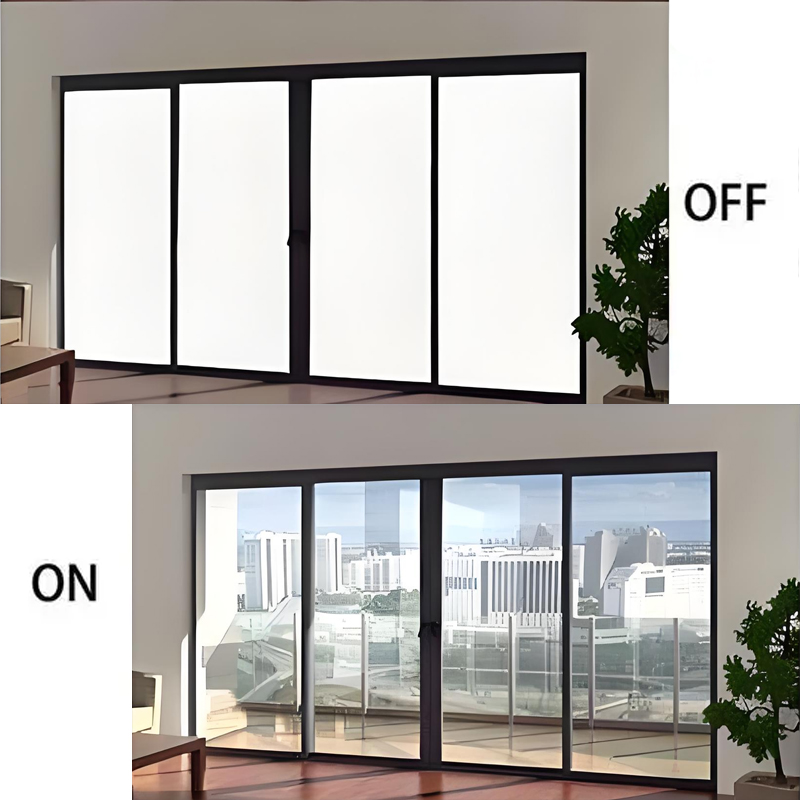
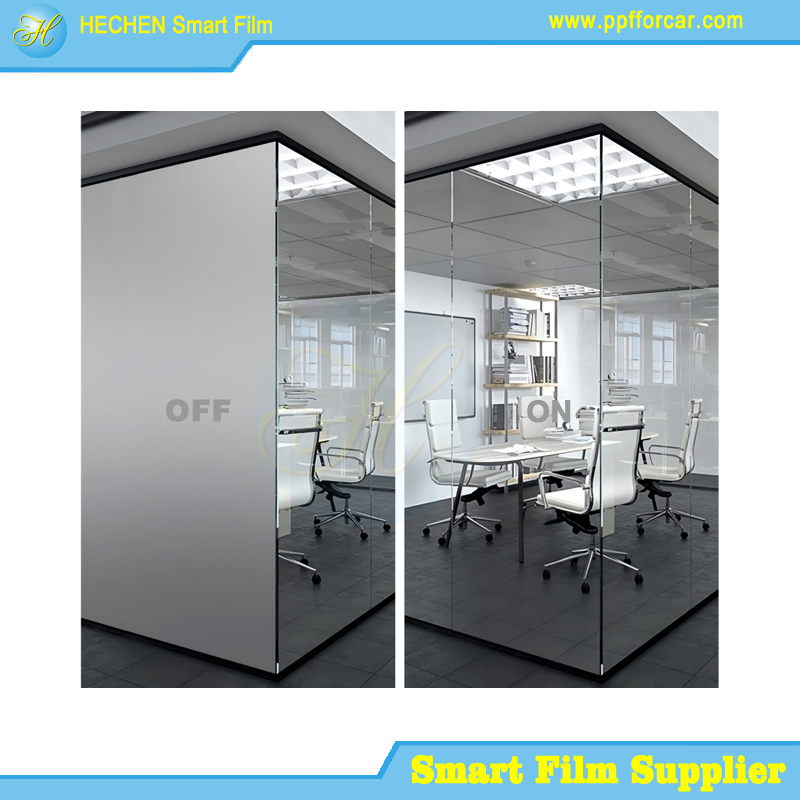
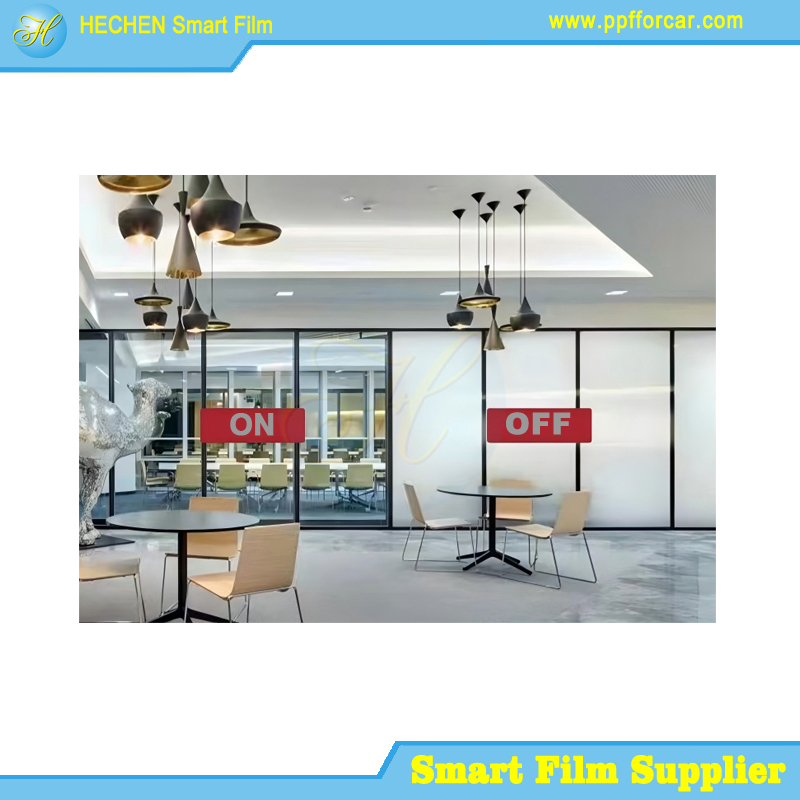
In the realm of smart glass technology, PDLC (Polymer Dispersed Liquid Crystal) film is widely recognized as an "electronic curtain" or "privacy glass" due to its characteristic of being transparent when powered on and opaque when powered off. However, the potential of this technology extends far beyond privacy protection. A frequently asked question sparks a deeper technical exploration: Can you project onto PDLC smart film?
The answer is yes. Moreover, when PDLC smart film is combined with projection technology, it unlocks a powerful dual-function potential—serving both as a smart privacy solution and a high-performance projection screen.
I. The Technical Principle of Projection Function: Why Can PDLC Serve as a Screen?
To understand why PDLC film can be used as a projection screen, the key lies in understanding its optical characteristics in the power-off state.
1. The Opaque State Creates a Natural Projection Surface
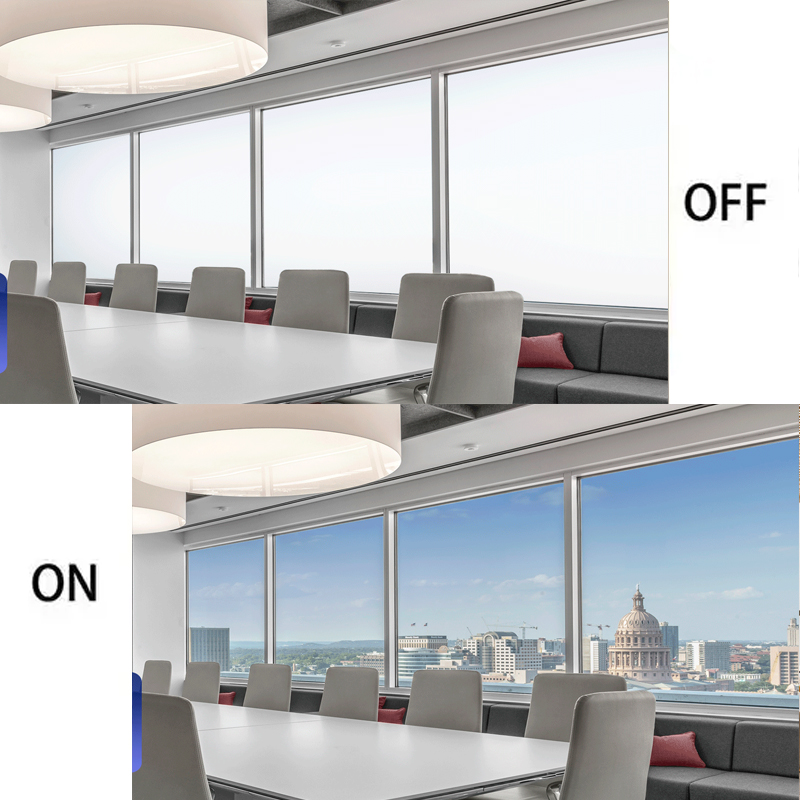
The core working principle of PDLC film is: when powered on, the liquid crystal molecules within the film align orderly under the influence of an electric field, allowing light to pass through directly, presenting a transparent state; when powered off, the liquid crystal molecules become randomly disordered, strongly scattering light, presenting an opaque, frosted state.
It is precisely this light-scattering property in the power-off state that makes PDLC film an ideal projection screen:
Traditional White/Milky White PDLC: In the power-off opaque state, it presents a milky white appearance, with haze typically reaching over 90%. This diffuse reflective surface effectively captures the light projected by the projector, forming clear and bright images.
New PDCLC Black Film: By incorporating dyes into the liquid crystal, it presents a gray-black appearance in the power-off state. This product also offers excellent projection performance, with haze >95% and higher contrast.
2. The Unique Advantage of Dual-Sided Viewing
Unlike traditional projection screens, PDLC dimming film in its opaque state supports dual-sided viewing—clear projected images can be seen from both the front and the back. This characteristic brings unprecedented flexibility to spatial design:
Rear Projection Applications: The projector can be hidden behind the glass, achieving a "hidden display" effect.
Front Projection Applications: The projector can also be placed on the same side as the viewer, adapting to different spatial layouts.
II. Comparison of Projection Effects of Different Types of PDLC Film
With technological advancements, various types of PDLC dimming films are available on the market, and their projection effects also differ:
III. Practical Application Scenarios: From Commercial Displays to Smart Spaces
The projection function of PDLC film has gained wide application globally. Here are some typical cases:
1. Commercial Displays and Advertising
Storefront Window Advertising: In the main meeting room of the Thai Parliament, Vujeon deployed a display system called "Vision Play" linked with a projector. This space serves not only as an important meeting room but also functions as a media facade for corporate promotion and transmitting video materials to the parliament.
Event Exhibitions: BenQ Materials' electronically controlled liquid crystal glass advertising system has been successfully used in major international exhibitions in the USA, Germany, Indonesia, Taiwan, and the Taichung Light and Shadow Art Festival, offering more possibilities for architectural space utilization, exhibition activities, and outdoor displays.
2. Office and Conference Spaces
Multi-functional Meeting Rooms: Solutions for the Hong Kong Government's Smart LAB explicitly list "projection screen application" as an important commercial use case for PDLC dimming film.
Flexible Partitions: Glass partitions in office areas can remain transparent during daily use and switch to an opaque state when needed, instantly transforming into a projection screen or private space.
3. Home Entertainment
Small Home Theaters: In residential applications, PDLC dimming film can serve as a small home theater screen, effectively combining the functions of a screen and a partition, saving space while enhancing the entertainment experience.
Hidden TVs: In the powered-on transparent state, the screen blends seamlessly with the surrounding glass; after powering off to the opaque state, it can be used to project and watch movies.
4. Public and Government Facilities
Diplomatic Missions: The consular consultation room of the South Korean Embassy in Luxembourg introduced PDLC smart film, enhancing spatial order and privacy protection while reserving functionality for potential future display needs.
Local Government: The Roiet Provincial Government in Thailand signed a contract worth approximately 5 billion KRW with Viewzen for the supply of PDLC smart film, applying it to major public and administrative facilities to achieve energy savings and improved spatial efficiency.
IV. Technical Limitations and Optimization Directions
While the projection function of PDLC film is exciting, certain technical limitations need attention in practical applications:
1. Balancing Transmittance and Contrast
Conventional PDLC can achieve light transmittance of over 84% in the transparent state, sometimes even reaching 90%, but its projection effect in the opaque state cannot yet completely match that of professional projection screens. The new PDCLC black film has made significant progress in this area by enhancing contrast.
2. Optimizing Color Reproduction
The milky white base color of traditional PDLC can slightly affect the projected colors. In response, some manufacturers are developing improved solutions incorporating dyes or nanoparticles to optimize color fidelity.
3. Projector Brightness Requirements
Due to the light-scattering characteristics of PDLC film, the brightness requirements for the projector are typically higher than for ordinary screens. It is recommended to perform professional illuminance calculations before installation and select projection equipment with appropriate brightness.
V. Future Development Trends
1. Integration of Touch Functionality
Some manufacturers have begun developing solutions that integrate touch functionality with PDLC projection. For instance, the "Projection Touch Dimming Film" launched by All-view Technology retains the dimming function while adding touch interaction capabilities.
2. Zoned Control and Customization
The new generation of PDCLC products supports customized zoned design, allowing users to choose different dimming areas, colors, and control methods according to their needs. This suggests that future smart window films may achieve functions like "multiple independent display areas on a single piece of glass."
3. Deep Integration with the Internet of Things
With the development of smart homes and smart buildings, PDLC projection film will become more deeply integrated into IoT systems, enabling scenario-based automated switching—automatically switching to projection mode at the start of a meeting and returning to transparent afterwards.
Conclusion
Returning to the initial question: Can you project onto PDLC smart film? The answer is not only "yes," but also "it can do it very well." This dual-function potential—serving as both a smart privacy solution and a high-performance projection screen—makes PDLC dimming film an extremely valuable material in modern spatial design.
From the meeting rooms of the Thai Parliament to the living rooms of ordinary homes, from commercial shop windows to diplomatic missions, the projection function of PDLC film is redefining our perception of "glass." As technology continues to advance, this intelligent surface capable of "switching at the touch of a button" will play an increasingly important role in the smart spaces of the future.
For more about Can You Project onto PDLC Smart Film? Exploring Its Dual-Function Potential. Everything you need to know, you can pay a visit to https://www.ppfforcar.com/product/PDLC-Smart-Film/ for more info.