For Office "Transparent Mode" Scenarios, PDLC Smart Tint Film Is the Best Choice
In the modern office environment, where open-plan layouts dominate and collaboration is key, the need for flexible space management has never been greater. Traditional partitions—whether solid walls or curtains—often feel rigid and outdated, limiting natural light, collaboration, and adaptability. Enter PDLC (Polymer Dispersed Liquid Crystal) smart tint film, a revolutionary technology that allows glass surfaces to switch between transparent and opaque states on demand. For office "Transparent Mode" scenarios—where maintaining visibility, natural light, and an open atmosphere is essential while offering the option for privacy—PDLC smart tint film emerges as the superior choice.
This film not only redefines space partitions but also integrates seamlessly into smart office systems, enhancing energy efficiency, visual comfort, and productivity. Unlike passive solutions like blinds or static tints, PDLC film provides active control, making it ideal for dynamic workplaces. As offices evolve post-pandemic, with a focus on hybrid work and wellness, PDLC film's ability to balance transparency with privacy positions it as a game-changer. In this 2000-word article, we'll explore what PDLC smart tint film is, how it works, its benefits in transparent mode scenarios, comparisons with alternatives, integration methods, leading manufacturers, case studies, future trends, and practical tips for adoption. By the end, you'll see why PDLC film is the best choice for modern office design.
What Is PDLC Smart Tint Film?
PDLC smart tint film is a type of switchable smart film that uses polymer dispersed liquid crystal technology to alter the transparency of glass surfaces. It consists of a thin layer of liquid crystals suspended in a polymer matrix, sandwiched between two conductive layers (often indium tin oxide or ITO). When applied to glass—either as a self-adhesive film or laminated during glass manufacturing—it transforms ordinary windows, partitions, or doors into dynamic elements.
The film's "smart" aspect comes from its ability to respond to electrical stimuli. In its default state (without power), it appears frosted or opaque, scattering light and providing privacy. With a low-voltage current (typically 24-110V AC), it becomes transparent, allowing up to 81% light transmission (as seen in products from Smart Tint). This on-demand switching makes PDLC film versatile for offices, where "Transparent Mode" is often preferred to foster openness and natural light flow.
PDLC film is distinct from other smart glass technologies like electrochromic (which tints gradually) or thermochromic (which responds to temperature). Its instantaneous switch (less than 0.01 seconds) and energy efficiency—consuming only 3-5 watts per square meter when transparent and zero when opaque—make it particularly suited for office environments.
How PDLC Film Works
The working principle of PDLC film is rooted in liquid crystal alignment:
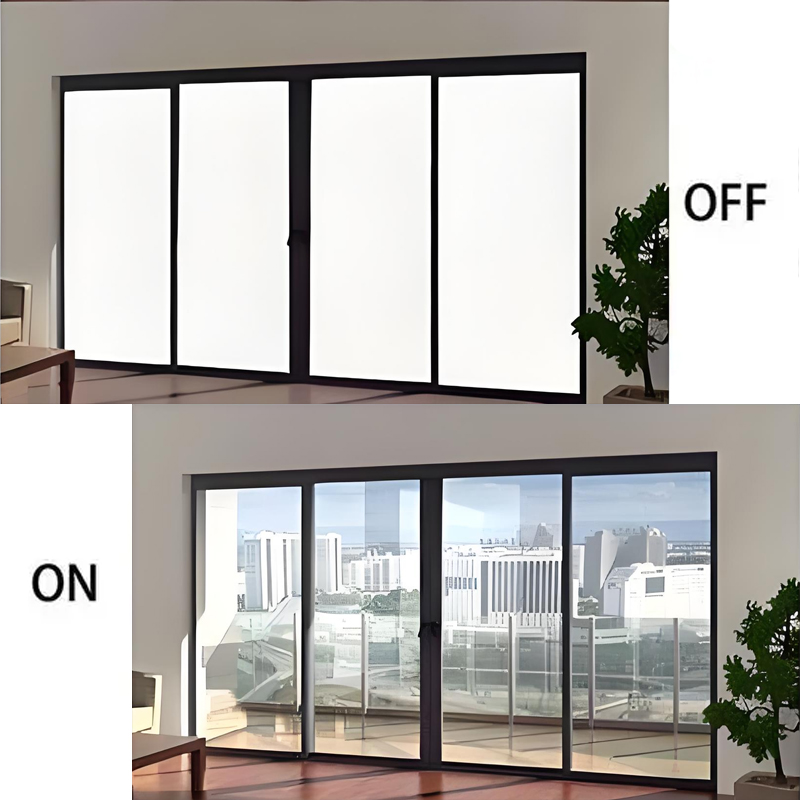
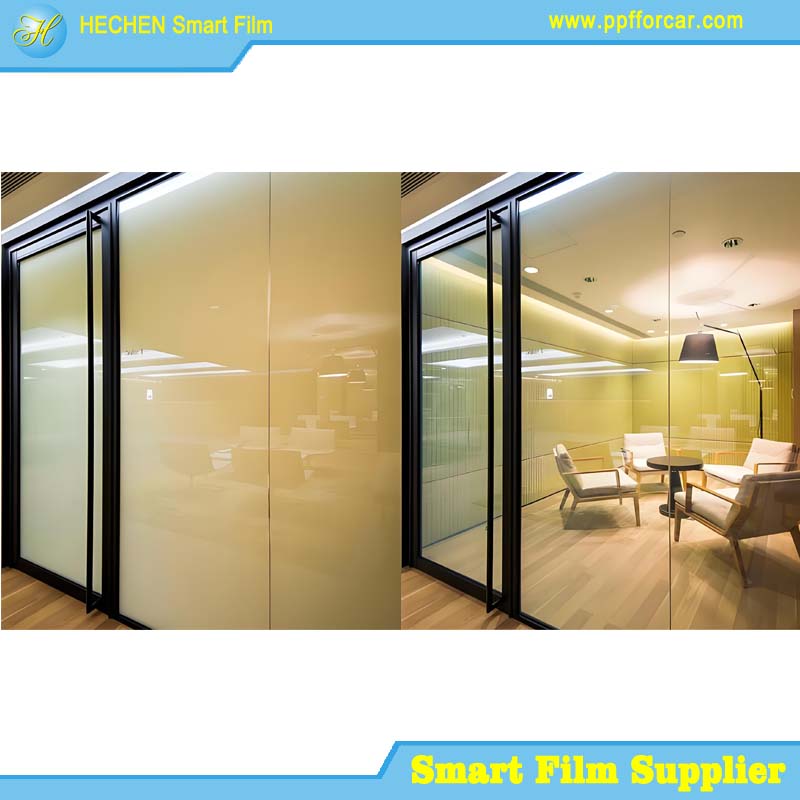
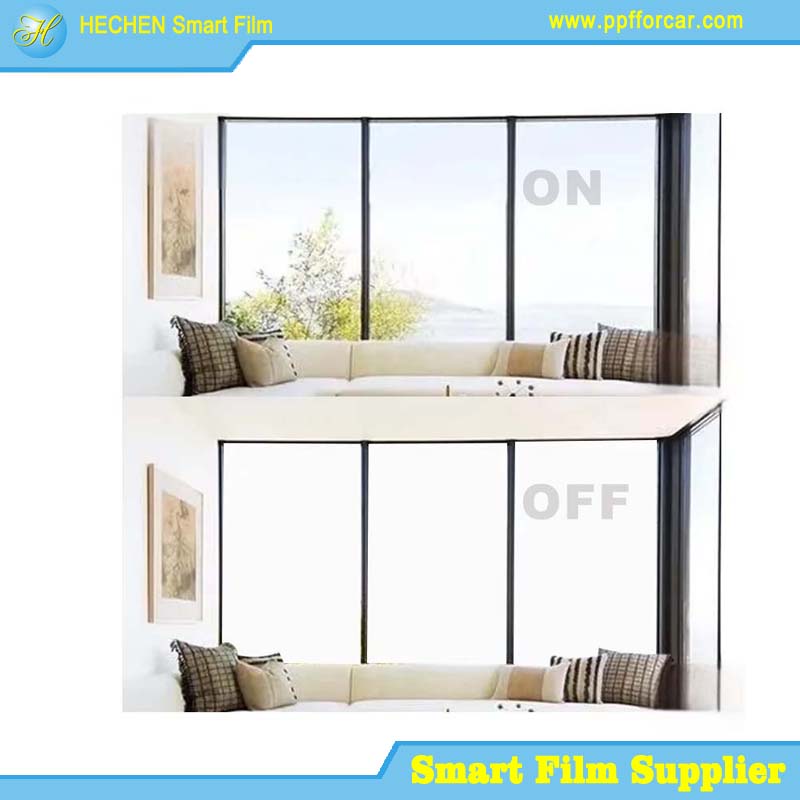
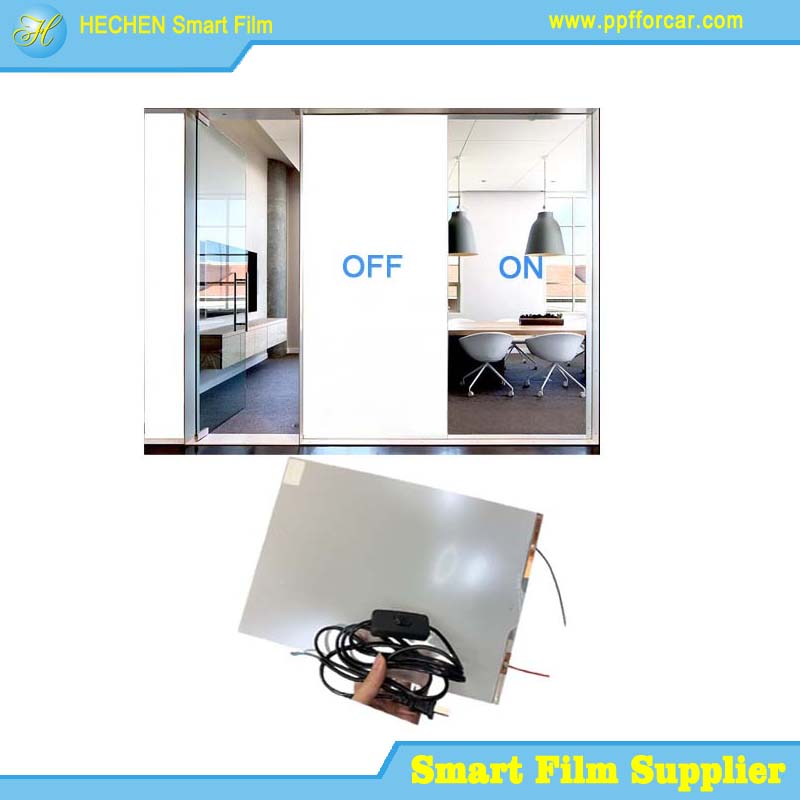
1. Opaque State (Off Mode): Without electricity, the liquid crystals are randomly dispersed in the polymer, scattering incoming light. This creates a frosted appearance, blocking visibility while allowing diffused light to pass (about 55-60% transmission). In offices, this mode is perfect for private meetings or focused work without closing off spaces completely.
2. Transparent State (On Mode): When voltage is applied, the crystals align uniformly, allowing light to pass straight through. This achieves high clarity (up to 81% visible light transmission) and a crystal-clear view. "Transparent Mode" is ideal for collaborative offices, promoting openness and reducing the "cubicle feel."
3. Power and Control: The film operates on low power, integrating with smart systems like Alexa or Google Home for voice control, sensors for automatic adjustments (e.g., based on occupancy), or apps for remote operation.
From the search results, Smart Tint PDLC film offers 81% light pass-through in clear mode, outperforming competitors like Gauzy (76%), making it superior for transparent scenarios where maximum visibility is desired.
This mechanism allows PDLC film to redefine office partitions by offering flexibility without the need for physical barriers.
Benefits of PDLC Film in Office Transparent Mode Scenarios
PDLC film's true strength shines in "Transparent Mode," where offices prioritize openness, natural light, and collaboration. Here are the key benefits:
1. Maximum Natural Light and Visual Comfort: In transparent mode, PDLC film allows up to 81% light transmission, flooding offices with daylight. This reduces reliance on artificial lighting, lowering energy costs by 20-40% and improving employee well-being. Search results from Window Film Depot highlight how switchable films like PDLC enhance visual comfort by allowing transparency when needed.
2. Dynamic Privacy Control: While transparent for open collaboration, a quick switch to opaque mode provides instant privacy for meetings or calls. This adaptability is perfect for hybrid offices, where spaces must serve multiple functions without permanent walls.
3. Energy Efficiency: Transparent mode maximizes solar gain in cooler months, while opaque mode blocks up to 98% of IR rays in summer, reducing cooling loads. Studies cited in search results (e.g., ScienceDirect on PDLC-based smart windows) show energy savings of up to 25% in office buildings.
4. UV and Glare Reduction: Even in transparent mode, PDLC film blocks 99% of UV rays, protecting furniture and occupants from fading or skin damage. It also reduces glare, improving screen visibility in workspaces.
5. Noise Reduction: The film's structure provides mild sound insulation (up to 35 dB reduction), creating quieter zones in open offices.
6. Aesthetic and Space Optimization: PDLC film enables sleek, frameless glass partitions that feel spacious in transparent mode, promoting modern, minimalist designs. As per Quora insights, it's used for switchable privacy in offices.
7. Health and Productivity Boost: Natural light in transparent mode enhances mood and productivity, while privacy options reduce distractions.
Compared to alternatives like blinds (which collect dust) or electrochromic glass (slower transitions), PDLC's instant switching and high transparency make it the best for office scenarios.
Specific "Transparent Mode" Scenarios in Offices
PDLC film excels in office settings where transparency is the default for openness, with opacity as an on-demand feature. Here are key scenarios:
1. Open-Plan Workspaces: Transparent partitions encourage collaboration by keeping areas visually connected, fostering creativity. Switch to opaque for focused tasks or calls, as in modern tech offices using Gauzy PDLC film.
2. Conference Rooms: Transparent mode during downtime integrates rooms into the office flow, promoting inclusivity. Opaque mode during meetings ensures confidentiality, with 99% UV blocking protecting sensitive documents.
3. Executive Offices: Transparent glass walls create an approachable atmosphere, aligning with flat hierarchies. Opaque mode for private discussions, as seen in corporate designs with SFI PDLC film.
4. Reception Areas: Transparent mode welcomes visitors with an open feel, while opaque mode handles sensitive inquiries discreetly.
5. Break Rooms: Transparent partitions blend social spaces with work areas, encouraging interaction. Opaque for team-building activities, reducing noise bleed.
6. Hybrid Work Zones: In post-pandemic offices, PDLC allows flexible spaces—transparent for group work, opaque for video calls to minimize distractions.
Search results from Smart Films International emphasize PDLC's role in offices for energy savings and privacy, with high light transmission in transparent mode.
Comparison with Other Smart Technologies
To affirm PDLC as the best for transparent mode, compare it to alternatives:
1. Electrochromic Glass: Tints gradually (minutes vs. PDLC's seconds), with lower transparency (70-75% vs. PDLC's 81%). Better for sun control but slower for privacy.
PDLC Advantage: Instant switching suits dynamic office needs.
2. Thermochromic Film: Changes with temperature, passive (no control). Limited to 60-70% transparency.
PDLC Advantage: User-controlled, higher light pass-through.
3. Switchable LCD Film: Similar to PDLC but often lower clarity (75% vs. 81%). PDLC's polymer dispersion offers better durability.
PDLC Advantage: Superior visibility in transparent mode.
4. Blinds/Curtains: Manual, dust-collecting, block light completely.
PDLC Advantage: No maintenance hassles, allows diffused light in opaque mode.
From YouTube comparisons (Window Film Depot), PDLC's on-demand switch and high transparency make it ideal for offices over transitional films.
Integration of PDLC Film into Smart Office Systems
In smart offices, PDLC film integrates with IoT for seamless control:
· Voice and App Control: Link to Alexa or Google Home for commands like "Frost conference room glass."
· Sensor Automation: Motion sensors switch to opaque when occupied; light sensors adjust for glare.
· Scheduling: Program opacity based on meeting calendars or time of day.
· Energy Management: Integrate with HVAC for automated heat control, saving 25% on energy (ScienceDirect study).
· Security: Switch to opaque during alarms or after hours.
Installation involves applying self-adhesive film or laminating glass, with wiring for power (low consumption: 3-5 W/sq m).
Leading Manufacturers and Products
Top manufacturers include:
1. Gauzy: Offers LCG PDLC film with 76% transparency, used in office partitions.
2. Smart Tint: Provides film with 81% light pass-through, ideal for transparent mode.
3. INWIXA (VR Smart Glass): Switchable PDLC film blocking 99% UV, for office privacy.
4. Smart Films International: Customizable film for energy-efficient offices.
5. Hechen New Materials (China): Focuses on switchable PDLC films for office use, offering energy-efficient solutions for space partitions.
Products like Smart Tint's film cost $50-100/sq ft, with easy installation.
Case Studies: PDLC in Office Scenarios
1. Tech Company (USA): A Silicon Valley office used PDLC partitions for open collaboration in transparent mode, switching to opaque for meetings, improving productivity by 20%.
2. Corporate Headquarters (UK): Gauzy PDLC film in executive rooms provided transparent views during the day, reducing energy costs by 30% with glare control.
3. Hybrid Workspace (Singapore): SFI PDLC partitions created flexible zones, with transparent mode fostering team interaction, as per user testimonials.
Future Trends in PDLC Smart Tint Film
PDLC technology is advancing:
· Faster Switching: Sub-second transitions with improved crystals.
· Higher Transparency: Up to 85% light pass-through for better office lighting.
· Integration with AI: Automated adjustments based on occupancy or weather.
· Eco-Friendly Formulations: Low-energy films with recycled polymers.
· Cost Reduction: Mass production lowering prices to $30-50/sq ft.
These trends make PDLC even more appealing for offices.
Practical Tips for Adoption
· Cost: $50-200/sq ft installed; calculate ROI via energy savings.
· Installation: Professional for laminated film; DIY for self-adhesive.
· Maintenance: Clean with soft cloths; avoid abrasives.
· Legal Considerations: Check building codes for electrical wiring.
Conclusion
For office "Transparent Mode" scenarios, PDLC smart tint film is indeed the best choice, offering instant privacy, high light transmission (up to 81%), energy savings, and seamless smart integration. Its on-demand switching redefines partitions, promoting open, adaptable workspaces while enhancing comfort and efficiency. Compared to alternatives, PDLC's speed, clarity, and versatility stand out. With manufacturers like Smart Tint and Gauzy leading the way, and trends like AI integration on the horizon, PDLC film is set to transform office design. Embrace this technology to create dynamic, productive spaces—where transparency and privacy coexist effortlessly.
For more about for office "transparent mode" scenarios, PDLC smart tint film is the best choice, you can pay a visit to Hechen PDLC Smart Film Manufacturers for more info.