How PDLC Smart Film Works: The Science of Dynamic Transparency
In the realm of smart materials, few offer as visually striking and immediately functional a transformation as Polymer Dispersed Liquid Crystal (PDLC) film. Often dubbed "smart glass" or "privacy glass" in its applied form, this technology allows a pane, partition, or window to switch between opaque and transparent states at the flick of a switch. This seamless metamorphosis is not mere magic but a sophisticated dance of physics, chemistry, and materials engineering. This article delves into the intricate working principles, material composition, manufacturing processes, and applications of PDLC smart film, demystifying the science behind its dynamic behavior.
Fundamental Concept: The Heart of the Technology
At its core, PDLC smart film is a composite material. Its name precisely describes its structure:
Polymer Dispersed: Liquid crystals are scattered (dispersed) within a solid polymer matrix.
Liquid Crystal (LC): The active component, possessing a unique state of matter that flows like a liquid but whose molecules maintain some long-range directional order, like a crystal.
The fundamental operating principle relies on controlling the alignment of these liquid crystal droplets embedded within the film. This alignment directly dictates whether light is scattered (opaque state) or transmitted (transparent state).
Material Composition and Structure
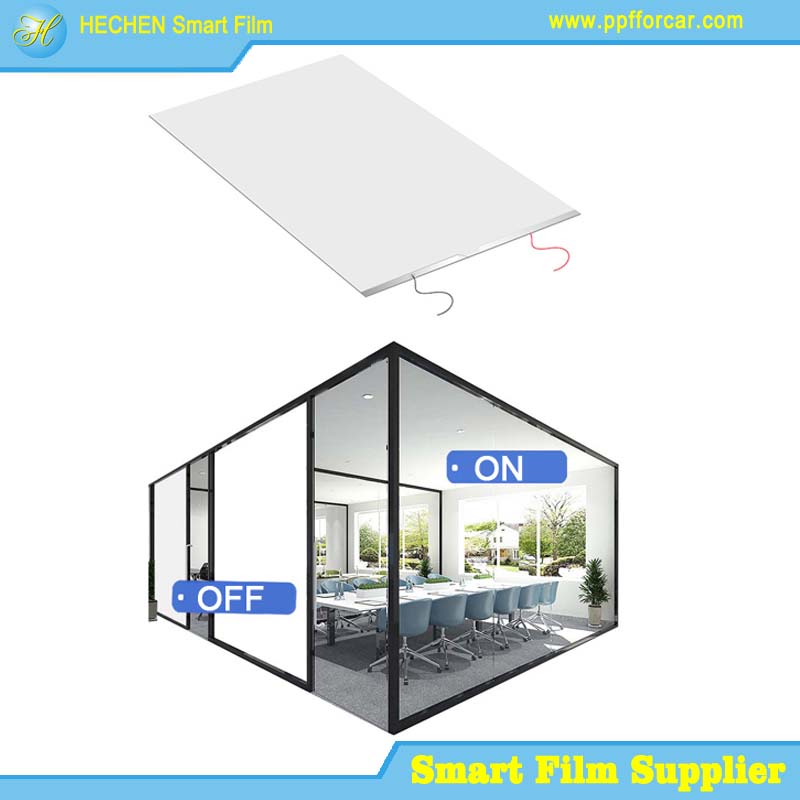
A typical PDLC film is a multilayer laminate, generally constructed as follows:
The Core PDLC Layer: This is the functional heart. It is created by mixing a prepolymer (often a UV-curable monomer like polyurethane or epoxy) with low-molecular-weight nematic liquid crystals. This mixture is then sandwiched between two conductive layers.
Conductive Layers: These are typically made of Indium Tin Oxide (ITO) or a transparent conductive polymer like PEDOT:PSS. They are coated onto the substrate films and act as the electrodes. Their high transparency and conductivity are crucial.
Substrate Films: The conductive layers are deposited onto durable, optically clear polyester (PET) films. These substrates provide mechanical strength and integrity to the laminate.
Adhesive & Laminating Layers: Pressure-sensitive adhesives (PSA) are used to bond the PDLC core to the conductive substrates and, ultimately, to seal the entire assembly. The outer laminating layers provide scratch resistance and environmental protection.
The manufacturing process is critical. The LC/prepolymer mixture is coated between the ITO-PET films and then cured using ultraviolet (UV) light. As the polymer solidifies, the liquid crystals become incompatible with the forming polymer network and phase-separate, forming microscopic droplets (typically 1-10 microns in diameter) randomly suspended within the solidified polymer matrix. The size and distribution of these droplets are key performance factors.
The Electro-Optical Switching Mechanism
The magic happens when voltage is applied. The state change is governed by the refractive index matching and the dielectric anisotropy of the liquid crystals.
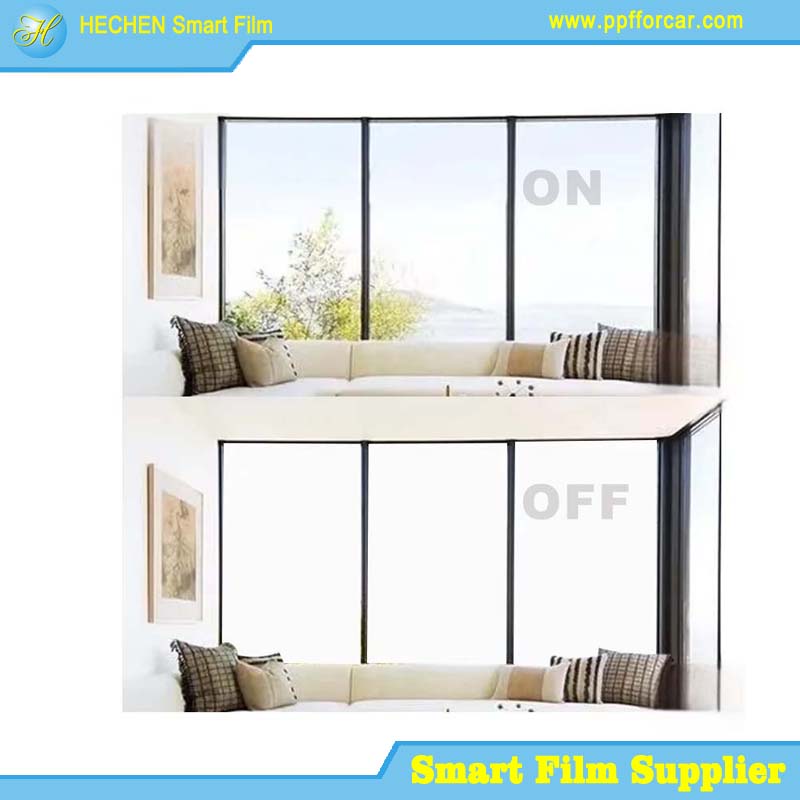
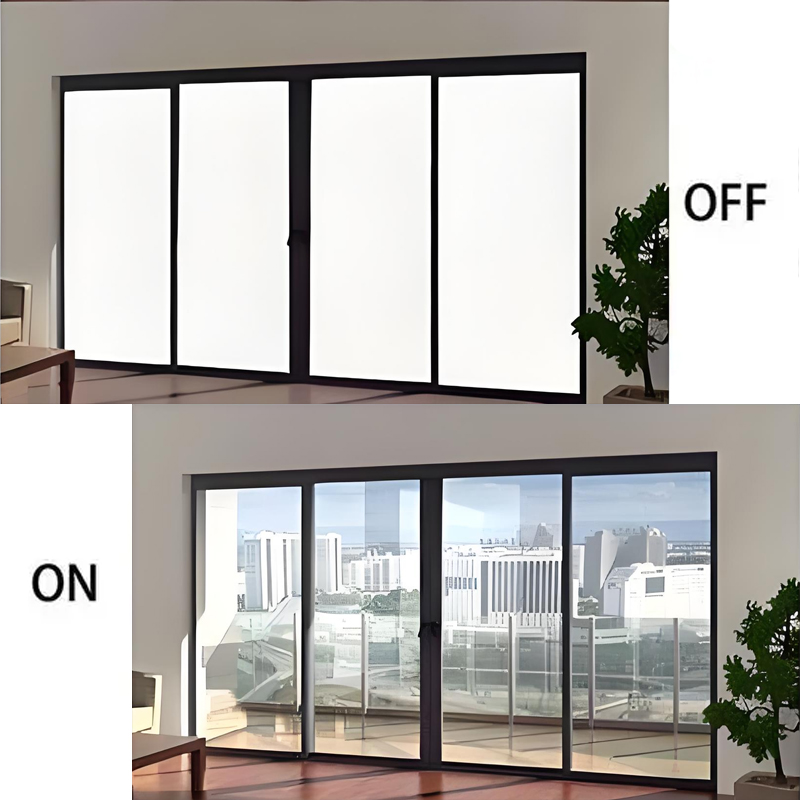
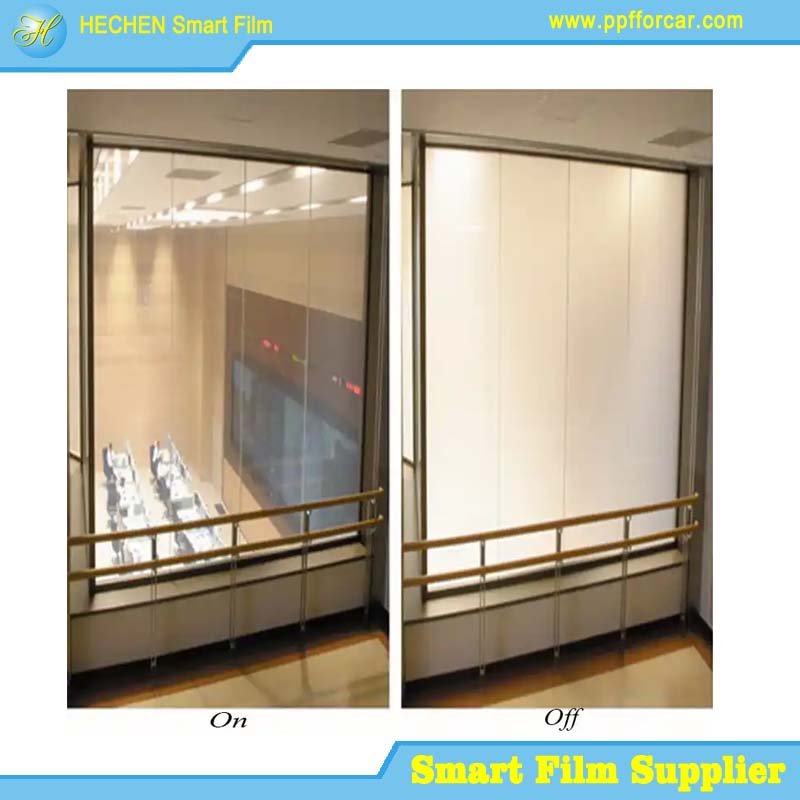
OFF State (Opaque/Frosted):
When no electrical voltage is applied, the liquid crystal molecules within each droplet are in a random, disordered orientation. Each droplet acts as a tiny lens with a different effective refractive index than the surrounding polymer matrix.
Refractive Index Mismatch: Due to the random orientation, the ordinary refractive index of the LC, which is isotropic perpendicular to the molecule's long axis, is what the light predominantly "sees." This n_o does not match the refractive index of the polymer.
Light Scattering: This index mismatch at the boundary of each droplet causes incident light to be scattered in multiple directions (Rayleigh or Mie scattering, depending on droplet size). With millions of such droplets, light is scattered diffusely, giving the film a translucent, milky-white appearance. It transmits light but not images, providing privacy.
ON State (Transparent/Clear):
When an alternating current (AC) voltage (typically 24VAC to 110VAC, at 50-1000Hz) is applied across the conductive ITO layers, an electric field is generated throughout the PDLC layer.
Molecular Re-alignment: Liquid crystal molecules possess dielectric anisotropy—they have a different dielectric constant along their long axis versus their short axis. In the presence of an electric field, the molecules (whose dipole moment is along the long axis) torque to align themselves parallel to the field lines.
Refractive Index Matching: When aligned, the light propagating perpendicular to the film (and the field) now "sees" the extraordinary refractive index (n_e) of the liquid crystal along the molecule's long axis. A critical design parameter is to formulate the polymer so that its refractive index (n_p) matches this extraordinary index.
Light Transmission: With the refractive indices matched, there is no significant scattering at the droplet boundaries. Light passes through the film with minimal deviation, rendering it transparent. Any residual haze is due to imperfections in matching, droplet size distribution, or film quality.
The switching is rapid, typically between 10-100 milliseconds. Removing the voltage, the liquid crystal molecules relax back to their random orientation due to elastic restoring forces within the droplet and at the polymer interface, returning the film to its opaque state.
Key Technical Parameters and Performance Metrics
Understanding PDLC film performance requires familiarity with several key metrics:
Haze: The percentage of transmitted light that is scattered. Low haze (<5%) in the ON state is desirable for clarity. High haze (>95%) in the OFF state is desirable for privacy.
Transmittance: The total percentage of incident light that passes through the film. This is measured in both ON (T_on, e.g., 75-80%) and OFF (T_off, e.g., 10-20%) states. The contrast ratio is T_on / T_off.
Driving Voltage (V_op): The AC voltage required to achieve full transparency. It depends on film thickness, LC properties, and droplet size.
Power Consumption: PDLC film is only a capacitor in circuit. It consumes power only during the switching transient to charge the capacitor. In a steady ON state, it draws minimal current (leakage current), making it energy-efficient. Typical power consumption is about 5-10 W/m² when ON.
Viewing Angle: The range of angles over which good transparency or opacity is maintained. Some films may exhibit slight grayscale or haze at oblique angles.
Response Time: The speed of switching from opaque to clear (rise time) and clear to opaque (decaytime). Decay time is usually slower as it relies on elastic relaxation.
Advanced Configurations and Control
Beyond simple on/off, PDLC technology can be adapted:
Dimmable Control: By applying a variable voltage (between 0V and V_op), partial alignment of LC molecules can be achieved. This creates intermediate states of translucency, allowing for continuous dimming from clear to opaque, though the linearity and stability of these states can be challenging.
Integration: PDLC films can be integrated with touch controls, motion sensors, voice assistants (via relays), and smart home systems (like Zigbee or Wi-Fi), enabling automated privacy, projection screen functionality, or dynamic room partitioning.
Projection Capability: In the OFF state, the scattering surface acts as an excellent rear-projection screen.
Applications: From Architecture to Mobility
The unique properties of PDLC smart film have led to diverse applications:
Architectural Glazing: Interior partitions, conference room walls, bathroom windows, and skylights in offices, hotels, and homes offer on-demand privacy without sacrificing light.
Retail & Advertising: Dynamic display windows, interactive product showcases, and promotional signage that can switch between transparent views and projected advertising.
Automotive & Transportation: Privacy partitions in limousines, sunroofs with adjustable opacity, and potential use in augmented reality head-up displays (HUDs).
Aviation & Marine: Cabin windows for passenger-controlled dimming, replacing mechanical shades.
Consumer Electronics: As a potential component in switchable lenses or advanced displays.
Advantages, Limitations, and Future Directions
Advantages:
Fast switching and good optical performance.
Low power consumption in steady state.
Flexibility (can be made in rolls for retrofit applications).
Easy integration into existing structures as a laminate.
Limitations:
Requires constant power to maintain transparency (unlike electrochromic glass which is bistable).
Typically requires AC voltage, needing a power supply/controller.
OFF state provides privacy but not blackout; some light is always transmitted.
Long-term UV stability and possible yellowing of polymers are considerations for exterior use.
Future Trends: Research focuses on developing bistable PDLC (maintaining state without power), improving UV and thermal stability for outdoor use, reducing driving voltage to USB levels (5VDC), and creating flexible, curved applications. Integration with solar cells and IoT for self-powered smart windows is also a promising avenue.
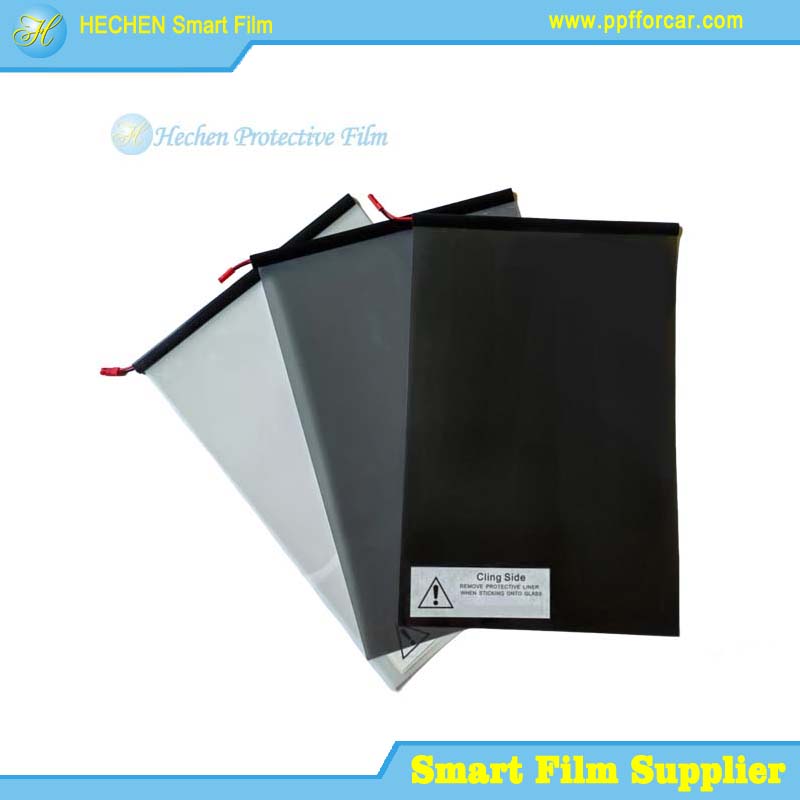
Conclusion
PDLC smart film is a elegant testament to applied materials science. By harnessing the unique electro-optical properties of liquid crystals and locking them into a polymer matrix, engineers have created a dynamically tunable optical filter. Its operation—centered on the electric field-induced matching of refractive indices—transforms a simple laminate into a window to the future of adaptive spaces. As the technology evolves toward lower power consumption, greater durability, and enhanced functionality, PDLC and its successor technologies are poised to redefine our interaction with light, privacy, and the very surfaces that make up our built environment. It is not just a film that switches; it is a fundamental reimagining of the boundary between the transparent and the opaque.
For more about how PDLC smart film works: the science of dynamic transparency, you can pay a visit to Hechen PDLC Smart Film Manufacturers for more info.