How does pdlc folie auto work on car windows?
TL;DR: This article explains the physics and engineering behind pdlc folie auto (polymer-dispersed liquid crystal film for automotive windows). It describes how liquid crystal microdroplets embedded in a polymer matrix switch between random orientation (opaque/private) and aligned orientation (transparent) under an applied alternating current (AC) voltage. You will learn about the multilayer film construction (ITO conductive layers, protective coatings, adhesive), the role of the AC driver in preventing ion migration, and how the film integrates with a car’s 12V electrical system. Special attention is given to automotive-specific challenges: curved glass, temperature extremes, UV exposure, and vibration. No brand or model names are used. By the end, you will understand the complete operating principle, from molecular behavior to real‑world installation on a car window.
1. Introduction: The basic question
When a driver sees pdlc folie auto for the first time – a film that changes from milky white to crystal clear at the push of a button – the natural question is: how does it actually work? Unlike traditional window tint that passively absorbs or reflects light, pdlc folie auto is an active electro‑optical device. It contains a thin layer of smart material that rearranges its internal structure when electricity is applied.
This article provides a detailed technical explanation suitable for engineers, automotive enthusiasts, and curious buyers. We will start with the molecular mechanism, then move to the film’s physical construction, the electrical driver, integration with car systems, and finally the practical challenges of making it work reliably on curved, vibrating, and heat‑stressed car windows.
2. The core principle: Polymer‑dispersed liquid crystals
At the heart of pdlc folie auto is a composite material called polymer‑dispersed liquid crystal (PDLC). This is not a single substance but a mixture of two components:
Liquid crystal (LC) molecules – elongated organic molecules that have an intermediate state between solid and liquid. They can rotate and align in response to an electric field.
Polymer matrix – a solid plastic network (e.g., epoxy, acrylate) that forms tiny cavities or “droplets” containing the liquid crystals.
During manufacturing, the LC and pre‑polymer are mixed, coated onto a conductive film, and then cured with UV light. As the polymer hardens, it phase‑separates, creating micron‑sized droplets of liquid crystal dispersed throughout the solid polymer. Each droplet is typically 1–10 µm in diameter.
Why droplets? Because in bulk, liquid crystals would flow. By confining them in polymer capsules, the film becomes a solid, flexible sheet that can be laminated onto glass.
2.1 Off‑state (opaque / privacy mode)
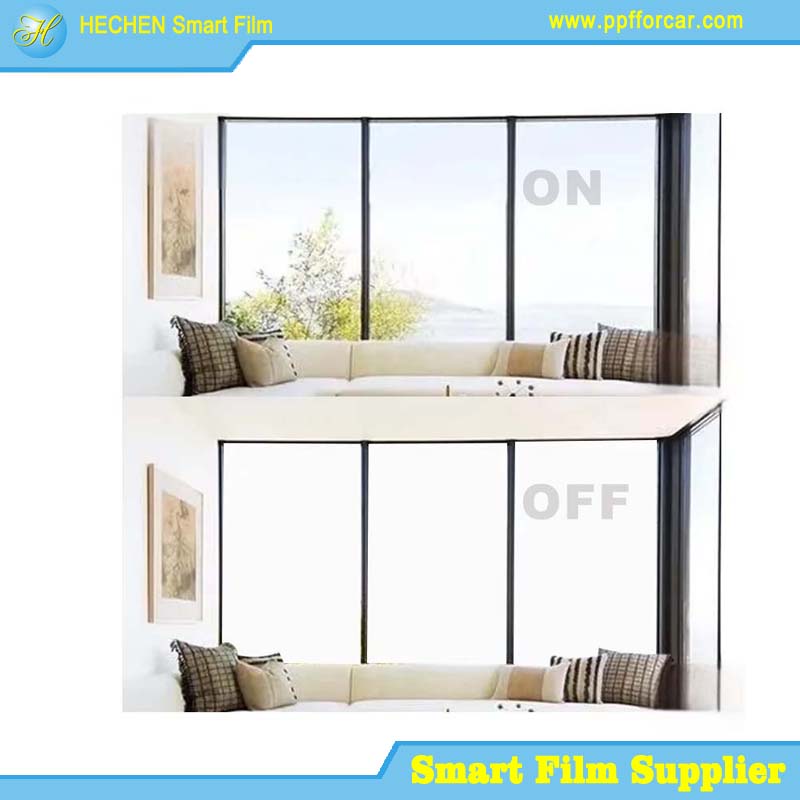
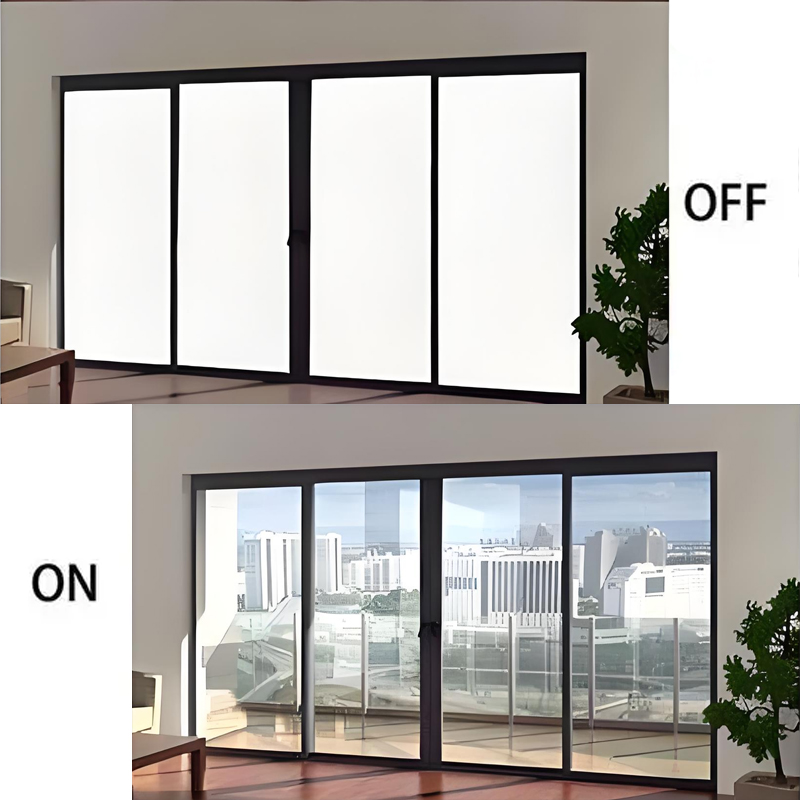
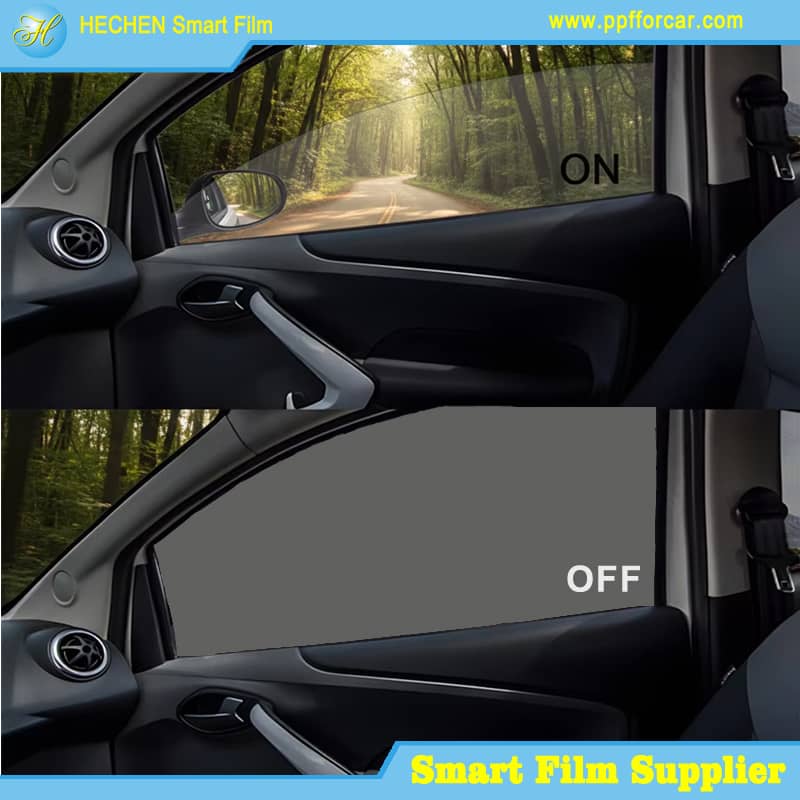
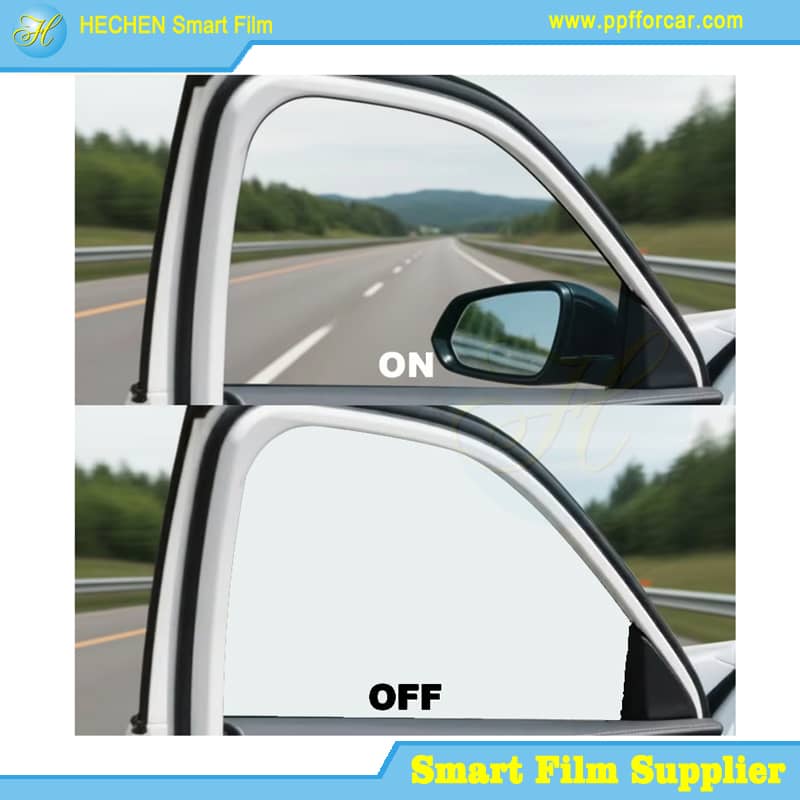
When no voltage is applied, the liquid crystal molecules inside each droplet have no preferred orientation. They point in random directions. Light entering the film encounters these randomly oriented droplets, each having a different refractive index relative to the surrounding polymer. This causes multiple scattering – the light is bounced around inside the film and emerges in all directions. To the human eye, the film appears milky white or translucent. This is the “private” state.
The degree of opacity is quantified as off‑state haze, typically 80–95%. Some light still passes through, but images are completely blurred.
2.2 On‑state (transparent / clear mode)
When an alternating current (AC) voltage is applied across the film’s thickness, an electric field forms inside each droplet. Liquid crystal molecules are dielectric anisotropic – they have a dipole moment and tend to align parallel to the electric field lines. As they align, the effective refractive index of the liquid crystal droplets becomes equal to that of the surrounding polymer matrix (index matching). Scattering drops dramatically, and light passes straight through. The film becomes transparent, typically with 70–80% visible light transmission and residual haze below 3%.
2.3 Why AC and not DC?
This is a critical detail. If you apply DC voltage, ions naturally present in the liquid crystal migrate to one side of the droplet, creating a permanent internal field. Over time, this “ion trapping” locks the molecules in a fixed orientation, and the film loses its ability to switch. An AC voltage (typically 30–60V, 50–1000 Hz) prevents ion migration by reversing the field thousands of times per second, keeping the ions oscillating in place. Therefore, every pdlc folie auto system includes an AC driver that converts the car’s 12V DC into a high‑frequency AC signal.
3. Physical construction of automotive PDLC film
A finished pdlc folie auto is not just the PDLC layer. It is a multilayer stack engineered for durability and optical quality. From outside (facing the car interior) to glass side:
| Layer | Material | Thickness | Function |
|---|---|---|---|
| Protective hard coat | Acrylic or silicone | 2–5 µm | Scratch resistance, cleaning durability |
| Outer PET substrate | Polyethylene terephthalate | 50–100 µm | Mechanical support, UV filtering |
| Transparent conductive electrode | Indium tin oxide (ITO) | 100–200 nm | Conducts voltage across the film |
| PDLC active layer | LC droplets in polymer | 10–30 µm | The switching core |
| Second conductive electrode | ITO (on another PET) | 100–200 nm | Completes the circuit |
| Inner PET substrate | Polyethylene terephthalate | 50–100 µm | Support |
| Pressure‑sensitive adhesive (PSA) | Optically clear adhesive (OCA) | 25–50 µm | Bonds film to car window |
| Release liner | Siliconized PET | Removed before install | Protects adhesive |
Total thickness: approximately 0.2–0.5 mm – thin enough to fit inside most window channels without interfering with power window operation.
Automotive‑specific modifications: Compared to architectural PDLC, automotive versions add UV stabilizers to the PET layers (prevents yellowing), use a higher‑tack adhesive to hold on curved glass, and include a moisture‑resistant edge seal (silicone or epoxy) to prevent humidity ingress. Without edge sealing, moisture wicks into the PDLC layer and causes electrolytic damage – the film becomes permanently cloudy.
4. The electrical driver: Converting 12V DC to AC
The car’s electrical system provides 12V DC (actually 11.5–14.5V when running). The PDLC film requires AC, typically 30–60V RMS at 50–400 Hz. The driver (also called controller or inverter) performs this conversion.
A typical driver contains:
DC‑DC boost converter – raises 12V to the required peak voltage (e.g., 40V AC has a peak of 56V).
H‑bridge inverter – switches the DC into a square wave or modified sine wave.
Microcontroller – manages soft start, switching timing, and optional remote control.
Protection circuits – overcurrent, reverse polarity, and short‑circuit protection.
The driver output is connected to the film via two thin wires (positive and negative on the AC side). On the input side, the driver connects to the car’s 12V system – usually tapped from a switched source (cigarette lighter, window switch, or fuse box) so that the film automatically returns to opaque when the ignition is off. This saves power (the film consumes 1–3 watts only in transparent mode) and provides privacy when parked.
Why not integrate the driver into the film? Heat. The driver generates some heat; PDLC is temperature‑sensitive. Keeping them separate allows the driver to be placed in a cooler location (e.g., inside the door panel) while the film remains on the glass.
5. Installation and electrical integration on a car window
To understand how pdlc folie auto works on a car window, we must follow the installation process:
Window preparation – The inner glass surface is cleaned to remove all dust, oil, and old tint. Even a single dust speck becomes a visible bubble under the transparent film.
Film cutting – The multilayer film is cut to match the exact shape of the window, accounting for the curvature. For curved windows, professional installers may pre‑form the film using a heat gun (gentle heating makes the PET more conformable).
Wet application – A slip solution (water + a few drops of soap) is sprayed on the glass and the adhesive side of the film. The film is positioned and then squeegeed to push out the liquid and air.
Wiring – Two flat or round wires exit the film (usually at a corner). These wires are routed through the door panel – often through existing grommets or by drilling a small hidden hole. They connect to the driver, which is hidden inside the door cavity or under the dashboard.
Edge sealing – After installation, a bead of silicone or UV‑cured sealant is applied around all four edges of the film. This prevents moisture from creeping in from the sides – the most common cause of premature failure.
Driver connection – The driver is connected to a 12V switched power source and a ground. A manual switch or remote receiver is installed within reach of the driver.
Once installed, the driver continuously monitors the switch position. When the user presses “clear”, the driver outputs AC; the film becomes transparent. When “privacy” is selected, the driver stops outputting voltage; the film returns to its naturally opaque state. Switching is nearly instantaneous – typically 0.1 to 2 seconds.
6. Automotive‑specific operating challenges
PDLC film behaves differently in a car than in a building. Several factors must be addressed for reliable operation.
6.1 Temperature extremes
Inside a parked car on a sunny day, window glass can reach 80–90°C (176–194°F). At these temperatures, the liquid crystal mixture may become isotropic (losing its ordered phase), and the polymer matrix can soften. Good automotive PDLC uses liquid crystals with a clearing point above 100°C. Below freezing (-30°C), the viscosity of the liquid crystals increases, slowing down switching – but the film still works, just slower.
Practical effect: Cheap (architectural) PDLC may fail above 60°C, becoming permanently hazy. Automotive‑grade film is formulated with high‑temperature stabilizers.
6.2 UV radiation
Car windows block some UV (especially the front windshield), but side windows typically block only ~50% of UVA. The remaining UV degrades polymers and liquid crystals, causing yellowing and loss of switching ability. Automotive PDLC includes UV absorbers in the PET substrate and sometimes in the polymer matrix. A good film rejects ≥99% of UV.
6.3 Vibration and shock
Car doors close with a thud, and windows vibrate during driving. The film’s adhesive must maintain bond under constant vibration. The conductive ITO layer is brittle; if the film is flexed too much, microcracks can form, creating non‑switching areas (visible as permanent white spots). High‑quality films use doped ITO or alternative conductive polymers (e.g., PEDOT:PSS) that are more flexible.
6.4 Curved glass conformity
Most car side windows are not flat – they have a cylindrical or even spherical curve. A flat PDLC film will bridge across the concave side, leaving air gaps. To solve this:
Pre‑curving – Some manufacturers heat‑form the film to match a specific glass curvature.
Conformable film – Thinner substrates (0.125 mm instead of 0.25 mm) and softer adhesives allow the film to bend.
Professional heat‑forming – During installation, a heat gun is used to gently shrink and shape the film to the glass curve.
Without proper conformity, the film will bubble at the edges and eventually peel.
6.5 Moisture ingress
Car windows get wet – rain, car washes, condensation. The PDLC layer is hydrophilic; absorbed water causes electrolysis when voltage is applied, irreversibly clouding the film. The edge seal is therefore critical. A proper seal is a continuous bead of flexible, waterproof material (silicone, polyurethane, or UV epoxy) applied after installation and allowed to cure.
7. Switching behavior: What the user experiences
From the driver’s perspective, operation is simple:
Press button → transparent – The film clears almost instantly. Some drivers implement a “soft start” where voltage ramps up over 0.5 seconds to reduce visible flicker.
Press again → opaque – Power is cut. The film returns to its natural scattered state. This is not instantaneous – the liquid crystals relax over ~0.1–1 second, during which the film may show swirling patterns briefly.
What about intermediate states? If you apply a lower voltage, the liquid crystals partially align, giving a variable level of haze. However, most automotive drivers are binary (on/off) because maintaining a precise intermediate voltage is difficult due to temperature drift. Some high‑end systems use pulse‑width modulation (PWM) to achieve stepless dimming, but this is rare.
Off‑state power consumption: Zero. The film only consumes power when transparent. For a typical installation (four side windows, each ~0.2 m², total 0.8 m²), power consumption in clear mode is about 1.5–2.5 watts – negligible compared to headlights (50W+) or infotainment systems.
8. Limitations and failure modes (to set realistic expectations)
Understanding how PDLC works also means knowing its limitations:
Not blackout opaque – Even in off‑state, the film is milky white, not black. Light still passes through (15–30% transmission). For complete blackout, you would need a secondary blackout shade or a dark backing layer.
Residual haze in clear state – Even high‑quality films have 2–3% haze. If you look through two layers (e.g., driver side plus rear side), haze adds up.
No heat rejection without IR blockers – PDLC alone blocks only ~30–50% of infrared. For summer comfort, combine with a clear ceramic IR‑blocking film.
Lifespan – After 5–8 years, the liquid crystals may degrade, causing slower switching and increased haze. Edge seal failure leads to permanent clouding earlier.
Cannot be repaired – If the film is scratched, delaminated, or electrically shorted, the only fix is replacement.
9. Summary of the operating principle
To answer the title question concisely:
Pdlc folie auto works by embedding liquid crystal droplets in a polymer film between two transparent conductive layers. With no voltage, random droplet orientation scatters light (opaque). Applying an AC voltage aligns the crystals to match the polymer’s refractive index, making the film transparent. A dedicated AC driver converts the car’s 12V DC to the required waveform. The film is laminated to the inner glass surface, edge‑sealed against moisture, and wired to a user switch.
The magic is not magic – it is controlled molecular alignment at the micron scale, enabled by decades of liquid crystal display research adapted to flexible films.
Key Takeaways
Core mechanism: PDLC switches between opaque and transparent by electrically aligning or randomly orienting liquid crystal microdroplets inside a polymer matrix.
AC voltage is mandatory – DC causes ion migration and permanent failure. An AC driver converts the car’s 12V DC to 30–60V AC at 50–400 Hz.
Multilayer construction includes ITO conductive electrodes, PET substrates, protective hard coat, and pressure‑sensitive adhesive – total thickness ~0.2–0.5 mm.
Off‑state (no power) = milky white / private (80–95% haze). On‑state (AC power) = transparent (70–80% transmission, <3% haze).
Automotive‑grade film differs from architectural grade by having wider temperature tolerance (-30°C to +85°C), UV stabilizers, high‑tack adhesive for curved glass, and mandatory edge sealing against moisture.
Installation requires dust‑free glass, precise cutting, wet application, wiring through door panels, and a waterproof edge seal – professional installation is strongly recommended.
Power consumption is very low (1–3 watts when transparent, zero when opaque) – safe for car battery.
Limitations: Not blackout (milky white), residual haze in clear mode, limited IR rejection (combine with ceramic film for heat), lifespan 5–8 years.
Failure modes include moisture ingress (permanent clouding), UV yellowing, ITO cracking on curved glass, and driver failure (use only AC driver).
Understanding how it works helps you choose wisely – look for automotive‑rated temperature range, edge sealing, AC driver, and UV protection.
For more about How does pdlc folie auto work on car windows? Everything you need to know, you can pay a visit to https://www.ppfforcar.com/product/PDLC-Smart-Film/ for more info.