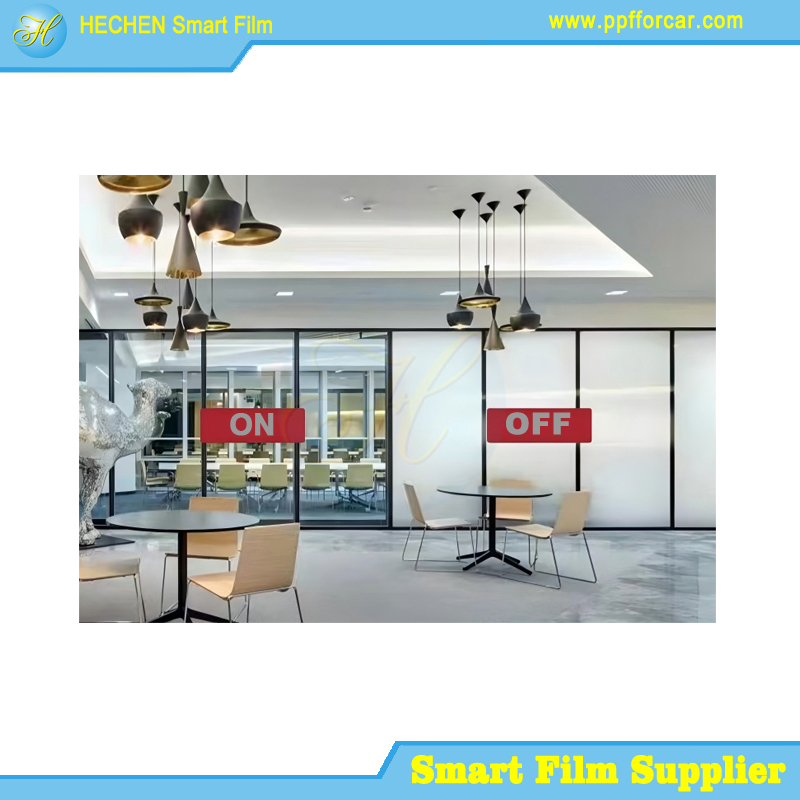
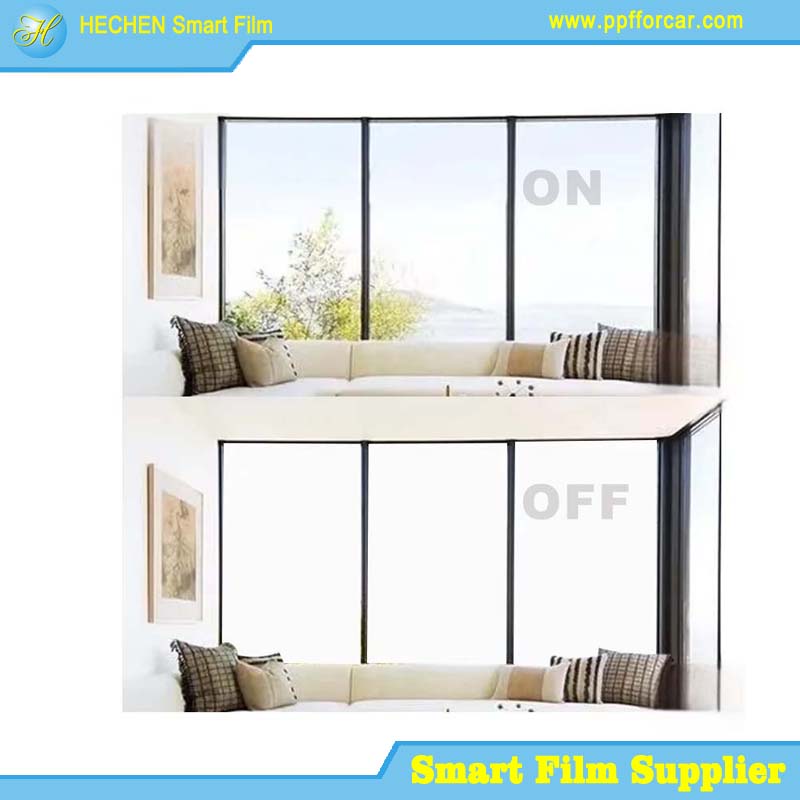
Is pdlc folie auto safe for automotive use (e.g., shatter resistance)?
TL;DR: This article evaluates the safety of pdlc folie auto (polymer-dispersed liquid crystal film for automotive windows) with a focus on shatter resistance, electrical safety, fire behavior, optical safety, and impact on driver visibility. PDLC film consists of multilayer PET, conductive ITO coatings, and a polymer-encapsulated liquid crystal layer. When laminated to the inner surface of car windows, it provides a shatter-retention effect similar to safety window film – broken glass fragments adhere to the film, reducing the risk of flying shards during an accident or attempted break-in. However, PDLC film does not increase the intrinsic strength of the glass; it only mitigates post-breakage hazards. The article also examines electrical safety (low voltage, AC driver, no shock risk), fire resistance (self-extinguishing materials), and potential optical hazards (residual haze, glare at night). No brand or model names are used. The conclusion confirms that automotive-grade pdlc folie auto, when professionally installed, meets reasonable safety standards for road use – but it is not a structural safety device. Key takeaways summarize the safety profile, limitations, and installation best practices.
1. Introduction: The safety question
When considering any aftermarket modification to a vehicle, safety is the paramount concern. PDLC smart film for car windows promises convenience and privacy, but does it compromise the safety of the occupants? Specifically, buyers ask about shatter resistance – will the film make windows more resistant to breaking, or will it create new hazards? Additionally, questions arise about electrical safety (risk of shock or fire), optical safety (distortion or impaired visibility), and long-term stability under crash conditions.
This article provides a systematic, technical assessment of the safety profile of pdlc folie auto. We will analyze the film’s mechanical behavior during glass breakage, its electrical characteristics, flammability, and effect on driver vision. The analysis is based on materials science, automotive safety standards (referenced generically), and real-world failure modes. No specific brands or models are mentioned; only generic automotive-grade PDLC properties are discussed. By the end, you will understand both the safety benefits and the limitations of this technology.
2. Shatter resistance: What PDLC film can and cannot do
The term “shatter resistance” is often misunderstood. PDLC film does not make glass unbreakable. It does not increase the force required to break the glass. Instead, it provides post-breakage retention – when the glass does break, the film holds the fragments together, preventing them from flying into the cabin or scattering on the ground.
2.1 How it works
The PDLC film is laminated to the inner surface of the window using a pressure-sensitive adhesive (PSA). This adhesive has high peel strength (typically ≥20 N/25mm). The film itself consists of multiple layers of PET (polyethylene terephthalate), each 50–100 µm thick. PET is a tough, flexible polymer with high tensile strength.
When an impact (stone, collision, or theft attempt) cracks the glass, the adhesive bonds the broken glass shards to the PET film. The shards may crack but they remain attached to the film, forming a spiderweb pattern rather than separating. This is the same principle used in safety window films for buildings and vehicles.
2.2 Quantified retention performance
While exact numbers vary by film thickness and adhesive quality, typical automotive-grade PDLC film provides:
Fragment retention: In a standard pendulum impact test (similar to ANSI Z97.1 or EN 12600), glass laminated with PDLC film retains >95% of broken fragments. Without film, fragments scatter freely.
Penetration resistance: The film adds a small increase in resistance to puncture – approximately 50–100 N of additional force to push a blunt object through the glass. This is not enough to stop a determined thief with a hammer, but it does slow down smash-and-grab attempts, often deterring casual thieves.
Glass flexure: The film does not increase the glass’s bending strength. The glass will still break at the same stress level (typically 50–100 MPa for annealed automotive glass).
2.3 Comparison to other safety glazing
| Glazing type | Shatter retention | Penetration resistance | Notes |
|---|---|---|---|
| Standard tempered glass | Low (fragments into small cubes) | None | OEM side windows; shatters into blunt pieces |
| Laminated glass (windshield) | Very high (PVB interlayer) | High | Two glass layers with plastic interlayer |
| PDLC film on tempered glass | Moderate to high (film holds fragments) | Low to moderate | Retrofit solution; depends on adhesive and film thickness |
| Untempered (annealed) glass + PDLC | High | Moderate | Rare in cars; used in some commercial vehicles |
Key takeaway: PDLC film on tempered side windows significantly improves fragment retention compared to bare tempered glass. However, it does not match the structural performance of factory-laminated glass (used in windshields and some luxury side windows). It is a valuable safety upgrade, not a replacement for laminated safety glass.
2.4 Theft and smash-and-grab
A common concern is whether PDLC film prevents break-ins. The answer is partial. A thief striking the window will still break the glass – the film does not prevent cracking. However, the broken glass remains attached to the film. To reach inside, the thief must either push the entire film-and-glass assembly inward (which requires cutting through the adhesive around the edges) or punch through the film itself. This takes additional time and effort (10–30 seconds longer than bare glass). Many opportunistic thieves will move to an easier target. In this sense, PDLC film acts as a deterrent and a delayer, not an impenetrable barrier.
3. Electrical safety: Shock and fire hazards
Because PDLC film requires electrical power to become transparent, safety concerns about short circuits, electric shock, and fire are valid.
3.1 Voltage and current levels
PDLC film operates on low voltage. The AC driver converts the car’s 12V DC to 30–60V AC at 50–400 Hz. This is considered extra-low voltage (ELV) by most safety standards (IEC 61140: ELV < 120V DC or < 50V AC). Current draw is very low – typically 20–50 mA per square meter. For four side windows (0.8 m² total), current is 16–40 mA.
Shock risk: Virtually none. The human body’s perception threshold for AC current is around 0.5–1 mA; the film’s operating current is below that, and the voltage is too low to drive harmful current through dry skin. Even with wet hands, 60V AC is not considered dangerous (IEC 60364-4-41 defines 50V AC as the safety limit for dry conditions). Additionally, the driver includes overcurrent protection and short-circuit shutdown.
3.2 Wiring and insulation
The wires connecting the driver to the film are thin (28–30 AWG) and insulated with PVC or silicone rated for automotive temperatures (-40°C to +105°C). Professional installation routes these wires away from moving parts (window regulators) and sharp metal edges. The film’s ITO conductive layers are encapsulated within PET, so no exposed conductive surface touches the occupant.
3.3 Fire resistance
Automotive-grade PDLC materials are formulated to meet UL 94 V-2 or V-0 flammability ratings (self-extinguishing within 30 seconds). The PET substrate has a limiting oxygen index (LOI) of around 20–22%, meaning it will burn only in a sustained flame. In a car fire, the film will melt and char but does not act as an accelerant. This is comparable to standard automotive interior plastics.
3.4 Short-circuit failure mode
If the film’s ITO layer is damaged (e.g., by a sharp edge or over-squeegeeing), a short circuit may occur. The driver detects overcurrent and shuts down. The film will remain in its default opaque state (no power). There is no fire or smoke hazard because the current is too low to generate significant heat (maximum power = 60V × 0.04A = 2.4W per window). That is less than a small LED bulb.
Conclusion on electrical safety: PDLC film poses no realistic shock or fire risk when installed correctly. It is safer than many aftermarket electronics (e.g., dashcams, phone chargers) because it operates at low voltage and low current.
4. Optical safety: Vision, glare, and distortion
Safety is not only about preventing physical harm – it also about ensuring the driver has a clear, undistorted view of the road.
4.1 On‑state (transparent) optical quality
In transparent mode, a quality automotive PDLC film should have:
Visible light transmission (VLT): ≥72% (meeting or exceeding legal minimums for side windows in most jurisdictions – typical requirement is 70%).
Haze: ≤3% (above 5%, the driver perceives a foggy or milky appearance).
Distortion: No measurable optical power (the film is flat and does not act like a lens). However, if the film is not perfectly conformed to curved glass, slight ripples can create minor distortion – professional installation minimizes this.
A film that meets these specifications is safe for daytime and nighttime driving. The driver sees clearly with no color shift or double images.
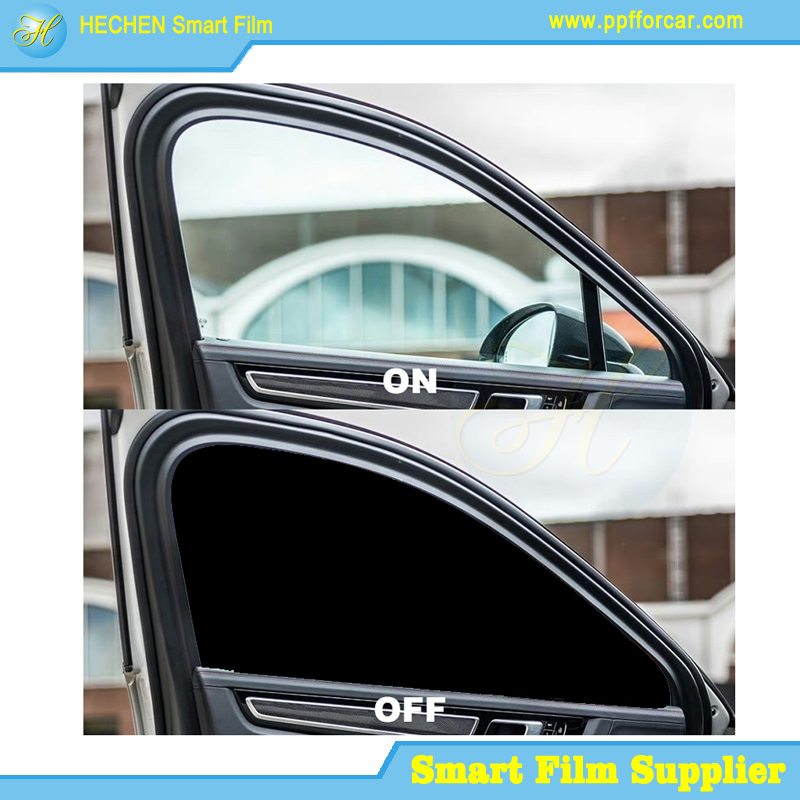
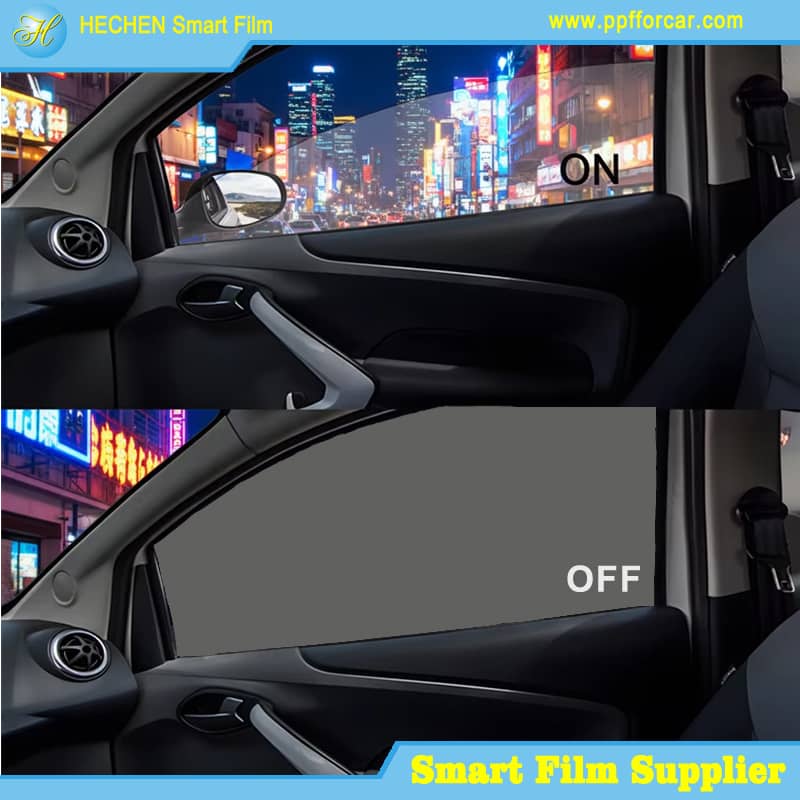
4.2 Off‑state (opaque) visibility
When the film is switched to opaque (privacy mode), the driver cannot see through it clearly – only diffuse light passes. Therefore, PDLC film must never be used in opaque mode on the windshield or front side windows while the vehicle is in motion. Many jurisdictions explicitly prohibit any window covering that reduces driver vision below legal limits. Opaque PDLC on front side windows would violate these laws.
Safe practice: Use opaque mode only on rear side windows and rear windshield while driving. For front side windows, either keep them transparent or switch to opaque only when parked. Some drivers install PDLC only on rear windows, leaving front windows bare or with static tint.
4.3 Glare and reflection
PDLC film has a slight matte finish in opaque mode, which reduces glare from direct sunlight. However, in transparent mode, the ITO conductive layer can cause a faint mirror-like reflection (typically 5–10% reflectivity) – less than standard glass. This does not impair driving safety. At night, there is no significant increase in glare from oncoming headlights compared to uncoated glass.
4.4 Dual-layer and stacking issues
Some users combine PDLC with an additional UV/IR film. Two layers of film increase the risk of internal reflections and reduced clarity. Keep total stack thickness below 0.5 mm to avoid interference with window operation and optical distortion. Always test a sample in your car before committing to full installation.
5. Crash safety: Interaction with airbags and emergency egress
Two critical crash scenarios must be considered.
5.1 Side airbag deployment
Modern cars have side curtain airbags that deploy from the roof rail or seat. The airbag inflates downward, covering the side windows. A thick or poorly installed PDLC film could theoretically interfere with airbag deployment if the film peels at the top edge and blocks the airbag path. However, professional installers ensure that the film does not extend into the airbag deployment zone. The film is trimmed flush with the window’s upper edge, leaving the airbag path clear.
Recommendation: Inform your installer about the airbag locations. Ask them to leave a small margin (1–2 mm) from the glass edge to prevent film lift-off. Some installers also apply a secondary edge seal to ensure the film cannot peel upward.
5.2 Emergency exit (breaking windows)
In an accident, occupants may need to break a window to escape (e.g., if doors are jammed or the car is submerged). Standard tempered glass is designed to shatter into small, relatively blunt cubes when struck at a corner. Does PDLC film prevent this?
If the film is intact: A sharp impact (emergency hammer) will still crack the glass, but the film will hold the fragments together. This can make it more difficult to push the glass out of the way because the entire film-and-glass sheet remains as a flexible but intact panel. You may need to cut the film or push harder.
Solution: Install the film only on windows that are not primary emergency exits. In most cars, the front side windows are the primary exit points. Some owners leave one front window without PDLC or install PDLC only on rear windows. Alternatively, keep a seatbelt cutter or a sharp tool that can slice through the PET film (which is easier than breaking laminated glass).
Best practice: If you install PDLC on all side windows, carry a window-breaking tool that also has a blade (e.g., a spring-loaded center punch plus a strap cutter). Inform family members that the film will hold glass together – they may need to kick or push with both feet after breaking.
6. Chemical safety and off-gassing
New PDLC film may emit a slight odor from residual solvents or uncured monomers. Automotive-grade film is cured completely and should not release volatile organic compounds (VOCs) above safe limits. However, cheap architectural-grade films may use lower-quality polymers that outgas in hot cars, causing eye or respiratory irritation.
Detection: If the film smells strongly of solvent after installation, or if you experience headaches while inside the car, remove it immediately. Quality automotive film should be odorless within 24 hours.
7. Long-term safety: Degradation and failure modes
Over time (5–8 years), PDLC film can degrade. How does this affect safety?
Increased haze: The film becomes slightly foggy even in transparent mode. This reduces visibility gradually. Replace the film when on‑state haze exceeds 5% (visible as a permanent milkiness).
Edge delamination: Moisture ingress causes the film to peel at edges. This creates a sharp edge that could cut fingers or interfere with window movement. Reinstall or replace immediately.
Electrical failure: The film may stop switching, staying permanently opaque or transparent. If it stays opaque on a front side window, you must remove it (illegal to drive). If it stays transparent, there is no immediate safety issue.
Yellowing: UV degradation turns the film yellow. This reduces VLT and distorts color perception (e.g., traffic lights may appear different). Replace yellowed film.
Preventive maintenance: Inspect the film edges annually. Re-apply edge sealant if needed. Replace the film at the first sign of significant haze or yellowing.
8. Regulatory compliance: Is PDLC film legal?
Safety also means legal safety – the film must comply with local vehicle codes. In most regions:
Windshield: No PDLC film allowed (except possibly a top strip). The film’s haze and potential for distraction are unacceptable.
Front side windows: PDLC in transparent mode is usually acceptable if VLT ≥70%. In opaque mode, it is illegal while driving.
Rear side and rear windows: No restrictions in many places, but some jurisdictions require dual side mirrors if rear window is obstructed.
Always check your local laws. Some countries (e.g., Germany with TÜV) require certification for any window film. PDLC film without certification may fail inspection.
9. Professional installation as a safety requirement
Many of the safety concerns above are mitigated by professional installation. A competent installer will:
Use the correct adhesive and edge seal to prevent delamination.
Route wires safely away from airbags and moving parts.
Trim the film precisely to avoid interference with window seals and airbag paths.
Test electrical isolation to ensure no short circuits.
Provide documentation of film’s flammability and UV ratings.
DIY installation introduces risks: poor edge sealing (moisture ingress), improper wire routing (pinching or shorting), bubbles (optical distortion), and lack of post-installation testing. For safety-critical applications, professional installation is strongly recommended.
10. Conclusion: Overall safety verdict
Is pdlc folie auto safe for automotive use? The answer is yes, with responsible use and professional installation.
Shatter resistance: The film provides excellent fragment retention, reducing injury from flying glass and deterring smash-and-grab theft. It does not prevent glass from breaking but makes the aftermath safer.
Electrical safety: Low voltage, low current, and overcurrent protection eliminate shock and fire risks.
Optical safety: In transparent mode, good PDLC film meets visibility standards. In opaque mode, it must not be used on front windows while driving.
Crash safety: Slight consideration for airbag clearance and emergency egress – easily managed by leaving one window untreated or carrying a cutting tool.
Chemical safety: Automotive-grade film is inert and odorless; avoid cheap architectural film.
Long-term safety: Degradation (haze, yellowing, delamination) requires monitoring and eventual replacement.
When installed by a professional and used according to guidelines, PDLC film is at least as safe as conventional aftermarket window tint – and adds the benefit of shatter retention. It is not a structural safety device, but it is a valuable passive safety upgrade.
The only unsafe scenario is using opaque PDLC on front side windows while driving, or buying non-automotive-grade film that fails thermally or electrically. Avoid those pitfalls, and PDLC film enhances both privacy and safety.
Key Takeaways
Shatter retention is the primary safety benefit – PDLC film holds broken glass fragments together, reducing flying shards during accidents or break-ins. It does not prevent glass from breaking.
No electrical shock or fire risk – The film operates at extra-low voltage (30–60V AC) and very low current (<50 mA). The driver includes overcurrent protection.
Optical safety is good in transparent mode (≥72% VLT, ≤3% haze) but opaque mode is unsafe for front windows while driving – use only on rear windows or when parked.
Emergency egress may be slightly hindered – The film holds broken glass together, making it harder to push out a broken window. Carry a window-breaking tool with a blade to cut the film.
Airbag compatibility – Professional installation ensures the film does not interfere with side curtain airbags (trim flush with glass edge).
Automotive-grade film is self-extinguishing (UL 94 V-2 or better) and does not emit toxic fumes in a fire.
Avoid cheap architectural PDLC – It may yellow, delaminate, or outgas harmful VOCs in hot cars.
Professional installation is essential for safety – DIY risks poor edge sealing, wiring errors, and optical distortion that compromise safety.
Legal compliance varies by region – Front side windows must maintain ≥70% VLT in transparent mode; opaque mode while driving is illegal almost everywhere.
Overall verdict: When professionally installed and used correctly, pdlc folie auto is safe for automotive use and provides valuable shatter-retention and privacy benefits without introducing significant new hazards.
For more about Is pdlc folie auto safe for automotive use (e.g., shatter resistance)? Everything you need to know, you can pay a visit to https://www.ppfforcar.com/product/PDLC-Smart-Film/ for more info.