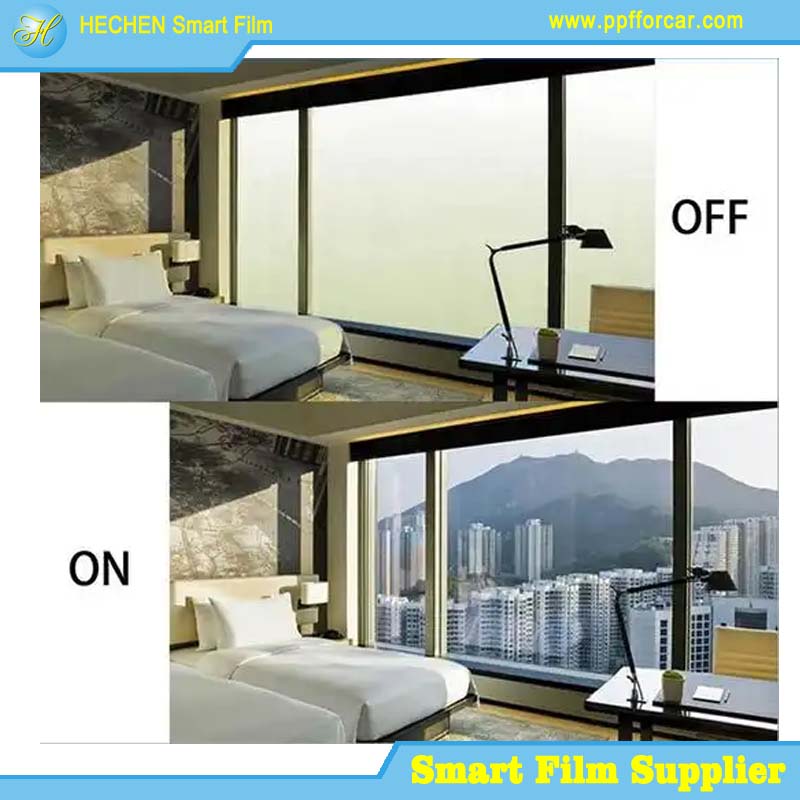
PDLC smart film, or Polymer Dispersed Liquid Crystal smart film, is a thin, flexible, electrically switchable glazing technology that transforms ordinary glass from a frosted, privacy-providing opaque state to a crystal-clear transparent state in milliseconds—literally in seconds—simply by applying low-voltage alternating current. This remarkable material has revolutionized architectural and interior design by offering instant, on-demand privacy control without mechanical shades, curtains, or heavy glass replacements. It is widely adopted in residential bathrooms and bedrooms, corporate conference rooms, healthcare patient suites, retail display windows, and hospitality spaces where flexibility between openness and seclusion is essential.Unlike static frosted glass or traditional blinds, PDLC smart film maintains high light transmission even when opaque, diffusing daylight softly while completely obscuring shapes and details. When powered, it becomes optically clear with minimal haze, preserving views and natural illumination. The entire switch is silent, instantaneous, and reversible, consuming only a fraction of the energy of a small LED bulb. This article provides a comprehensive technical explanation of PDLC smart film: its underlying physics, molecular mechanism, layered construction, electrical requirements, optical performance metrics, manufacturing principles, real-world applications, installation considerations, maintenance, durability, limitations, and future development directions. The focus remains purely on engineering fundamentals and performance data common across industry implementations.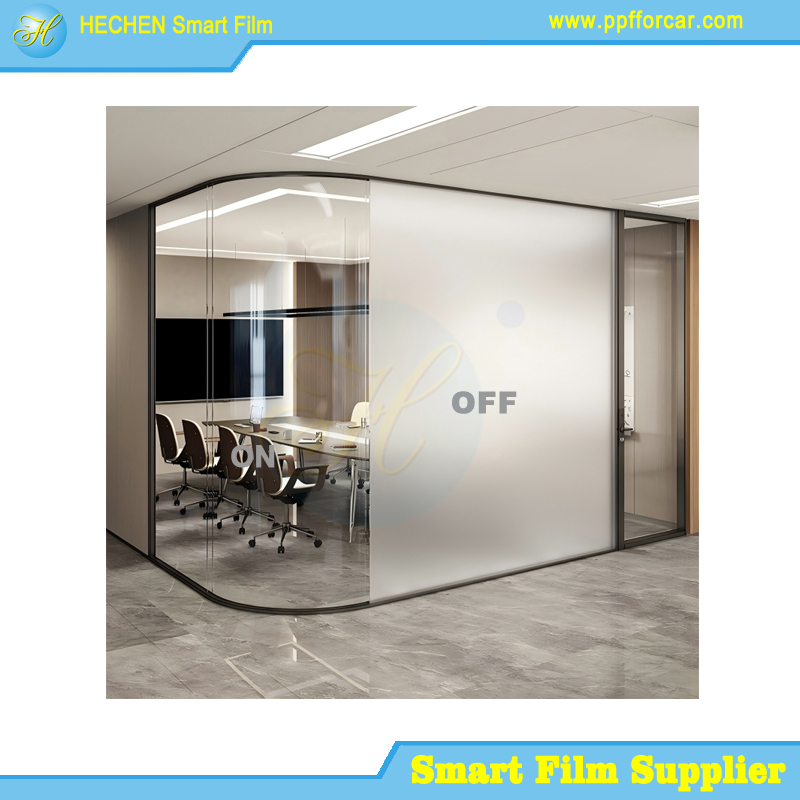
The Core Physics: Liquid Crystals in a Polymer MatrixThe magic of PDLC smart film originates from the unique electro-optical properties of liquid crystals dispersed within a polymer matrix. Liquid crystals are a state of matter that exhibits both the fluidity of liquids and the ordered molecular alignment of solid crystals. In PDLC, microscopic droplets (typically 1–10 micrometers in diameter) of nematic liquid crystals are embedded throughout a continuous polymer binder, forming a thin film approximately 0.1–0.5 mm thick.In the absence of an electric field (the default “off” or opaque state), the liquid crystal molecules inside each droplet are randomly oriented. The refractive index of the liquid crystal iffers significantly from that of the surrounding polymer. This refractive index mismatch causes incoming visible light to scatter at every droplet interface according to principles similar to Mie scattering for particles comparable in size to the wavelength of light (400–700 nm). The result is strong forward and backward scattering, producing a milky-white appearance with high haze (typically 70–80 %) and low direct visible-light transmittance (often 5–20 %). Shapes and images behind the film are completely obscured, delivering excellent privacy while still allowing diffuse daylight to enter the space—reducing glare and the need for artificial lighting.When an alternating current (AC) electric field is applied across the film, the liquid crystal molecules rapidly reorient along the field lines. Nematic liquid crystals possess positive dielectric anisotropy, meaning their long molecular axes align parallel to the applied electric field. Once aligned, the extraordinary refractive index of the liquid crystals matches the polymer matrix. Light rays now pass straight through with minimal refraction or scattering. Visible-light transmittance rises sharply to 80–85 % or higher, while haze drops below 5 % in well-engineered films. The transition is governed by the torque balance between the electric field force and the elastic restoring forces within the droplets, resulting in response times typically under 100 milliseconds for turn-on and slightly longer (200–500 ms) for turn-off. This speed is orders of magnitude faster than mechanical shading systems and occurs uniformly across the entire surface when voltage is properly distributed.The process is fully reversible and repeatable for millions of cycles. Importantly, the film requires continuous AC voltage to remain transparent; removing power instantly returns it to the opaque privacy state. Direct current (DC) must never be used, as it causes ion migration and permanent electrochemical degradation of the liquid crystal alignment.Detailed Construction of PDLC Smart FilmPDLC smart film is a multi-layer composite engineered for both optical performance and practical application. The central functional layer is the PDLC core, where the liquid crystal droplets are dispersed in the polymer matrix. This core is sandwiched between two transparent conductive coatings, most commonly indium tin oxide (ITO) deposited on thin polyethylene terephthalate (PET) substrates. The ITO layers serve as electrodes, delivering the uniform electric field across the PDLC.One side of the film features a pressure-sensitive adhesive (PSA) layer protected by a release liner, allowing direct bonding to existing glass surfaces. The opposite side is usually protected by a hard-coat or scratch-resistant layer. Pre-attached copper bus bars—thin conductive strips—are laminated along one or two edges to ensure even voltage distribution and prevent hot spots or dimming over large areas. Total film thickness is typically 0.3–0.5 mm, adding negligible weight or dimensional change to the host glass.Optional enhancements include UV-blocking additives (achieving >98 % UV rejection), infrared-reflective coatings for minor solar control, or anti-reflective treatments to further reduce haze in the clear state. The entire structure is flexible enough to be shipped in rolls yet robust enough for vertical or curved applications when properly installed. Edge sealing with neutral-cure silicone is mandatory after application to prevent moisture ingress, which would otherwise cause permanent clouding by disrupting the liquid crystal droplets.Electrical Requirements and Power CharacteristicsPDLC smart film operates exclusively on low-voltage AC power, typically 48–60 V at 50/60 Hz. The exact voltage is calibrated during manufacturing to match the dielectric properties of the specific liquid crystal mixture and droplet size distribution. Power consumption is remarkably low—approximately 4–6 W per square meter when in the transparent (powered) state—comparable to the standby draw of a modern LED night-light. In the opaque state, consumption drops to zero.A step-down transformer converts standard household voltage (110–220 V AC) to the required film voltage. Transformer sizing is linear with area: a 10 m² installation requires roughly 40–60 W capacity. Wiring uses standard 18–22 AWG stranded copper, kept under 30 m total run length to minimize voltage drop. Because the film behaves as a capacitive load rather than a resistive heater, there is no significant heat generation during normal operation. Bus bars distribute current evenly; poor contact or undersized transformers can cause visible non-uniformity or delayed switching at the far edges.Integration with building automation is straightforward: relays, timers, motion sensors, or smart-home protocols can control the film via low-voltage switches. Safety is inherent—the operating voltage is classified as extra-low voltage (ELV), eliminating shock risk when properly insulated.Optical Performance MetricsKey measurable parameters define PDLC smart film performance. In the transparent state:Visible-light transmittance reaches 80–85 % or higher.
Haze is typically <5 %, ensuring high clarity for viewing.
Color rendering index (CRI) remains neutral, with minimal tint shift.
In the opaque state:Direct transmittance falls to 5–20 %, while total transmittance (including diffuse light) stays around 60–70 %.
Haze exceeds 70 %, producing effective privacy (zero visibility of silhouettes at distances greater than 1 m).
The film blocks >98 % of ultraviolet radiation in both states, protecting furnishings and occupants from fading and skin damage. Solar heat gain coefficient (SHGC) is similar to clear glass because the PDLC layer itself does not selectively absorb or reflect infrared; pairing with low-E glass or secondary glazing can enhance thermal performance if needed. Angular dependence is minimal up to 60° incidence, making the film suitable for sloped or curved surfaces.Manufacturing PrinciplesProduction begins with the preparation of a homogeneous mixture of liquid crystals and polymer precursors. This emulsion is coated onto an ITO-PET substrate under clean-room conditions, then cured via UV light or thermal polymerization to lock the droplets in place. A second ITO-PET sheet is laminated on top, followed by adhesive coating and bus-bar attachment. Precision control of droplet size distribution is critical: too large and scattering efficiency drops; too small and switching voltage rises. Autoclave or vacuum pressing ensures bubble-free interfaces. Finished rolls are inspected optically and electrically before slitting to customer dimensions.Practical Applications and BenefitsPDLC smart film excels wherever dynamic privacy is valued. In residential settings, it converts bathroom windows or bedroom partitions into privacy screens that still admit soft natural light. Corporate environments use it for meeting-room walls that switch from collaborative open-plan visibility to confidential closed-door mode at the touch of a button. Hospitals deploy it on patient-room windows and ICU dividers for dignity and infection-control compliance. Retail and hospitality applications include storefronts that reveal merchandise by day and protect displays by night, or hotel suites offering guests instant view control.Beyond privacy, the technology contributes to energy management by maximizing daylight use when clear and reducing glare when opaque, potentially lowering lighting and HVAC loads. Its retrofit capability—applying directly over existing glass—minimizes disruption and waste compared with full glass replacement.Installation Overview and Best PracticesSuccessful deployment begins with meticulous glass cleaning using 99 % isopropyl alcohol to remove all contaminants. The film is cut 1–2 mm undersized, applied using a dry method with gradual release-liner peeling and roller consolidation to eliminate air pockets. Immediate neutral-cure silicone edge sealing prevents moisture damage. Electrical connections are made to the bus bars, and the system is tested for uniform switching before commissioning. Professional installers or experienced DIY users can complete small-to-medium projects in a single day.Maintenance, Durability, and LifespanDaily maintenance is minimal: power the film off and clean with a soft microfiber cloth and mild solvents. Annual inspection of edge seals is recommended. Under normal indoor conditions (15–40 °C, <70 % RH), service life reaches 5–10 years with millions of switching cycles. Daily off-cycling (at least 4 hours in the opaque state) extends liquid crystal longevity by allowing molecular relaxation. The film is not intended for permanent exterior exposure without protective glazing.Limitations and Technical ConsiderationsPDLC smart film is primarily an interior or protected application. It does not provide blackout (some diffuse light always passes) or significant solar shading. Large installations require careful transformer zoning to avoid voltage drop. In very high-humidity environments or areas subject to frequent mechanical abrasion, additional protective measures are advisable. Cost per square meter, while lower than laminated alternatives, remains higher than static glass or basic films, making return-on-investment calculations important for large-scale projects.Emerging DevelopmentsOngoing research focuses on lowering switching voltages, improving clear-state transmittance beyond 90 %, reducing haze further, and incorporating nanotechnology for self-cleaning or energy-harvesting properties. Integration with electrochromic layers or photochromic additives may eventually produce hybrid films offering both binary switching and variable tinting. Advances in roll-to-roll manufacturing continue to drive down costs, broadening adoption in mass-market architecture.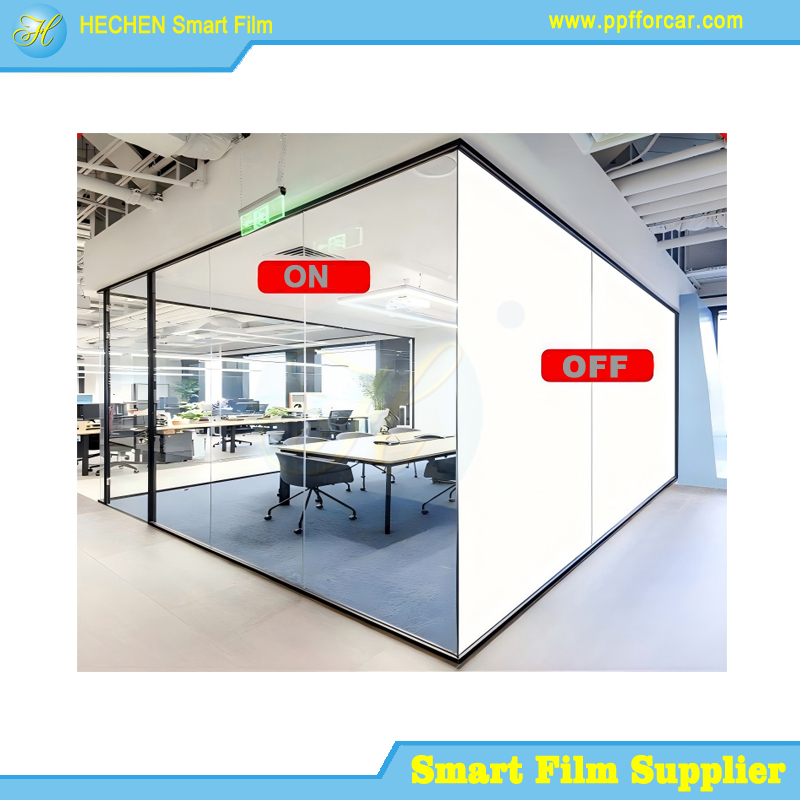
ConclusionPDLC smart film elegantly bridges materials science and practical architecture, delivering a true “smart” surface that switches from opaque privacy to transparent openness in seconds through precise control of liquid crystal alignment within a polymer matrix. Its low power, fast response, high optical contrast, and retrofit-friendly design make it one of the most versatile dynamic glazing solutions available. By understanding the refractive-index physics, layered construction, electrical operation, and performance metrics detailed above, designers and end-users can confidently specify PDLC smart film for projects demanding flexible, energy-efficient, and aesthetically pleasing privacy control. As building envelopes evolve toward greater intelligence and adaptability, this technology stands poised to play an even larger role in shaping the transparent, responsive spaces of the future.