Smart Film for Office: Complete Guide to Smart Privacy Glass for Modern Workspaces
Modern offices increasingly require flexible spaces that can support collaboration, privacy, natural light, and professional aesthetics at the same time. Traditional blinds, curtains, and permanently frosted glass can provide privacy, but they often reduce daylight, interrupt the visual design of an office, or require manual adjustment.
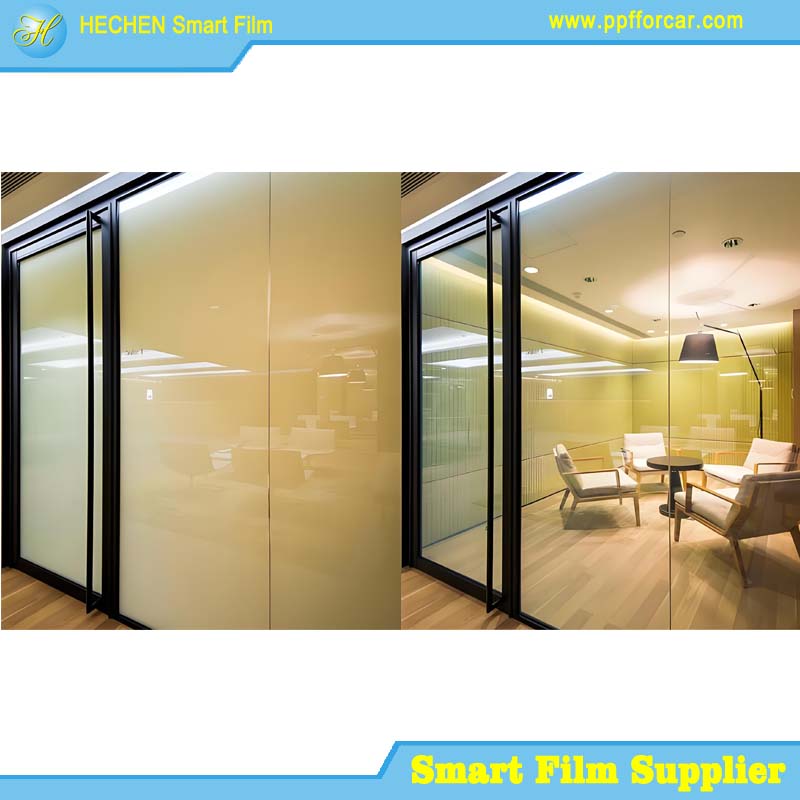
Smart film for office applications provide a more flexible alternative. By using electrically switchable privacy technology, office glass can change from transparent to opaque or translucent at the touch of a button. This makes PDLC smart film for office environments particularly useful for conference rooms, glass partitions, executive offices, reception areas, and other spaces where privacy needs can change throughout the day.
This guide explains how smart privacy glass for offices works, where it can be used, installation requirements, cost considerations, and how to select the right solution for a commercial workspace.
What Is Smart Film for Office?
Smart film for office is an electrically switchable film designed to transform ordinary glass into controllable privacy glass. The most common technology used for this application is PDLC (Polymer Dispersed Liquid Crystal).
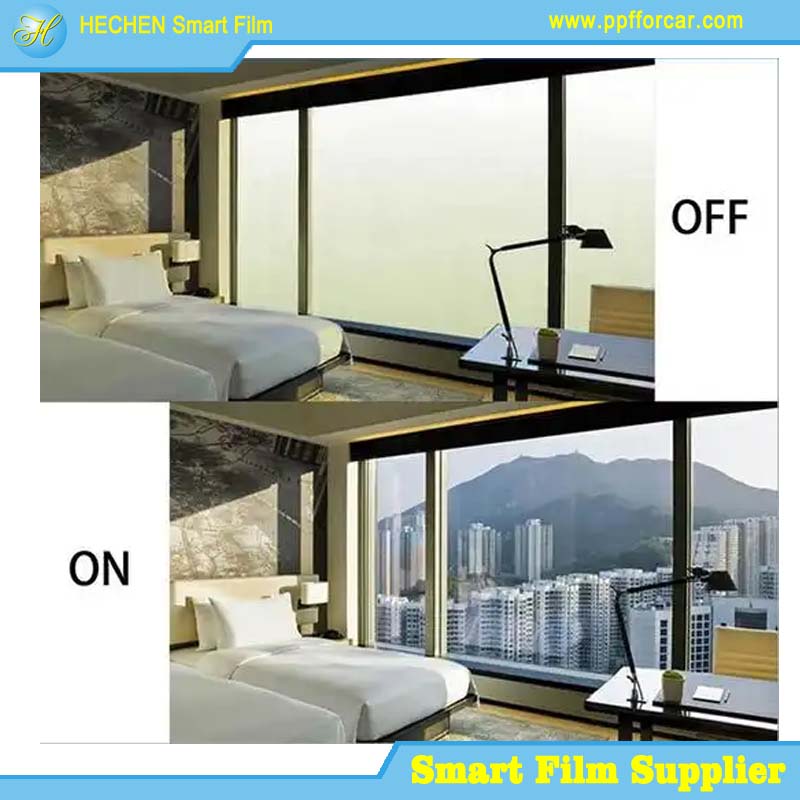
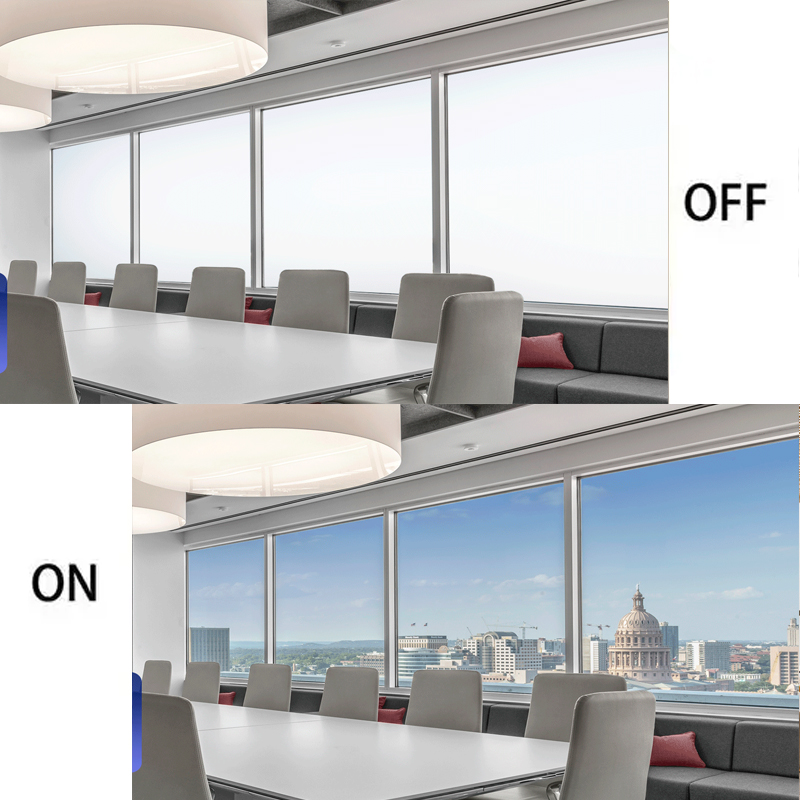
PDLC smart film contains microscopic liquid crystal droplets embedded within a polymer matrix. When no electrical current is applied, the liquid crystals are randomly oriented, scattering incoming light and creating a frosted or opaque appearance. When electrical power is applied, the liquid crystals align, allowing light to pass through and making the glass transparent.
In practical office applications, this creates two primary states:
Transparent state: Employees can see through the glass.
Privacy state: The glass becomes opaque or translucent, limiting visibility.
Unlike traditional window film, smart film does not simply provide a permanent tint or decorative finish. Its main function is on-demand privacy control.
Depending on the product specification, smart film can be installed directly onto existing office glass as a retrofit solution. This makes it particularly attractive for renovation projects where replacing existing glass would be expensive or disruptive.
The term smart privacy film, switchable film, electric privacy film, and PDLC film are often used to describe similar products.
How Does Smart Film Work in an Office?
The operating principle of PDLC smart film for office applications is relatively straightforward.
The film contains several functional layers, typically including transparent conductive electrodes, a PDLC layer, and protective or adhesive layers. The conductive layers connect to a low-voltage power supply through busbars and electrical wiring.
When the power is switched on, an electric field is generated across the PDLC layer. The liquid crystal molecules align in a way that allows light to pass through the film.
When power is switched off, the molecules return to a random orientation. Light is scattered, producing the privacy effect.
A typical system consists of:
PDLC smart film
Transparent conductive electrodes
Busbars
Electrical wiring
Transformer or power controller
Wall switch, remote control, sensor, or smart-home/building automation interface
For larger commercial installations, multiple film panels can be connected to a centralized control system. This allows users to control individual rooms, zones, or multiple glass partitions simultaneously.
Smart film can also be integrated with automation systems such as timers, occupancy sensors, meeting-room controls, and building management systems, depending on the controller and project requirements.
Why Use Smart Film in Modern Offices?
The popularity of smart film for office partitions is closely related to the changing design of modern workplaces.
1. On-Demand Privacy
Employees can switch glass from transparent to private whenever confidentiality is required. This is especially useful for meetings, interviews, financial discussions, HR conversations, and executive offices.
2. Flexible Workspace Design
Open-plan offices can maintain visual connectivity while still providing temporary privacy. Instead of constructing permanent walls, businesses can use switchable glass to create adaptable workspaces.
3. Modern Appearance
Smart film creates a clean, minimalist appearance without curtains, blinds, or bulky privacy screens.
4. Better Use of Natural Light
Traditional blinds can block daylight even when complete privacy is not required. Smart film allows businesses to choose between visibility and privacy according to the situation.
5. Branding and Decorative Applications
Custom-cut smart film can be used for logos, patterns, room numbers, or decorative graphics. Some projects use partial-film designs to combine privacy with corporate branding.
6. Retrofit Potential
Self-adhesive smart film can often be installed over existing glass, making it suitable for office renovation projects.
Where Can Smart Film Be Used in an Office?
The versatility of smart privacy film for office glass makes it suitable for many commercial applications.
Common locations include:
Conference rooms
Meeting rooms
Executive offices
HR offices
Financial departments
Glass partitions
Reception areas
Training rooms
Medical or consultation rooms
Co-working spaces
Showrooms
Hotel business centers
Government offices
Security-sensitive areas
The ideal application depends on the required privacy level, glass dimensions, electrical infrastructure, and frequency of switching.
Smart Film for Office Partitions
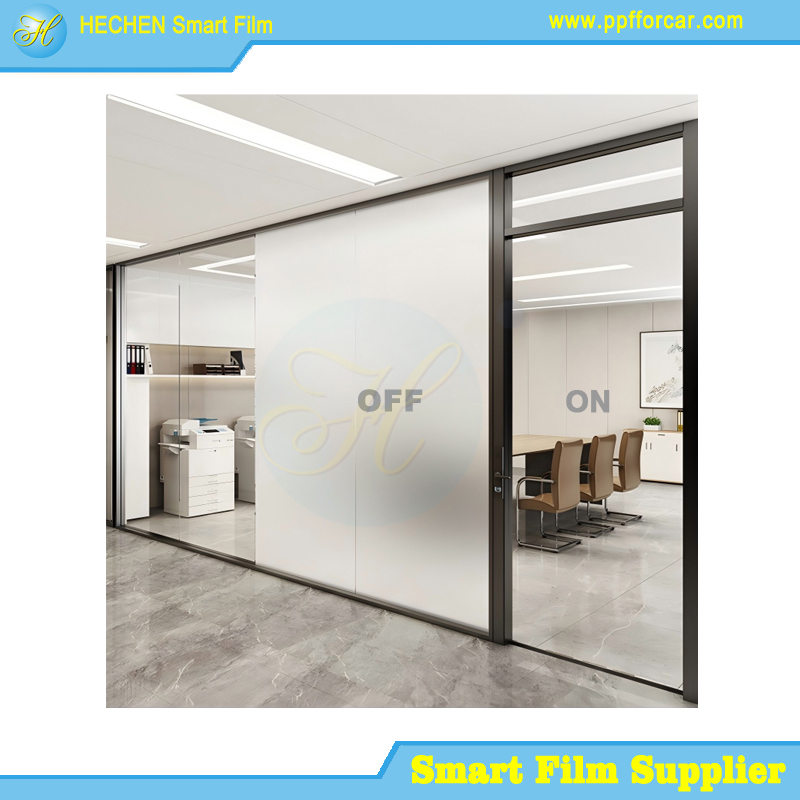
Glass partitions are one of the most common applications for smart film for office projects.
Modern offices often use floor-to-ceiling glass partitions to create a sense of openness. However, permanent transparency can become a problem when confidential meetings or focused work require privacy.
Installing PDLC smart film on office partitions solves this problem without eliminating the architectural advantages of glass.
For example, a meeting room can remain transparent during normal working hours. Before a confidential meeting begins, employees can activate the smart film and instantly create a private environment.
For partition applications, pay particular attention to:
Glass dimensions
Film panel size
Joint positioning
Busbar location
Electrical cable routing
Edge finishing
Glass surface condition
Controller capacity
Large partitions may require several independently controlled film sections rather than one continuous panel.
Smart Film for Conference Rooms
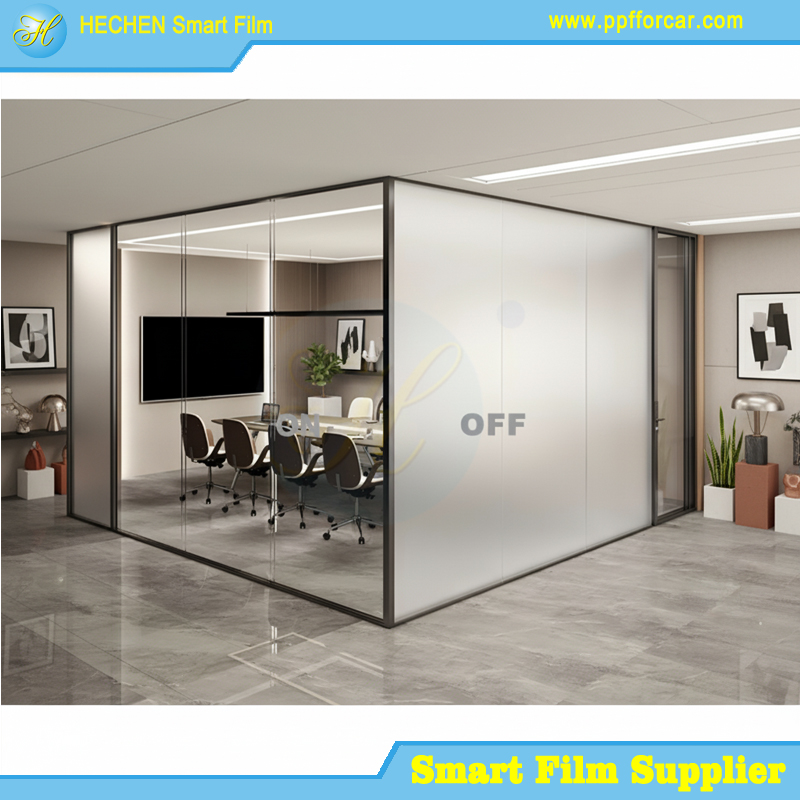
Smart film for conference rooms is particularly valuable because meeting privacy requirements change frequently.
During normal operations, transparent glass allows employees outside the room to see whether the room is occupied. During confidential meetings, switching the film to its privacy state limits visual distractions and protects sensitive information.
Conference-room smart film can also be integrated with meeting-room automation.
For example:
Meeting starts → smart film switches to privacy mode → meeting ends → smart film returns to transparent mode.
Additional functions may include remote control, wall switches, mobile control, scheduled switching, and integration with building automation systems.
However, it is important to understand that PDLC primarily provides visual privacy. It should not automatically be considered a complete acoustic or security solution. If a room requires sound insulation or protection against specialized surveillance, additional technologies may be necessary.
PDLC Smart Film vs Traditional Office Privacy Solutions
Businesses traditionally use blinds, curtains, frosted film, or permanently opaque glass.
| Feature | PDLC Smart Film | Blinds/Curtains | Frosted Film | Fixed Frosted Glass |
|---|---|---|---|---|
| Switchable privacy | Yes | Yes | No | No |
| Instant control | Yes | Manual/motorized | No | No |
| Maintains glass appearance | Yes | Partially | Yes | Yes |
| Retrofit potential | High | High | High | Low |
| Natural light control | Good | Variable | Diffused | Diffused |
| Modern appearance | Excellent | Moderate | Good | Excellent |
| Requires electricity | Yes | Optional | No | No |
The biggest advantage of PDLC smart film is flexibility. Traditional frosted film permanently changes the appearance of glass, while curtains and blinds introduce physical elements that may conflict with minimalist office designs.
PDLC provides a third option: transparent when visibility is useful and private when confidentiality is required.
Self-Adhesive Smart Film vs Laminated Smart Glass
Two major approaches are commonly considered for smart privacy glazing.
Self-Adhesive Smart Film
Self-adhesive smart film is designed to be applied directly to existing glass.
Its main advantages include:
Suitable for retrofit projects
Lower installation disruption
Existing glass can often be retained
Flexible for renovation
Faster installation compared with glass replacement
However, installation quality is critical. Dust, bubbles, scratches, poor edge finishing, or incorrect electrical connections can affect the final appearance and durability.
Laminated Smart Glass
Laminated smart glass integrates the PDLC layer inside a glass structure during manufacturing.
Advantages can include:
Factory-controlled quality
Better protection of the functional film layer
Premium architectural appearance
Suitable for new construction projects
The disadvantage is that laminated smart glass generally requires replacing or specifying the glass unit itself.
For office renovation projects, self-adhesive smart film is often more practical. For new commercial construction, laminated smart glass may be considered when long-term architectural integration is the priority.
Smart Film Installation for Office Glass
Professional installation is essential for achieving reliable performance.
Before installation, the glass should be inspected for:
Cracks or chips
Surface contamination
Scratches
Uneven surfaces
Existing coatings
Silicone or sealant contamination
The glass must be thoroughly cleaned before applying the film.
A typical installation process includes:
Step 1: Measure the Glass
Accurate measurements are essential because smart film is normally manufactured according to the required dimensions.
Step 2: Prepare the Glass
The glass surface must be cleaned carefully to remove dust, oil, fingerprints, and other contaminants.
Step 3: Position the Film
The film is aligned carefully with the glass before adhesive application.
Step 4: Apply the Film
The protective liner is removed gradually while the film is applied to the glass. Installation tools are used to minimize air bubbles and wrinkles.
Step 5: Connect the Busbars
Electrical busbars must be connected according to the manufacturer's specifications.
Step 6: Connect the Power Supply
The film is connected to an appropriate transformer or controller. Voltage and power requirements should always be confirmed from the product specification.
Step 7: Test the System
The film should be tested repeatedly between transparent and privacy states.
Step 8: Finish the Edges
Proper edge treatment helps protect the film from moisture, contamination, mechanical damage, and accidental peeling.
For commercial projects, electrical installation should be performed by qualified professionals where required by local regulations.
How Much Does Smart Film for Office Cost?
The cost of smart film for office projects depends on considerably more than the price per square meter of film.
Important cost factors include:
Film technology
Film thickness
Transparency and haze performance
Film dimensions
Total project area
Number of independent zones
Controller requirements
Installation labor
Electrical wiring
Edge finishing
Custom shapes
Shipping
Project location
A small office conference room may require only a few square meters of film, while a large corporate headquarters could require hundreds of square meters and centralized control.
For this reason, suppliers should normally provide a project-based quotation rather than relying solely on a generic retail price.
When comparing suppliers, evaluate the total installed cost instead of only the film price.
A low-cost product may become expensive if it has poor optical performance, difficult installation, unreliable controllers, or short service life.
How to Choose the Best Smart Film for Your Office?
Choosing the best smart film for office glass requires evaluating both technical specifications and project requirements.
1. Optical Performance
Look at visible light transmission, haze, clarity, and the appearance of the film in both operating states.
A high-quality product should provide a clear transparent state and a uniform privacy state.
2. Switching Performance
Check how quickly the film changes between transparent and privacy states.
Consistent switching across the entire panel is particularly important for large office partitions.
3. Electrical Specifications
Confirm:
Operating voltage
Power consumption
Controller capacity
Wiring requirements
Maximum panel dimensions
Do not select a controller solely based on appearance or price. It must be matched to the actual electrical requirements of the film.
4. Film Size and Customization
Large conference-room partitions may require custom dimensions or multiple film sections.
Ask the supplier whether they provide custom cutting, shaped panels, busbar placement, and multi-zone control.
5. Adhesive Quality
For retrofit applications, adhesive performance is critical. The adhesive must provide reliable bonding without creating excessive bubbles or edge lifting.
6. Durability
Ask for information about switching cycles, operating temperature, storage conditions, warranty, and expected service life.
7. Installation Support
For large B2B projects, technical support can be as important as the film itself.
A professional supplier should be able to provide installation instructions, wiring diagrams, controller specifications, and troubleshooting support.
Smart Film for Office FAQs
Is smart film suitable for office glass?
Yes. Smart film for office glass is widely suited to conference rooms, meeting spaces, glass partitions, executive offices, and other areas where privacy requirements change.
Does smart film provide complete privacy?
PDLC smart film provides strong visual privacy by scattering light in its privacy state. However, it does not automatically provide acoustic privacy or complete physical security.
Can smart film be installed on existing office glass?
Yes. Self-adhesive PDLC smart film is specifically designed for many retrofit applications and can be applied to existing glass when the surface and dimensions are suitable.
Does smart film need electricity?
Yes. PDLC smart film requires electrical power to switch between its operating states. The exact voltage and power consumption depend on the product design.
Can office smart film be controlled remotely?
Yes. Depending on the controller, smart film can be operated through wall switches, remote controls, sensors, timers, centralized systems, or compatible building automation systems.
Can smart film be cut on site?
Smart film should generally be manufactured to the required dimensions. Cutting or modifying a finished panel on site can damage conductive components and should only be performed according to the manufacturer's instructions.
Is PDLC smart film better than frosted film?
They serve different purposes. Frosted film provides permanent privacy, while PDLC smart film provides switchable privacy. If an office needs privacy only during specific meetings or activities, PDLC can provide greater flexibility.
How long does office smart film last?
Service life depends on product quality, installation, electrical control, operating conditions, and switching frequency. Buyers should request manufacturer test data and warranty information rather than relying only on generic lifespan claims.
Can smart film be used on large conference-room glass walls?
Yes, but large installations require careful planning for panel dimensions, electrical zones, busbar placement, controller capacity, and installation quality.
Conclusion
Smart film for office applications provide a practical way to transform ordinary architectural glass into controllable privacy glazing. By combining PDLC technology with modern electrical controls, offices can switch between transparency and privacy without relying on traditional blinds, curtains, or permanently frosted glass.
For office partitions, smart film can preserve the openness of glass while providing privacy when needed. For conference rooms, it can create an instant visual barrier during confidential meetings. For renovation projects, self-adhesive smart film can provide a more flexible alternative to replacing existing glass.
However, choosing the right product requires more than comparing prices. Optical performance, switching consistency, electrical specifications, adhesive quality, customization, installation requirements, durability, and supplier support should all be evaluated.
For commercial projects, the best approach is to define the glass dimensions, application, privacy requirements, control method, and installation conditions first, then select a PDLC smart film supplier capable of providing the appropriate technical specifications and project support.
With proper product selection and professional installation, smart privacy film can become an important part of modern workplace design—helping businesses create spaces that are more flexible, visually clean, and adaptable to changing privacy requirements.
Recommend related products:
Switchable PDLC Film For Office