
Smart Film vs. Frosted Glass for Bathrooms: Which Privacy Solution Is Better?
Choosing between smart film and frosted glass for bathrooms depends on whether you prioritize adjustable privacy, permanent obscurity, installation flexibility, or long-term simplicity. Smart film is better when users want privacy on demand and clear glass when privacy is not needed. Frosted glass is better when permanent privacy, simplicity, and no electrical components are the priorities.
Both solutions provide effective bathroom privacy while allowing natural light to enter. However, they differ significantly in operating principles, installation requirements, costs, and maintenance. Understanding these differences helps homeowners, hotel developers, architects, and contractors select the most appropriate bathroom privacy glass solution.
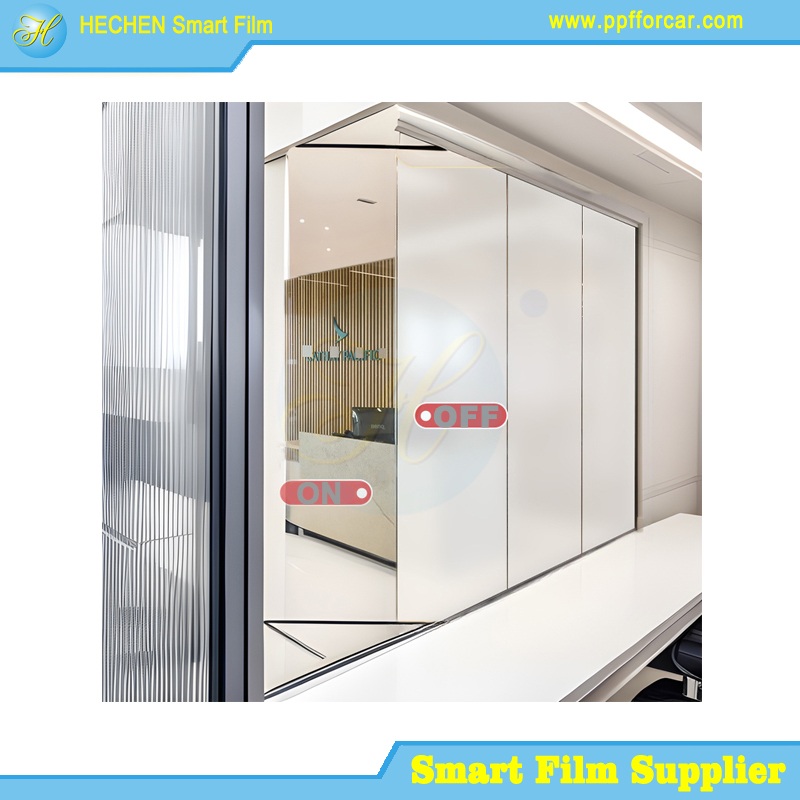
What Is the Difference Between Smart Film and Frosted Glass?
The primary difference between PDLC smart film and frosted glass is how they control light transmission and visual privacy.
Smart film is an electrically controlled optical material that changes between transparent and translucent states. Frosted glass is manufactured or treated to create a permanently diffused surface that obscures visibility.
What Is PDLC Smart Film?
PDLC (Polymer Dispersed Liquid Crystal) smart film consists of liquid crystal droplets distributed within a polymer matrix and positioned between transparent conductive layers.
When electrical power is applied, an electric field aligns the liquid crystal molecules, allowing more light to pass through with reduced scattering. The glass appears transparent.
When the power is switched off, the molecules return to random orientations, scattering incoming light and creating a frosted appearance.
This technology allows users to control privacy through a wall switch, remote controller, or compatible automation system.
Smart film can be installed on suitable existing flat glass, making it a practical retrofit option for bathroom renovation projects.
What Is Frosted Glass?
Frosted glass is a privacy glazing material produced through processes such as acid etching, sandblasting, or the application of a permanent translucent coating.
These processes modify the glass surface or optical characteristics, scattering light and reducing direct visibility.
Unlike PDLC smart film, frosted glass does not require electricity, transformers, or electronic controllers.
Its privacy characteristics remain consistent throughout the day, making it suitable for bathrooms that require permanent visual separation.
Smart Film vs Frosted Glass: Core Technical Comparison
| Comparison | PDLC Smart Film | Frosted Glass |
|---|---|---|
| Privacy control | Switchable | Permanent |
| Transparent state | Yes, when powered | No |
| Frosted state | Yes, when power is off | Permanent |
| Electrical power | Required | Not required |
| Existing glass retrofit | Suitable for compatible glass | Usually requires replacement or additional glass treatment |
| Installation | Film application and electrical connections | Glass processing or replacement |
| Maintenance | Film surface and electrical connections require attention | Generally standard glass maintenance |
| Privacy flexibility | High | Fixed |
| Initial investment | Generally higher | Depends on glass type and processing |
| Automation | Available with compatible controls | Not applicable |
The most important distinction is flexibility. Smart film provides two optical states, while frosted glass maintains one permanent privacy state.
Smart Film vs Frosted Glass: How Privacy Works
Privacy performance is one of the most important considerations when comparing bathroom smart film and frosted glass.
However, the two materials achieve privacy through different optical mechanisms.
Adjustable Privacy with Smart Film
PDLC smart film provides two operating modes.
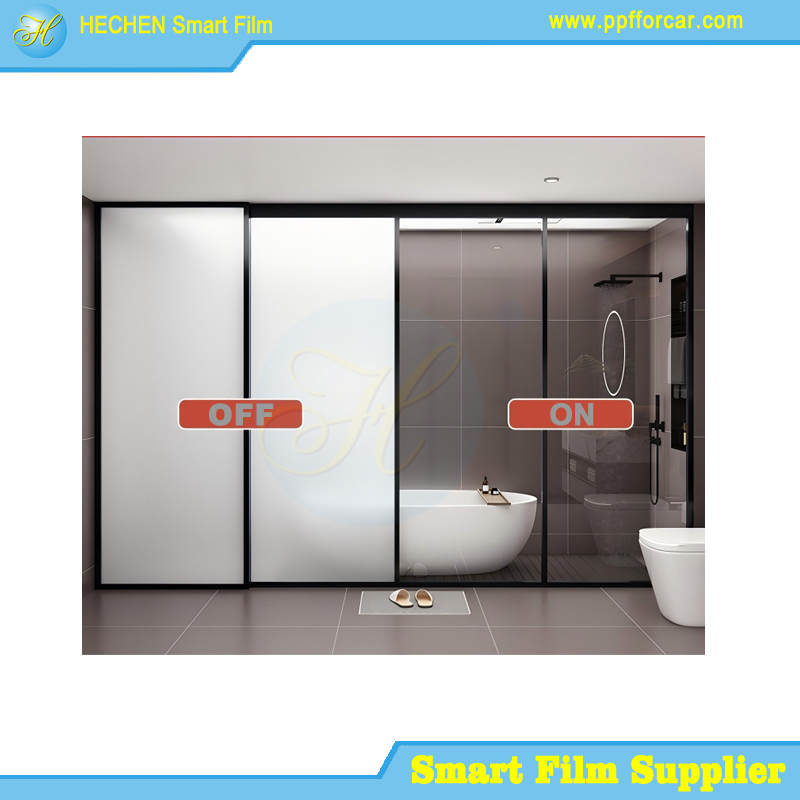
OFF state: Frosted privacy mode
When electrical power is removed, the liquid crystal molecules become randomly oriented. Light scattering creates a translucent appearance that obscures direct visibility.
This mode is useful when privacy is required during showering, bathing, or other bathroom activities.
ON state: Transparent mode
When power is applied, the liquid crystal molecules align with the electric field. The film becomes substantially transparent, allowing users to see through the glass.
This is particularly useful for bathrooms connected to bedrooms, dressing rooms, or other private interior spaces.
One important limitation is that PDLC film provides visual privacy through light scattering rather than complete optical opacity. Its actual privacy performance depends on haze, lighting conditions, viewing distance, and product specifications.
Permanent Privacy with Frosted Glass
Frosted glass provides continuous visual privacy without requiring user interaction.
Its surface scatters light, making objects behind the glass appear blurred or indistinct.
It is especially useful for:
Bathroom windows facing neighboring buildings
Shower partitions
Public washroom partitions
Commercial bathroom enclosures
Residential bathrooms requiring permanent privacy
However, frosted glass cannot become transparent when users want an unobstructed view.
For homeowners who want both privacy and transparency, this limitation may be significant.
Which Option Provides Better Natural Light?
Both smart film and frosted glass can maintain natural daylight transmission, but their optical performance differs.
Light Transmission Through Smart Film
PDLC smart film allows higher visual transparency when powered on.
In its OFF state, it scatters light, producing a translucent appearance while still allowing daylight to enter the bathroom.
The amount of transmitted light depends on the film's visible light transmission (VLT), haze, glass substrate, and installation configuration.
The ON-state haze is also important because a film may appear transparent while still producing some optical distortion.
Light Transmission Through Frosted Glass
Frosted glass diffuses incoming light regardless of the lighting conditions or user preferences.
It can distribute daylight more evenly across a bathroom, reducing direct visibility and creating a softer interior appearance.
However, it does not provide the clear optical view available from transparent glass.
Which Performs Better?
The answer depends on the desired lighting experience.
| Requirement | Better Option |
|---|---|
| Clear outside view | Smart film |
| Permanent diffused daylight | Frosted glass |
| Adjustable transparency | Smart film |
| Consistent privacy throughout the day | Frosted glass |
| Flexible bathroom design | Smart film |
| No electrical dependency | Frosted glass |
For bathrooms with attractive exterior views, smart film offers greater flexibility. For bathrooms facing neighboring properties, frosted glass may provide a simpler permanent solution.
Smart Film vs Frosted Glass: Installation
Installation requirements can significantly affect project budgets, construction schedules, and renovation complexity.
Installing Smart Film on Existing Bathroom Glass
One major advantage of smart film is its retrofit capability.
Self-adhesive PDLC film can be applied to compatible existing glass without necessarily removing the entire glazing assembly.
A typical installation involves:
Measuring the existing glass dimensions.
Checking glass compatibility and surface condition.
Cleaning and drying the glass thoroughly.
Cutting and positioning the smart film.
Applying the film while minimizing bubbles and contamination.
Connecting the conductive busbars and electrical wiring.
Installing the compatible power supply and controller.
Testing switching performance and electrical safety.
The electrical system requires additional planning. Wiring must be concealed or routed safely, and the power supply must be located in an appropriate dry area.
Bathroom humidity, condensation, and direct water exposure must also be evaluated before installation.
Installing Frosted Glass
Frosted glass installation depends on whether the project uses newly manufactured glass or existing glass that can be treated.
Common approaches include:
Replacing existing clear glass with factory-frosted glass.
Applying permanent frosted coatings.
Using acid-etched or sandblasted glass panels.
Installing prefabricated frosted glass partitions.
Replacing existing bathroom glazing may require removing frames, disconnecting fixtures, adjusting dimensions, and reinstalling the glass assembly.
Although the glass itself does not require electrical connections, replacement projects can involve considerable labor.
Which Is Easier to Install?
For suitable existing glass, smart film can be a convenient retrofit solution because the original glazing may remain in place.
Frosted glass is often simpler in new construction, where the glass dimensions and finish can be specified before manufacturing.
Therefore, the best installation method depends on whether the project involves existing glazing or new bathroom construction.
Cost Comparison for Bathroom Privacy Solutions
Cost is an important factor when selecting between smart film and frosted glass.
The total project cost should include more than the material price. Installation labor, electrical components, glass replacement, and long-term maintenance can all influence the final investment.
Smart Film Cost Factors
The cost of PDLC smart film depends on:
1. Film specifications
Film thickness, transparency, haze, adhesive construction, and manufacturing quality affect material pricing.
2. Glass dimensions
Larger glass panels require more film material. Custom cutting and complex shapes may also increase costs.
3. Electrical components
A complete system generally requires a compatible transformer or power supply, controller, wiring, and switching accessories.
4. Installation labor
Labor costs depend on glass accessibility, surface preparation, wiring routes, and the complexity of the installation.
5. Moisture protection
Bathroom applications may require additional protection for edges and electrical connections. Shower applications can require specialized glazing assemblies.
Frosted Glass Cost Factors
The cost of frosted glass depends on:
Glass thickness
Glass dimensions
Tempered or laminated safety requirements
Etching or sandblasting processes
Edge polishing
Frame and hardware requirements
Removal and replacement labor
Standard frosted glass may have a lower system cost because it does not require electrical components.
However, replacing large or customized glass panels can increase total project expenses.
Overall Cost Comparison
| Cost factor | Smart Film | Frosted Glass |
|---|---|---|
| Material cost | Generally higher than basic privacy film | Varies by glass specification |
| Electrical components | Required | Not required |
| Existing glass modification | Often possible | Depends on treatment method |
| Glass replacement | Not always necessary | Often required for factory-frosted glass |
| Installation labor | Film and electrical work | Glass processing and installation |
| Maintenance | Electrical and film-related | Generally low |
| Functional flexibility | High | Limited |
For renovation projects with suitable existing glass, smart film may reduce the need for glass replacement.
For new construction requiring permanent privacy, frosted glass may offer better cost efficiency.
A project-specific quotation is recommended because dimensions, glass specifications, electrical requirements, and installation conditions vary considerably.
Which Is Better for Shower Enclosures?
Shower enclosures present more demanding conditions than ordinary bathroom windows.
High humidity, direct water contact, condensation, cleaning chemicals, and temperature fluctuations must all be considered.
Smart Film for Shower Glass
Smart film can provide adjustable privacy for shower enclosures, but not every PDLC film is suitable for direct wet-area installation.
Standard self-adhesive smart film generally requires careful evaluation before being used on shower glass.
Potential concerns include:
Moisture penetration at exposed edges
Adhesive deterioration
Corrosion or damage to conductive connections
Electrical insulation failure
Temperature-related material changes
Cleaning chemical compatibility
For direct shower exposure, a purpose-designed laminated PDLC smart glass assembly may be a more appropriate solution.
The complete glazing system should be assessed for water resistance, electrical safety, structural performance, and applicable bathroom installation requirements.
Frosted Glass for Shower Enclosures
Frosted glass is commonly used in shower enclosures because it provides permanent privacy without electrical components.
It can be manufactured as tempered safety glass or incorporated into suitable laminated glazing assemblies.
Its surface finish must be selected according to cleaning requirements and the expected exposure to soap, water deposits, and cleaning chemicals.
Shower Application Comparison
| Requirement | Smart Film | Frosted Glass |
|---|---|---|
| Adjustable privacy | Yes | No |
| Direct water exposure | Requires verified wet-area suitability | Depends on glazing design |
| Electrical safety considerations | Yes | No electrical system required |
| Permanent privacy | Available in OFF state | Always available |
| Cleaning | Requires compatible cleaning methods | Standard glass cleaning |
| System complexity | Higher | Lower |
For most projects prioritizing straightforward permanent shower privacy, frosted glass is a practical choice.
For projects requiring adjustable transparency, a properly engineered smart glass system can provide additional functionality.
Which Solution Is Better for Homeowners, Hotels, and Developers?
Different customer groups have different priorities. The best bathroom privacy solution should match the building type, budget, operating requirements, and architectural design.
Homeowners
For residential bathrooms, the choice often depends on renovation budgets and personal preferences.
Smart film is suitable for homeowners who:
Want privacy only when needed.
Prefer clear glass when the bathroom is not in use.
Want to retain existing glazing.
Value modern interior design.
Plan to integrate privacy controls into home automation.
Frosted glass is more suitable for homeowners who prefer a simple, permanent privacy solution with minimal system complexity.
Hotels and Hospitality Projects
Hotels often use extensive internal glazing between bedrooms and bathrooms.
Smart film can provide flexible privacy control, allowing guests to switch between an open visual environment and a private bathroom space.
Potential advantages include:
Contemporary room design
Flexible guest privacy
Integration with room control systems
Reduced dependence on conventional curtains or blinds
However, hotel projects must also evaluate switching frequency, maintenance access, cleaning procedures, and replacement costs.
Frosted glass may be more appropriate for standard bathrooms where permanent privacy is sufficient and maintenance simplicity is the priority.
Architects, Contractors, and Property Developers
For developers, material selection should consider total project cost, construction schedules, maintenance requirements, and consistency across multiple units.
Smart film can be particularly attractive for premium residential developments, luxury hospitality projects, and architectural spaces featuring extensive glass partitions.
Frosted glass remains a practical solution for large-scale projects requiring predictable privacy performance and straightforward operation.
Frequently Asked Questions
1. Is Smart Film Better Than Frosted Glass for Bathrooms?
Smart film is better when adjustable privacy and transparent viewing are required. Frosted glass is better when permanent privacy, simple installation, and no electrical components are priorities.
2. Is Smart Glass More Expensive Than Frosted Glass?
Smart glass and PDLC smart film generally involve higher system costs than basic frosted glass because of their switchable technology and electrical components. However, retrofit smart film may reduce glass replacement expenses.
3. Can Smart Film Replace Frosted Bathroom Glass?
Yes. Smart film can provide a similar frosted appearance when switched off while offering transparency when powered on. Its suitability depends on the glass surface and installation environment.
4. Does Frosted Glass Provide More Privacy Than Smart Film?
Frosted glass provides permanent visual obscurity. PDLC smart film also provides visual privacy in its OFF state, but its effectiveness depends on optical specifications and lighting conditions.
5. Can Smart Film Be Installed on Existing Bathroom Windows?
Yes. Self-adhesive PDLC smart film can be applied to compatible existing glass. The surface must be suitable, clean, and properly prepared.
6. Which Is Better for Bathroom Shower Doors?
Frosted glass is generally simpler for permanent shower privacy. Smart film requires a purpose-designed assembly with verified moisture protection and electrical safety.
7. Does Smart Film Consume Electricity Continuously?
PDLC smart film typically consumes electricity while maintaining its transparent state. Its OFF state generally requires no operating power. Actual consumption depends on the film specifications and system design.
8. Which Solution Requires Less Maintenance?
Frosted glass generally requires less specialized maintenance because it has no electrical components. Smart film requires appropriate surface cleaning and periodic attention to its electrical connections and control system.
9. Can Frosted Glass Be Made Transparent Later?
Permanent frosted glass cannot be switched to transparent. Replacing it or applying a different glazing solution would be necessary to change its optical characteristics.
10. Is Smart Film Suitable for Commercial Bathroom Projects?
Yes. It can be used in suitable commercial applications, including hotels, serviced apartments, and premium office facilities. The project must consider durability, moisture protection, electrical safety, and maintenance requirements.
Conclusion: Smart Film or Frosted Glass?
Smart film and frosted glass both provide effective bathroom privacy, but they are designed for different functional requirements.
PDLC smart film is the better choice when adjustable privacy, clear visibility, and modern automation are important. It is particularly attractive for existing-glass renovations, premium residential interiors, and hotel bathroom partitions.
Frosted glass is the better choice when permanent privacy, lower system complexity, and minimal maintenance are the main priorities. It is especially practical for standard shower enclosures and bathrooms that do not require adjustable transparency.
Ultimately, the right solution depends on the intended application, project budget, glass compatibility, and moisture exposure. Evaluating these factors before installation helps ensure the selected bathroom privacy solution delivers the appropriate balance of functionality, safety, durability, and long-term value.
Recommended linking:
Smart Privacy Film for Bathroom Glass: The Complete Guide to Switchable Bathroom Privacy
Recommend related products:
Smart Privacy Film for Bathroom Glass