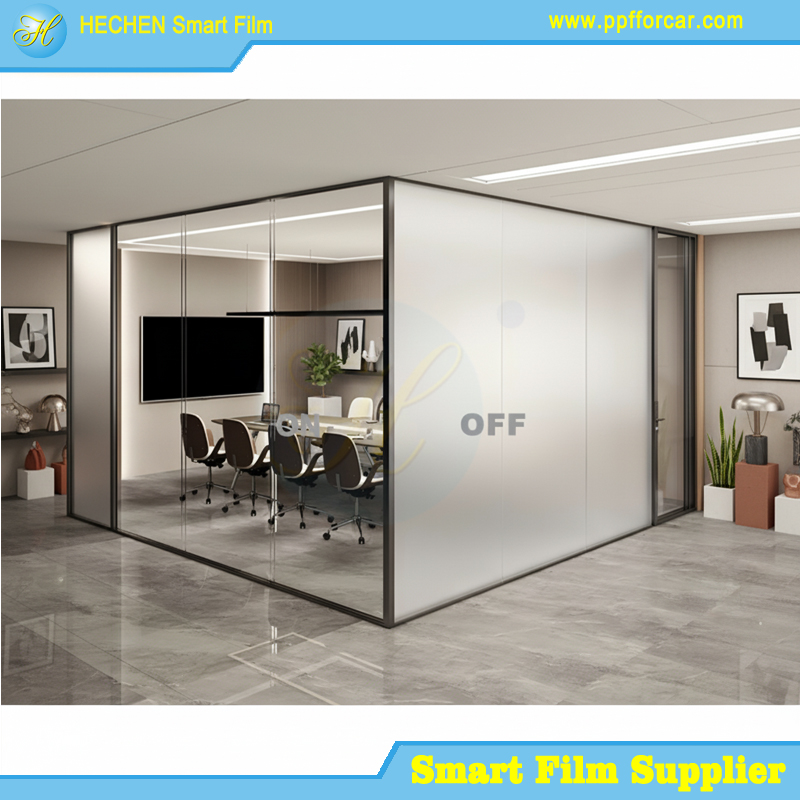
Smart Film for Conference Rooms: The Complete Privacy Solution for Modern Offices
Why Conference Room Privacy Matters in Modern Offices
Modern offices increasingly use glass walls, glass partitions, and transparent meeting rooms to create open, collaborative workspaces. Glass improves natural daylight, visual connectivity, and architectural design, but it can also introduce privacy challenges. Confidential discussions, financial information, employee interviews, strategic planning, and client negotiations may require controlled visibility.
Traditional privacy solutions, including blinds, curtains, and permanently frosted glass, can restrict design flexibility or fail to provide on-demand privacy. Smart film for conference rooms offers an electrically controlled solution that allows users to switch compatible glass surfaces between transparent and opaque states.
By integrating switchable privacy film into meeting room glass, businesses can manage visual privacy while maintaining a modern office appearance. This technology is particularly relevant to corporate offices, executive meeting rooms, healthcare facilities, financial institutions, and commercial buildings requiring flexible space management.
The effectiveness of a conference room privacy solution depends on several factors, including the film type, glass dimensions, electrical control system, installation quality, and the privacy performance specified by the manufacturer.

What Is Smart Film for Conference Rooms?
Smart film for conference rooms is a switchable glazing film designed to provide controllable visual privacy on glass surfaces. The most common technology used for this application is Polymer Dispersed Liquid Crystal (PDLC) film.
PDLC smart film contains liquid crystal material distributed within a polymer matrix. When an electrical field is applied, the liquid crystals align to allow light transmission through the film. When the electrical field is removed, the crystals become randomly oriented, scattering light and creating a translucent or opaque appearance.
The exact optical performance depends on the product design, glass structure, voltage, and operating conditions.
Smart film can be installed in different configurations:
Self-adhesive smart film: Applied directly to an existing, compatible glass surface.
Laminated smart glass: PDLC material is integrated between glass layers during manufacturing.
Custom switchable glass systems: Designed for specific architectural dimensions, control requirements, and project specifications.
For conference rooms, the choice between adhesive film and laminated smart glass should be based on the existing glazing, expected service conditions, installation environment, and project budget.
Unlike conventional decorative film, smart privacy film is connected to an electrical control system. This enables users to change the visual state of the glass when privacy is required.
How Switchable PDLC Film Creates On-Demand Privacy
Understanding how PDLC technology works is essential when evaluating smart film conference room privacy solutions.
1. Transparent Mode
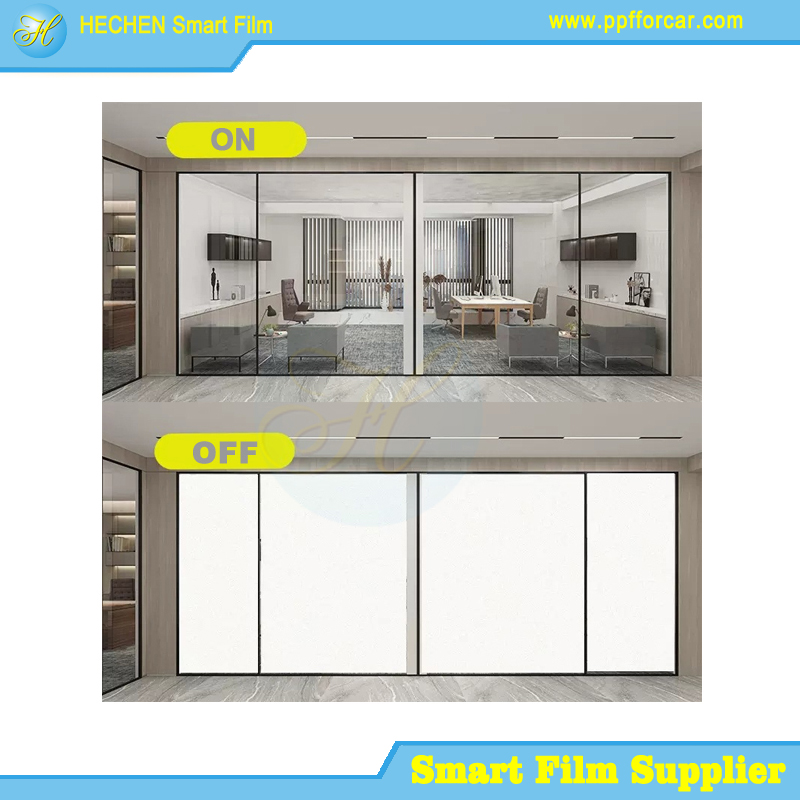
When the appropriate electrical voltage is applied, the liquid crystals align with the electric field. This allows light to pass through the film more directly, creating a transparent appearance.
In a conference room, transparent mode can support:
Natural daylight transmission.
Visual connection between workspaces.
Open office design.
Visibility for supervision and collaboration.
Glass-based projection applications, depending on the product.
The level of transparency varies by product. Buyers should review the manufacturer's visible light transmission and haze specifications instead of assuming all PDLC films offer identical clarity.
2. Privacy Mode
When the electrical power is switched off, the liquid crystals lose their alignment. Incoming light is scattered, causing the film to appear translucent or opaque.
This mode can help reduce direct visibility into the conference room during:
Private business discussions.
Management meetings.
Employee interviews.
Legal consultations.
Financial planning sessions.
Confidential presentations.
PDLC film primarily provides visual privacy. It does not automatically provide sound insulation, prevent all silhouettes from being visible, or guarantee protection against electronic surveillance. The required privacy level should be evaluated based on the specific application.
3. Electrical Control System
A typical switchable PDLC installation includes smart film, conductive busbars, electrical wiring, a compatible transformer or power supply, and a control interface.
Common control methods include:
Wall-mounted switches.
Remote controls.
Centralized building control systems.
Smart automation interfaces, where supported.
Independent control zones for multiple glass panels.
Electrical specifications must be confirmed with the supplier. Incorrect voltage, unsuitable power supplies, poor connections, or improper installation can affect performance and service life.
Key Benefits of Smart Film Conference Room Privacy
Businesses choose conference room privacy film for a combination of functional, architectural, and operational reasons.
Instant Visual Privacy Control
One of the main benefits of switchable PDLC film is the ability to change glass visibility on demand. Users can switch from a transparent state to a privacy state without manually installing curtains or moving blinds.
This is useful for offices where the same room serves multiple purposes throughout the day.
Modern Architectural Appearance
Smart film maintains the clean appearance of glass partitions when integrated correctly. It can support contemporary office designs while providing a controllable privacy feature.
For architects and interior designers, the technology offers an alternative to permanent opaque partitions and traditional window coverings.
Flexible Meeting Room Utilization
A conference room may be used for collaborative discussions, presentations, training sessions, or confidential meetings. Switchable privacy film allows the glass to be adapted to different activities.
In open-plan offices, this flexibility can help organizations manage privacy without permanently closing off meeting spaces.
Potential Projection Surface
Some PDLC films can be used as projection surfaces in their privacy state, depending on haze, optical characteristics, projector type, lighting conditions, and installation configuration.
Businesses should request a demonstration or technical data before specifying smart film as a projection screen. Projection quality is not guaranteed solely by the presence of PDLC technology.
Daylight and Visual Comfort
In transparent mode, smart film can allow daylight to enter the conference room. In privacy mode, it can reduce direct visual distractions from surrounding workspaces.
However, PDLC film should not automatically be described as a high-performance solar control product. UV rejection, infrared rejection, solar heat gain, and glare performance depend on the complete glazing system and should be verified through product specifications.
Potential Reduction in Permanent Window Coverings
For projects where on-demand privacy is required, smart film may reduce the need for separate blinds or curtains. The actual cost and design benefits depend on the size of the installation, electrical requirements, controls, and project conditions.
Common Applications in Corporate Meeting Rooms
Smart privacy film for meeting rooms is suitable for various commercial and institutional environments.
Executive Conference Rooms
Executive meeting rooms often handle strategic planning, sensitive financial information, and management decisions. Switchable film allows users to limit visibility during private sessions while maintaining transparent glass when the room is available for collaboration.
Boardrooms
Boardrooms may require a balance between architectural openness and controlled visual privacy. Smart film can be integrated into large glass walls, doors, and partitions, subject to compatibility and safety requirements.
HR Interview Rooms
Human resources departments conduct interviews, employee evaluations, and private discussions. Conference room privacy film can reduce direct visibility into these spaces, helping create a more discreet environment.
The film should be considered one part of a broader privacy strategy that includes acoustic design and organizational controls.
Financial and Legal Meeting Rooms
Financial departments, law firms, and consulting companies may use meeting rooms for confidential client consultations and document reviews. Switchable glass privacy can help control visual access to the room.
Training and Multipurpose Rooms
Large meeting rooms can serve as training spaces, presentation areas, and collaborative work zones. Smart film provides flexible visibility management without requiring permanent visual separation.
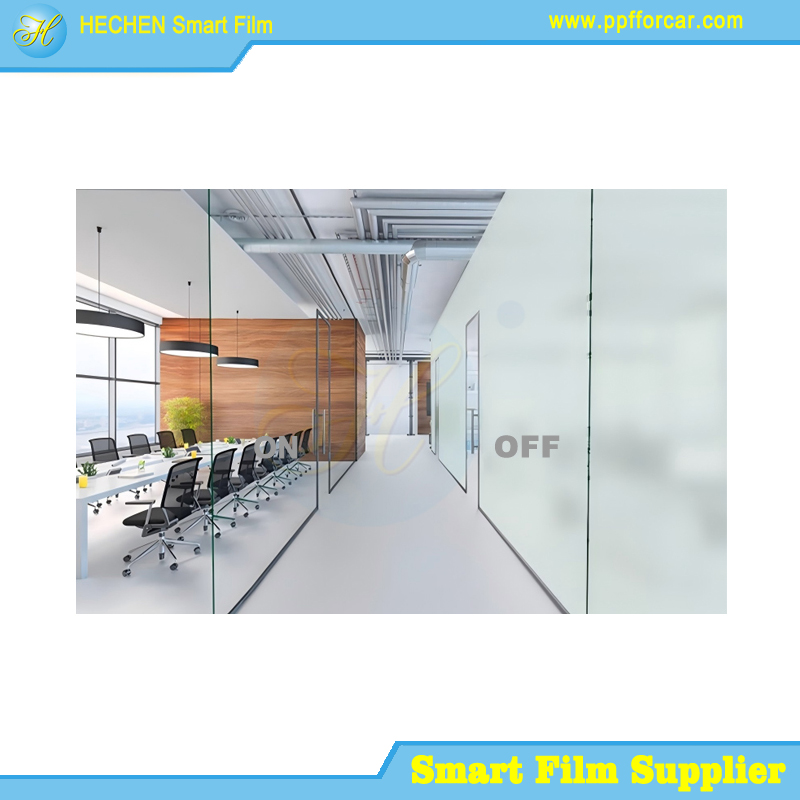
Smart Film vs. Blinds, Curtains, and Frosted Glass
When selecting a conference room privacy film, buyers should compare smart film with other privacy solutions based on project requirements rather than focusing only on initial purchase cost.
Feature | Smart Film | Blinds / Curtains | Frosted Glass or Film |
|---|---|---|---|
Privacy control | Electrically switchable, depending on product | Manual or motorized | Usually fixed |
Appearance | Glass surface remains visually integrated | Adds a covering layer | Permanent translucent appearance |
Electrical requirement | Usually required | Depends on system | Typically not required |
Existing glass retrofit | Possible with compatible adhesive film | Requires appropriate mounting | Often possible, depending on surface |
Daylight management | Depends on optical properties | Can block or filter daylight | Diffuses light |
Maintenance | Electrical system and film care | Mechanical components, fabric or surface | Surface cleaning and film care |
Best suited for | On-demand visual privacy | Flexible physical shading | Fixed privacy applications |
Smart film may be appropriate when businesses require frequent switching between transparency and privacy. Blinds can offer adjustable shading and privacy, while frosted solutions may be preferable when permanent visual obscurity is sufficient.
The final decision should consider privacy requirements, energy performance, maintenance, installation complexity, and the architectural design.
Self-Adhesive vs. Laminated Smart Film for Conference Rooms
The installation configuration is an important factor when choosing smart film for conference room glass.
Self-Adhesive Smart Film
Self-adhesive PDLC film is designed to be applied directly to an existing glass surface, provided the glass and installation conditions are compatible with the product.
Potential advantages include:
Retrofit installation on selected existing glass.
Reduced need to replace complete glazing units.
Flexible application in office renovation projects.
Custom cutting for different glass panel dimensions.
Installation requires careful surface preparation, accurate measurement, electrical connection, and appropriate edge protection. The adhesive system, environmental conditions, and glass compatibility must be confirmed before installation.
Laminated Smart Glass
Laminated smart glass integrates the switchable PDLC layer between glass substrates during manufacturing.
Potential advantages include:
Integrated glazing construction.
Custom architectural configurations.
Suitable options for new construction projects.
A factory-manufactured glass assembly.
Laminated smart glass may require greater coordination with architects, glazing contractors, and building suppliers. Thickness, glass type, safety requirements, dimensions, and electrical connections must be specified during the design stage.
Which Option Should You Choose?
For an existing office conference room, self-adhesive smart film may be considered if the current glass is compatible and the project requires retrofit installation. For new construction or complete glazing replacement, laminated smart glass may be evaluated as part of the building's glazing design.
A professional supplier should provide installation guidance and technical documentation for the selected configuration.
How to Choose a Reliable Smart Film Supplier
Selecting the right supplier is essential for commercial smart film projects. Product performance, technical support, documentation, and installation guidance can significantly influence the project outcome.
1. Review Technical Specifications
Request detailed specifications for:
Film thickness.
Standard and custom widths.
Operating voltage.
Power consumption.
Visible light transmission.
Haze in transparent and privacy modes.
Switching response time.
Operating temperature range.
Expected service life.
Warranty conditions.
Specifications should be based on standardized testing where applicable. Ask the supplier to clarify test methods and whether performance data applies to the film alone or the complete glass assembly.
2. Evaluate Product Quality
A reliable supplier should be able to explain manufacturing processes, quality control procedures, and product consistency.
For larger conference room projects, request samples or demonstrations before placing a bulk order. Evaluate optical uniformity, edge appearance, switching behavior, and compatibility with the intended glass.
3. Check Installation and Technical Support
Smart film installation requires more than simply applying a film to glass. The supplier should provide guidance on electrical connections, busbars, transformer selection, control systems, and maintenance.
For international B2B projects, clear technical documentation and communication with installers can help reduce installation errors.
4. Confirm Customization and Commercial Terms
Depending on the project, buyers may need custom dimensions, control zones, branded packaging, OEM services, or bulk purchasing arrangements.
Important commercial factors include:
Minimum order quantity (MOQ).
Sample availability.
Production lead time.
Packaging and shipping.
Customization options.
Warranty and after-sales support.
Cost should be evaluated alongside technical compatibility, installation requirements, and long-term maintenance.
Installation and Electrical Requirements
The installation of smart film for conference rooms should be completed according to the product manufacturer's instructions and applicable electrical and building requirements.
Glass Preparation
The glass surface must be cleaned thoroughly before applying self-adhesive film. Dust, oil, moisture, and surface contamination can affect adhesion and appearance.
Installers should inspect the glass for damage and confirm the film's compatibility with the substrate.
Film Measurement and Application
Accurate measurements are essential when cutting smart film. The installer should confirm glass dimensions, film orientation, connection locations, and edge clearance requirements before installation.
Improper handling can cause creases, air bubbles, scratches, or damage to the conductive components.
Busbar and Electrical Connections
PDLC film typically requires conductive busbars to distribute voltage across the active film area. The connection design depends on film dimensions and the manufacturer's electrical configuration.
The transformer or power supply must match the specified voltage and load requirements. For large conference rooms, multiple glass panels may require separate control zones or an appropriately designed control system.
Testing and Commissioning
After installation, the system should be tested to confirm:
Transparent and privacy modes operate correctly.
All electrical connections are secure.
Glass panels switch consistently.
Control interfaces function as designed.
No visible installation defects compromise the finished appearance.
Electrical work should be carried out by qualified personnel in accordance with applicable regulations.
Frequently Asked Questions
1. What is smart film for conference rooms used for?
Smart film for conference rooms is used to provide controllable visual privacy on compatible glass surfaces. It can support executive meetings, corporate boardrooms, HR interviews, and other areas requiring flexible privacy.
2. Does smart film make a conference room completely private?
PDLC smart film primarily provides visual privacy. It does not automatically block sound or prevent all visibility of silhouettes. For confidential meetings, combine visual privacy with suitable acoustic and information security measures.
3. Can smart film be installed on existing conference room glass?
Some self-adhesive smart films are designed for retrofit installation on compatible existing glass. The glass condition, dimensions, adhesive system, and electrical connection requirements must be checked before installation.
4. How much electricity does conference room smart film use?
Power consumption varies according to the film technology, active area, operating voltage, and manufacturer specifications. PDLC film generally requires power to maintain its transparent state, while the power requirements in privacy mode depend on the specific system.
Always request the supplier's rated power consumption and electrical specifications.
5. Can smart film be controlled by a wall switch or remote?
Many PDLC systems support wall switches and remote controls. Some can also be integrated with compatible automation systems. The available options depend on the transformer, controller, and product configuration.
6. Is smart film suitable for large conference room glass walls?
Smart film can be used in large glass installations when the film dimensions, electrical configuration, glass structure, and installation method are appropriate. Large areas may require careful control zoning and specialized installation planning.
7. How do I choose a smart film supplier?
Compare technical specifications, product samples, installation support, quality control, customization capabilities, warranty terms, and commercial conditions. A supplier should be able to provide documentation relevant to your project requirements.
8. Can smart film be used as a projection screen?
Certain PDLC products may support projection in their privacy state. Performance depends on the film's optical characteristics, projector, room lighting, and installation conditions. Request a product demonstration before specifying it for professional presentations.
Conclusion: Smart Film for Flexible Conference Room Privacy
Smart film for conference rooms provides a controllable approach to visual privacy in modern office environments. By combining PDLC technology with compatible glass partitions, businesses can switch between transparency and privacy to support different meeting requirements.
The right solution depends on several factors, including the type of glass, film configuration, electrical requirements, optical performance, installation conditions, and project budget.
For commercial projects, choosing a reliable smart film supplier is essential. Buyers should evaluate technical documentation, product quality, customization capabilities, installation support, and warranty conditions before making a purchasing decision.
Whether you are planning a new office, renovating an existing conference room, or sourcing smart privacy film for a commercial project, a properly specified and installed switchable film system can be considered as part of a flexible glass privacy design.
Looking for smart film for conference rooms? Contact a professional smart film supplier to discuss your glass dimensions, technical requirements, customization options, and project needs. Request product specifications or a sample before placing your order.
Recommend related products:
Smart Film For Conference Rooms