Smart Privacy Film for Bathroom Glass: The Complete Guide to Switchable Bathroom Privacy
Smart privacy film for bathroom glass is an electrically controlled PDLC film that switches between a transparent state and a frosted privacy state. It allows homeowners and commercial property designers to control visual privacy while retaining natural light. The film can be applied to suitable existing glass, but bathroom installations require careful consideration of moisture exposure, edge sealing, electrical connections, and the intended wet-area application.
What Is Smart Privacy Film for Bathroom Glass?
Smart privacy film for bathroom glass is a switchable polymer dispersed liquid crystal (PDLC) film designed to provide adjustable visual privacy on glass surfaces. Unlike conventional bathroom privacy film, which maintains a permanent frosted appearance, PDLC smart film changes its optical state when electrical power is applied.
The technology consists of liquid crystal droplets dispersed within a polymer matrix and positioned between transparent conductive layers. When integrated with suitable electrodes and an electrical control system, the film can switch between clear and opaque states.
How Does PDLC Smart Film Work?
PDLC technology relies on the alignment of liquid crystal molecules under an electric field.
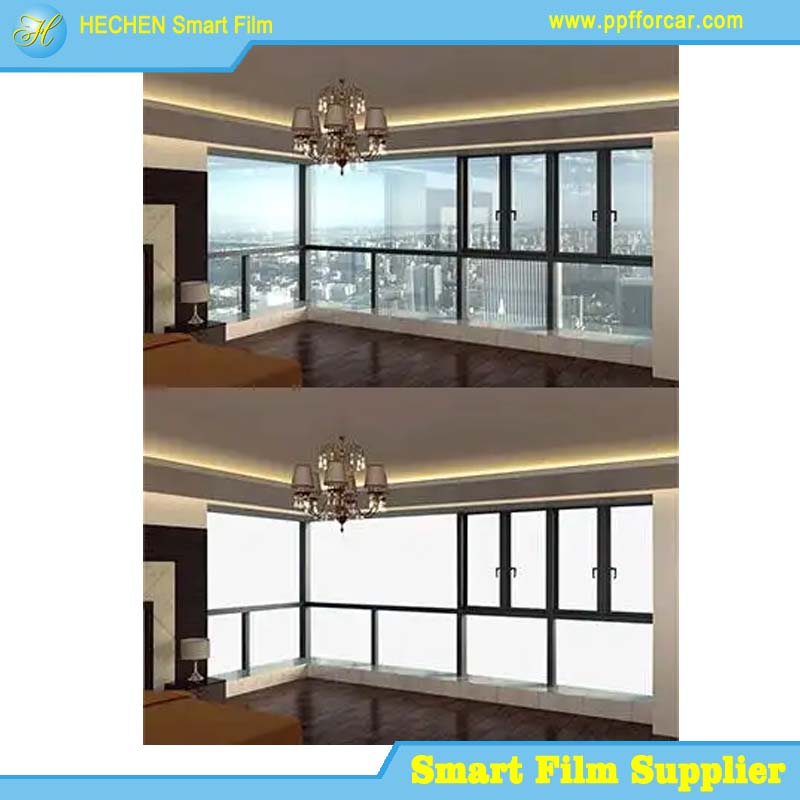
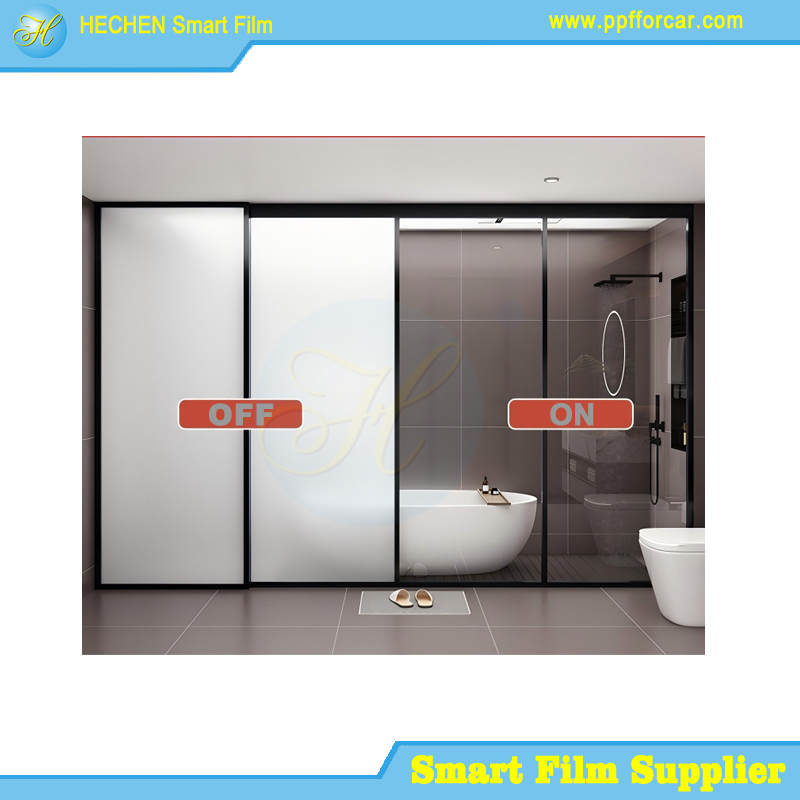
When the film is switched OFF, the liquid crystal molecules are randomly oriented. Incoming light is scattered at the interfaces between the liquid crystals and polymer matrix, creating a translucent or frosted appearance.
When the film is switched ON, an electric field aligns the liquid crystal molecules. Light passes through the film with reduced scattering, making the glass appear transparent.
The primary operating states are:
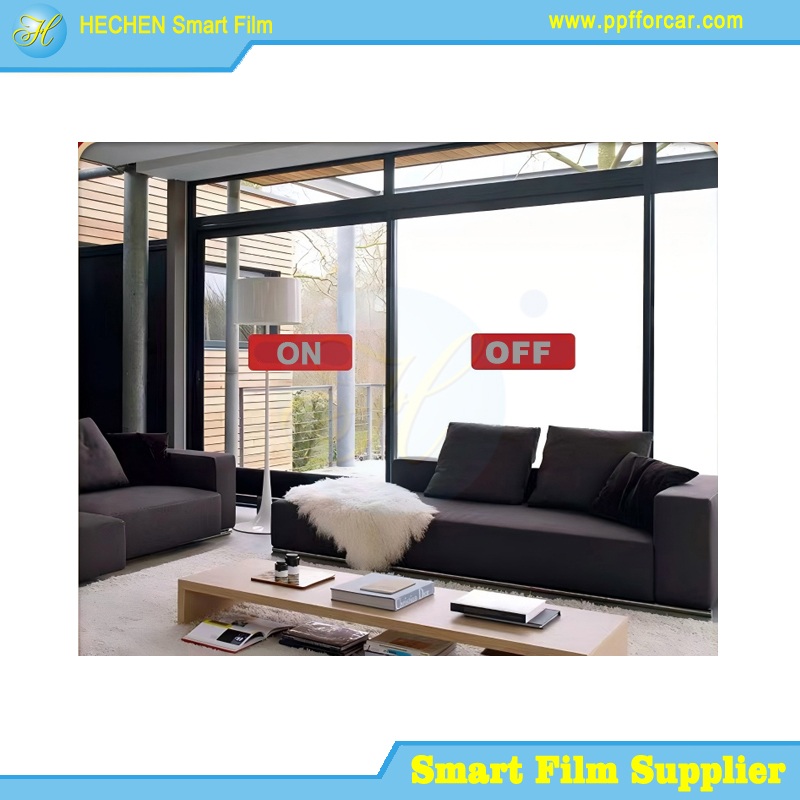
OFF state: The film appears frosted and provides visual privacy.
ON state: The film becomes transparent, allowing visibility through the glass.
The exact transparency, haze, switching speed, and power requirements depend on the film's formulation, thickness, and electrical specifications.
Smart Film vs. Smart Glass
Smart film and smart glass use similar switchable technologies but differ in their construction.
Smart film is typically a flexible film applied to existing glass. It is suitable for retrofit projects where replacing the glass would be expensive or disruptive.
Smart glass incorporates the switchable layer directly into a glass assembly, often through lamination or another integrated manufacturing process.
For bathroom renovation projects, smart film may offer lower replacement costs and greater flexibility. Smart glass is often preferred for new construction, integrated glazing systems, or applications requiring factory-controlled edge protection.
How Does Bathroom Smart Film Work?
Bathroom smart film operates through an electrical control system consisting of the PDLC film, conductive electrodes, a transformer or power supply, and a switching controller.
The controller supplies the electrical voltage required to align the liquid crystal molecules. Depending on the product specification, the film may operate through a dedicated AC power supply.
Electrical Control and Switching
A typical bathroom smart film installation includes:
PDLC smart film applied to the glass surface.
Conductive busbars connected to the film.
A compatible AC power supply.
A wall switch, remote control, or automation interface.
Electrical wiring routed through an appropriate protected installation.
The operating voltage and frequency must match the film manufacturer's specifications. Applying an incorrect voltage may cause unstable switching, overheating, or premature film failure.
For bathroom applications, the power supply should be installed in a suitable dry location, with electrical protection selected according to local regulations.
Optical Performance
The optical performance of bathroom smart film is determined by several parameters:
| Parameter | Technical significance |
|---|---|
| Visible light transmission (VLT) | Determines light transmission in the clear state |
| Haze | Measures light scattering and affects visual clarity |
| Switching time | Indicates how quickly the film changes state |
| Operating voltage | Determines electrical compatibility |
| Power consumption | Influences operating cost |
| Film thickness | Affects installation and optical characteristics |
| Service life | Indicates expected operational durability |
For bathrooms, high privacy performance in the OFF state and sufficient transparency in the ON state are both important.
Why Use Smart Privacy Film in Bathrooms?
Smart privacy film offers several functional and architectural advantages for residential and commercial bathrooms.
1. Adjustable Privacy
The most significant benefit is the ability to switch between transparent and frosted states.
Users can activate privacy when showering, bathing, or using the bathroom and restore transparency when additional light or an open visual appearance is desired.
This is particularly useful in bathrooms with large windows, glass partitions, or layouts connected to bedrooms.
However, PDLC film provides visual privacy rather than complete physical enclosure. It does not replace curtains, blinds, or architectural privacy measures where external visibility must be eliminated under all conditions.
2. Natural Light Transmission
Traditional opaque bathroom materials can reduce daylight and make smaller spaces feel enclosed.
Smart privacy film allows natural light to enter through suitable glass surfaces, even when the film is switched to its frosted state.
This helps maintain a bright interior while reducing direct visibility.
The actual light transmission depends on the glass, film construction, and optical properties.
3. Modern Bathroom Design
Smart film supports minimalist bathroom designs by reducing the need for conventional blinds, curtains, or permanent frosted glass.
It can be incorporated into:
Frameless shower enclosures
Glass bathroom partitions
Bedroom-to-bathroom glazing
Hotel bathroom windows
Contemporary residential interiors
The technology also supports automated privacy control through compatible switches, sensors, and building management systems.
4. Space Efficiency
Bathrooms often have limited space for traditional privacy solutions.
Smart film does not require additional mechanical components such as curtain tracks or blinds. This makes it useful for compact bathrooms, ensuite spaces, and commercial washroom designs.
Where Can Smart Film Be Installed in a Bathroom?
Smart film can be used on different bathroom glass surfaces, but the installation requirements vary according to the location and moisture exposure.
Bathroom Windows
Bathroom windows are among the most common applications.
PDLC film can be applied to suitable interior glass surfaces to provide adjustable privacy while preserving daylight.
Before installation, the glass orientation, external visibility, condensation risk, and exposure to direct water must be evaluated.
Glass Bathroom Partitions
Smart film is suitable for internal glass partitions separating bathroom areas from bedrooms, dressing rooms, or other interior spaces.
It provides a flexible privacy solution without requiring a permanent opaque partition.
For these applications, the film should be installed on a clean, smooth glass surface with appropriate electrical connections.
Shower Glass
Smart film for shower glass requires more careful technical evaluation than ordinary bathroom window installations.
The main concerns include:
Direct water exposure
High humidity
Frequent temperature changes
Condensation
Edge sealing
Electrical insulation
Cleaning chemicals
Standard self-adhesive PDLC film should not automatically be considered suitable for direct shower exposure.
For shower enclosures, a purpose-designed laminated smart glass system or a specifically rated smart film assembly may be more appropriate.
Hotel and Commercial Bathrooms
Smart privacy film is increasingly relevant to hotel suites, serviced apartments, luxury residences, and commercial accommodation projects.
It can be integrated into bathroom partitions and glazing between bedrooms and bathrooms.
For commercial applications, system selection should consider switching frequency, maintenance access, electrical safety, cleaning requirements, and long-term operational reliability.
Is Smart Film Suitable for Wet Bathroom Environments?
Smart film can be used in bathroom environments, but suitability depends on the film construction, installation method, and level of water exposure.
A bathroom is not a uniform environment. A window outside the shower enclosure experiences different conditions from glass directly exposed to shower water.
Humidity and Condensation
High humidity may affect the adhesive layer, conductive connections, and electrical components if the system is not adequately protected.
Condensation can form on glass surfaces when warm, humid air contacts cooler glazing.
Repeated condensation may increase the risk of moisture entering exposed film edges or electrical connections.
For this reason, bathroom smart film should be selected according to the actual environmental conditions rather than general indoor-use specifications.
Edge Sealing
Edge sealing is a critical consideration for PDLC film in wet environments.
The conductive busbars and electrical connection areas are particularly vulnerable to moisture ingress.
A suitable installation may require:
Moisture-resistant edge protection
Insulated electrical connections
Appropriate sealing materials
Protected cable routing
A compatible installation substrate
However, edge sealing alone does not make a standard PDLC film waterproof.
The complete assembly must be evaluated, including the film, adhesive, glass, electrical connections, and installation method.
Electrical Safety
Bathroom electrical installations must comply with the applicable local electrical regulations.
In the United Kingdom, bathroom electrical work should be assessed against the relevant requirements of BS 7671, including the applicable bathroom zones and protection measures.
Important considerations include:
Locating the power supply outside unsuitable wet areas
Using appropriate protective devices
Ensuring suitable electrical enclosure ratings
Providing safe isolation
Preventing exposed conductive connections
Using qualified electrical professionals where required
The power supply should never be installed in a location where water exposure or condensation could compromise electrical safety.
Smart Film vs. Traditional Bathroom Privacy Film
Smart privacy film and conventional bathroom privacy film provide different functionality.
Traditional frosted film is a passive privacy solution. It maintains a fixed appearance and does not require electricity.
PDLC smart film provides adjustable privacy through electrical control.
| Feature | PDLC Smart Film | Traditional Privacy Film |
|---|---|---|
| Privacy control | Switchable | Permanent |
| Electrical power | Required | Not required |
| Clear-state visibility | Available | Usually unavailable |
| Daylight transmission | Depends on specification | Depends on film type |
| Installation complexity | Higher | Lower |
| Initial cost | Higher | Lower |
| Maintenance | Electrical system may require maintenance | Generally minimal |
| Design flexibility | High | Moderate |
| Suitable for automation | Yes, with compatible controls | No |
For bathrooms requiring both privacy and transparency, smart film offers greater functionality.
For projects requiring permanent privacy at a lower cost, conventional frosted film may be more practical.
How to Install Smart Privacy Film for Bathroom Glass
Professional installation is recommended for bathroom smart film, particularly where wiring, moisture protection, or large glass panels are involved.
The following process outlines a typical retrofit installation on suitable interior glass.
Step 1: Measure the Glass
Measure the visible glass dimensions accurately.
Record the width, height, glass thickness, and any existing frame or obstruction.
The film dimensions should account for the required edge clearance and electrical connection location.
Step 2: Inspect the Glass Surface
Confirm that the glass is smooth, clean, and suitable for adhesive application.
Inspect for:
Scratches
Cracks
Surface contamination
Existing coatings
Uneven edges
Excessive curvature
Some coated, textured, laminated, or curved glass surfaces may require additional compatibility testing.
Step 3: Clean the Glass
Remove dust, oil, soap residue, and other contaminants.
Bathroom glass should be thoroughly cleaned because soap deposits and mineral residue can interfere with adhesive bonding.
The surface must be completely dry before film application.
Step 4: Apply the Smart Film
Position the film carefully and apply it according to the manufacturer's installation procedure.
Use suitable application tools to minimize air bubbles, wrinkles, and trapped particles.
Avoid excessive pressure on the conductive layers and electrical connection areas.
Step 5: Connect the Electrical System
Connect the film's busbars to the compatible power supply.
Electrical connections should be insulated and protected against moisture according to the installation design.
Wiring should be routed through suitable pathways without damaging the film or glass assembly.
Step 6: Test Switching Performance
After installation, test the ON and OFF states.
Check for:
Uniform transparency
Consistent frosted appearance
Switching response
Visible bubbles
Electrical connection stability
Unusual heating
The system should be tested under the actual bathroom operating conditions before final handover.
How Much Does Bathroom Smart Film Cost?
The cost of smart privacy film for bathroom glass depends on the film specification, glass dimensions, electrical system, and installation complexity.
Unlike conventional privacy film, PDLC smart film requires additional electrical components and installation work.
Main Cost Factors
1. Film material
The film price depends on its thickness, optical performance, adhesive type, manufacturing quality, and customization requirements.
2. Glass dimensions
Larger glass panels require more material. Custom cutting and complex shapes may increase production costs.
3. Electrical components
The installation may require a transformer, controller, wall switch, remote control, or automation interface.
4. Installation labor
Professional installation costs depend on the glass accessibility, wiring route, moisture protection, and preparation work.
5. Wet-area requirements
Shower applications may require specialized laminated assemblies, additional sealing, or more complex electrical protection.
Typical Budget Structure
For an initial project estimate, the total cost can be divided into:
| Cost component | Description |
|---|---|
| PDLC film | Main switchable material |
| Power supply | Voltage conversion and film operation |
| Controller | Manual or automated switching |
| Installation materials | Adhesives, insulation, and edge protection |
| Labor | Glass preparation, film application, and wiring |
| Additional protection | Wet-area or specialized assembly requirements |
Actual pricing varies considerably by region and project specification.
For an accurate quotation, buyers should provide glass dimensions, installation location, required privacy performance, control method, and whether the glass is inside or outside a shower enclosure.
How to Choose the Right Smart Film for Bathroom Glass
Selecting the correct PDLC smart film requires evaluating both optical performance and environmental suitability.
1. Evaluate Optical Specifications
Important parameters include:
Visible light transmission in the clear state
Haze in the clear state
Privacy performance in the frosted state
Switching response time
Uniformity across the glass panel
For bathroom windows, daylight transmission may be particularly important.
For shower partitions, privacy performance and visual uniformity may be the primary considerations.
2. Confirm Glass Compatibility
Smart film is generally designed for suitable flat glass surfaces.
Before purchasing, confirm compatibility with the existing glass type, surface coatings, dimensions, and installation orientation.
If the project involves curved glass, textured glass, or specialized coatings, technical evaluation is necessary.
3. Check Electrical Specifications
The power supply must match the film's rated operating voltage and frequency.
The supplier should provide clear information about:
Operating voltage
Power consumption
Transformer requirements
Switching frequency
Control compatibility
Electrical connection design
4. Evaluate Moisture Resistance
For bathroom applications, moisture protection should be treated as a system-level requirement.
Ask whether the film is suitable for high-humidity environments, condensation, or direct water exposure.
Do not assume that a product described as moisture-resistant is suitable for installation inside a shower enclosure.
5. Review Durability and Warranty
A reliable supplier should provide technical documentation covering expected service life, switching performance, installation conditions, and warranty limitations.
For bathrooms, particular attention should be given to warranty exclusions related to moisture, adhesive failure, electrical connections, and improper installation.
6. Choose a Suitable Supplier
A professional smart film supplier should be able to provide:
Technical datasheets
Installation instructions
Electrical specifications
Sample testing
Custom dimensions
Wet-area application guidance
Warranty documentation
After-sales technical support
For large commercial projects, sample evaluation and a pilot installation are recommended before full-scale deployment.
Frequently Asked Questions
1. What Is Smart Privacy Film for Bathroom Glass?
Smart privacy film is an electrically controlled PDLC film that changes between transparent and frosted states. It provides adjustable visual privacy while allowing natural light to pass through suitable glass.
2. Does Bathroom Smart Film Need Electricity?
Yes. PDLC smart film requires electrical power to maintain its transparent state. When power is switched off, the film typically becomes frosted.
3. Can Smart Film Be Used on Shower Glass?
It may be possible, but only when the complete film or glazing assembly is specifically designed and approved for the intended wet-area application. Standard retrofit film should not be assumed to be waterproof.
4. Is Smart Film Waterproof?
Not necessarily. Moisture resistance depends on the film construction, adhesive, edge protection, electrical connections, and installation method. Waterproof suitability must be confirmed for the complete assembly.
5. Can Smart Film Be Installed on Existing Bathroom Glass?
Yes. Suitable flat glass can often be retrofitted with self-adhesive PDLC smart film. The glass surface must be compatible, clean, and properly prepared.
6. Does Smart Privacy Film Completely Block Visibility?
PDLC film creates a frosted appearance by scattering light. It provides visual privacy, but its effectiveness depends on the product specification and lighting conditions. It should not be treated as an opaque physical barrier.
7. Can Smart Film Replace Traditional Frosted Bathroom Film?
Yes, when adjustable privacy is required. Smart film offers transparent and frosted states, while traditional frosted film provides permanent privacy without electrical components.
8. How Long Does Bathroom Smart Film Last?
Service life depends on film quality, electrical stability, installation conditions, moisture exposure, and maintenance. Buyers should request documented durability and warranty information from the supplier.
9. Can Bathroom Smart Film Be Controlled Automatically?
Yes. Compatible controllers may support wall switches, remote controls, sensors, or building automation systems. The control method depends on the electrical system and project requirements.
10. Is Smart Film Suitable for Small Bathrooms?
Yes. Smart film can help small bathrooms maintain natural light and a clean visual appearance without requiring additional blinds or curtains. However, the installation must still meet the bathroom's moisture and electrical safety requirements.
Conclusion
Smart privacy film for bathroom glass provides an advanced alternative to conventional privacy solutions by combining adjustable transparency, natural light transmission, and modern architectural design.
PDLC smart film is particularly suitable for bathroom windows, internal glass partitions, and selected shower applications where the complete system has been designed for the required moisture exposure.
The most important factors when selecting bathroom smart film are optical performance, glass compatibility, electrical specifications, moisture protection, and installation quality.
For residential renovations, smart film can offer a practical way to upgrade existing glass. For hotels and commercial projects, it provides a flexible privacy solution that can be integrated into contemporary bathroom designs.
Before purchasing, confirm the film's technical specifications and wet-area suitability with the supplier. Proper product selection and professional installation are essential for achieving reliable switching performance, long-term durability, and safe bathroom operation.
Recommend related products:
Smart Privacy Film for Bathroom Glass