A Technical Deep Dive into Switchable Smart Film for Car Window Tinting
For decades, the automotive aftermarket has relied on a simple equation for window tinting: a layer of dyed or metallic polyester film applied to glass to block light and heat. While effective, traditional tint is static. Once applied, its level of opacity and privacy is permanent. However, a paradigm shift is underway, driven by the adoption of Switchable Smart Film (also known as Privacy Glass or PDLC film). This technology is transforming the driving experience, offering on-demand privacy, dynamic thermal management, and a futuristic aesthetic that static films cannot match.
This article provides a comprehensive technical overview of switchable smart film for car window tinting, exploring its core technology, installation methods, benefits, and the challenges it presents.
1. The Core Technology: How PDLC Works
At the heart of almost all switchable smart film used in automotive applications is Polymer Dispersed Liquid Crystal (PDLC) technology. To understand the film's magic, one must delve into its complex microstructure.
A standard PDLC smart film is a sophisticated multi-layer laminate, typically consisting of five distinct layers:
Protective Release Liner: Removed during installation.
Clear Adhesive: Bonds the film to the glass.
Conductive PET Layer: A polyester film coated with a transparent, conductive material (usually Indium Tin Oxide or ITO). This acts as an electrode.
PDLC Layer (The Active Layer): The functional heart of the film.
Second Conductive PET Layer: Completes the electrical circuit.
The PDLC Layer in Detail
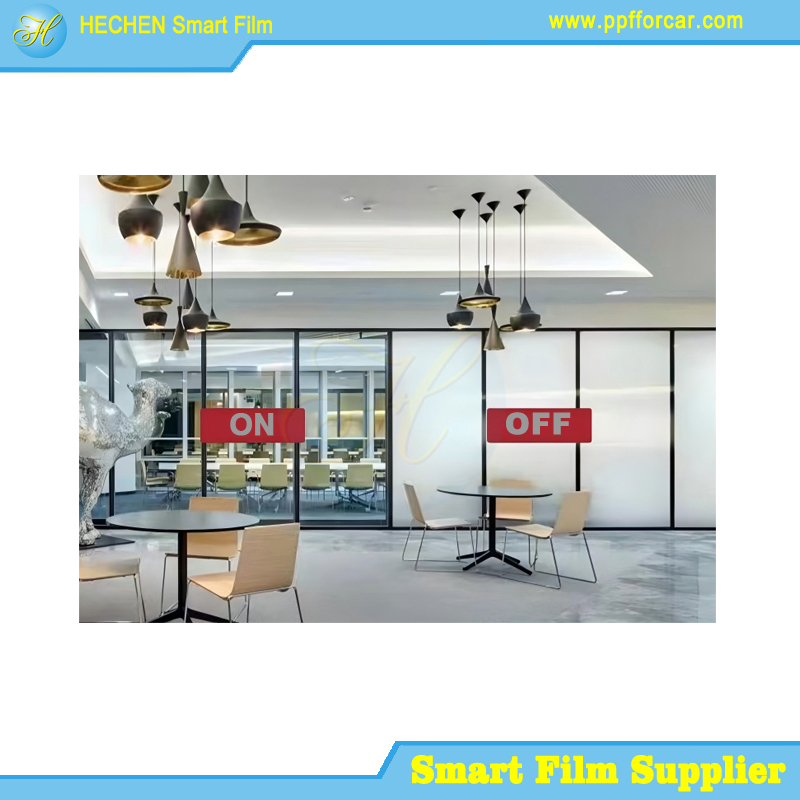
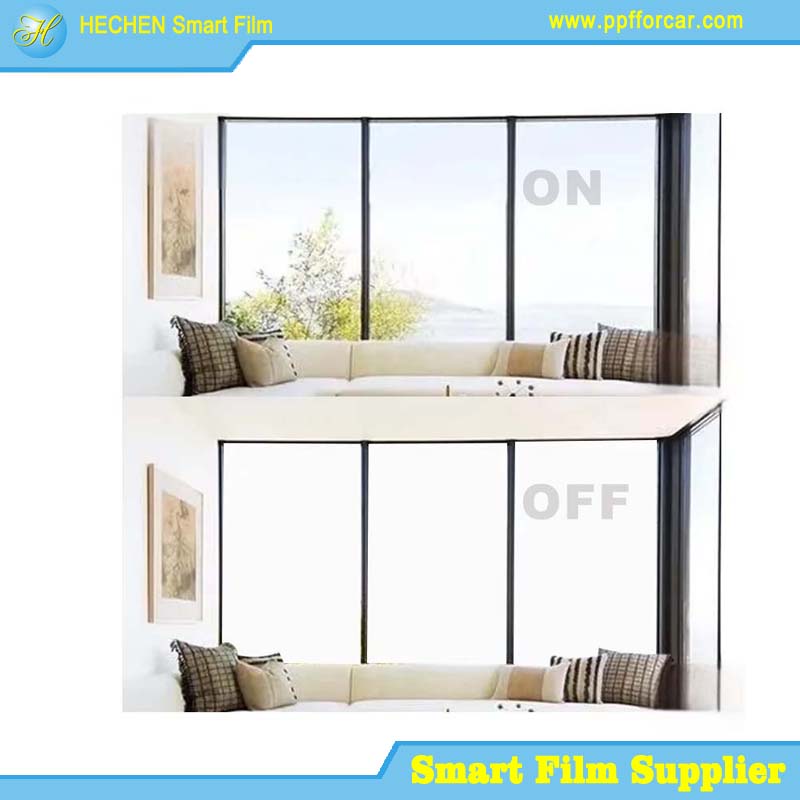
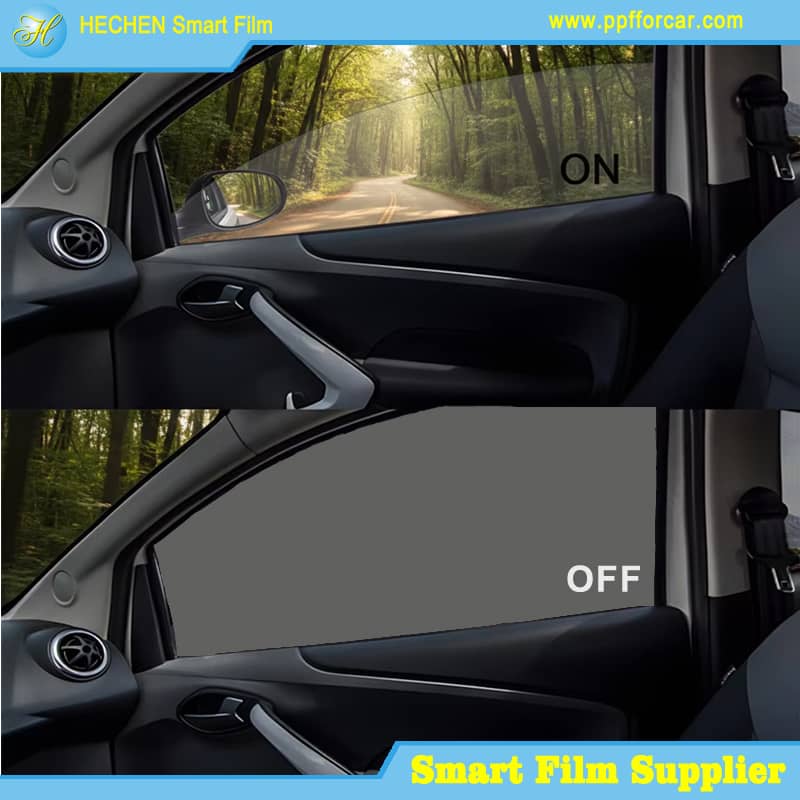
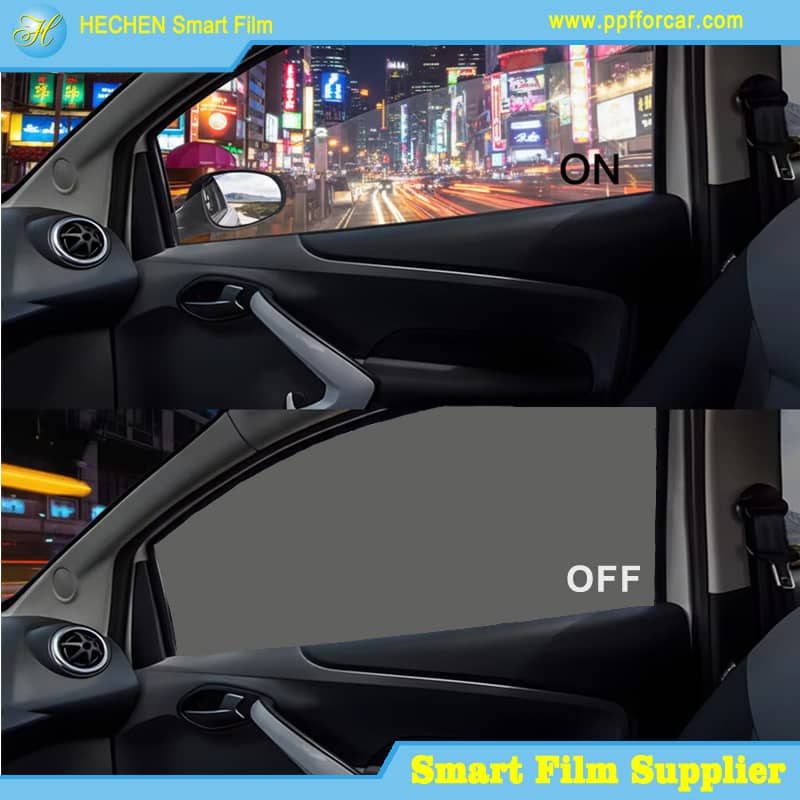
The PDLC layer is a thin polymer matrix containing millions of microscopic droplets of liquid crystals. These liquid crystal molecules have unique optical properties. In their natural, unpowered state, they are randomly oriented. This random orientation causes light passing through the film to be scattered in multiple directions. The light doesn't pass through in a straight line; instead, it is diffused, rendering the film opaque and milky-white. This is the "Off" state.
When an alternating current (AC) voltage is applied across the two conductive ITO layers, an electric field is created through the PDLC layer. This field forces the liquid crystal droplets to align uniformly in the same direction. In this aligned state, the liquid crystals become transparent, allowing light to pass through with minimal scattering. The film instantly switches from opaque to clear. This is the "On" state.
It is crucial to note that the film requires AC power. Most automotive systems use DC power, so a small inverter is required to convert the vehicle's 12V DC to the ~48-65V AC required by the film. The power consumption is remarkably low, typically drawing only 3-5 watts per square meter when in the clear state.
2. Types of Switchable Films for Automotive Use
While the core PDLC technology is common, the form factor has evolved to meet specific automotive requirements.
Self-Adhesive Film (Retrofit): This is the most common type for the aftermarket. It resembles traditional window tint but has the multi-layer smart structure. It is installed on the interior surface of the existing glass. Wires are carefully routed from the film's bus bars (conductive strips along the edge) to the vehicle's power system and a control switch.
PDLC Glass (OEM): For original equipment manufacturers, the PDLC layer can be laminated directly between two pieces of glass during the manufacturing process. This creates a factory-sealed, highly durable smart glass unit that is integrated into the vehicle's electronics, as seen in some high-end luxury cars for panoramic roofs.
Dimmable Film (Electrochromic): A different technology, electrochromic film, darkens gradually like transition lenses. While used in some automotive applications (e.g., the Mercedes-Benz Magic Sky Control roof), PDLC remains the dominant technology for instant switching between clear and opaque states, which is preferred for privacy.
3. Installation: A Precision Task for Professionals
Installing switchable smart film is significantly more complex than applying standard tint. It requires a high level of skill, not just in film application, but also in electrical work. The process typically involves:
Preparation: The window is meticulously cleaned in a dust-free environment to ensure no particles are trapped, which would be permanently visible.
Cutting: The film is precision-cut to match the exact contours of the car window. For rear windows with defroster lines or radio antennas, special care must be taken, and the installer must verify compatibility, as the conductive lines can sometimes interfere with the film's electrical field.
Application: Using a slip solution, the film is carefully positioned on the inside of the glass. A squeegee is used to remove all air and excess liquid from between the film and the glass.
Electrical Connection: This is the most critical and challenging step. The film has two thin bus bars (typically made of copper) along one edge. Ultra-thin wires must be soldered or attached to these bus bars using a conductive adhesive. These wires are then routed through the window seal, down the door panel (using the existing rubber boot for the wiring harness), and connected to the control unit. This routing is delicate; if done poorly, it can lead to water leaks or wire breakage.
Integration: The wires are connected to the AC inverter and a control switch. The switch can be a simple toggle, a button integrated into the dashboard, or even connected to a smart home system for luxury vehicles. The system is then fused and connected to a 12V power source.
4. Technical Benefits and Performance Analysis
Why would a car owner or manufacturer choose switchable film over a premium static ceramic tint? The advantages are both functional and experiential.
On-Demand Privacy and Security
The primary benefit is the ability to switch from a completely clear view to instant privacy. With a flip of a switch, the windows become opaque, shielding the car's interior and its occupants from view. This is invaluable for:
Campers and Vans: Creating a private sleeping area without the need for cumbersome curtains or external window covers.
Luxury Vehicles: Protecting high-value items left in the car.
Security: In its opaque state, potential thieves cannot see into the vehicle, acting as a powerful deterrent.
Enhanced Comfort and Thermal Management
While not primarily a thermal barrier, the multi-layer structure of smart film provides significant insulation.
Solar Rejection: High-quality smart films incorporate infrared (IR) rejection properties, blocking a substantial portion of the sun's heat before it enters the cabin, similar to premium ceramic tint.
UV Protection: The film blocks over 99% of harmful UVA and UVB rays, protecting the skin of occupants and preventing the car's interior (leather, dash, upholstery) from fading and cracking.
Insulation: The multiple layers of PET and the PDLC itself add a layer of insulation to the glass, helping to keep heat in during the winter and out during the summer, reducing the load on the HVAC system.
Modern Aesthetics and Ambiance
The technology adds a "wow" factor. The instantaneous transformation is visually striking. Furthermore, the opaque state has a smooth, matte-white appearance that can be used as a projection surface for rear-seat entertainment systems, a feature impossible with traditional dark tint.
Glare Reduction
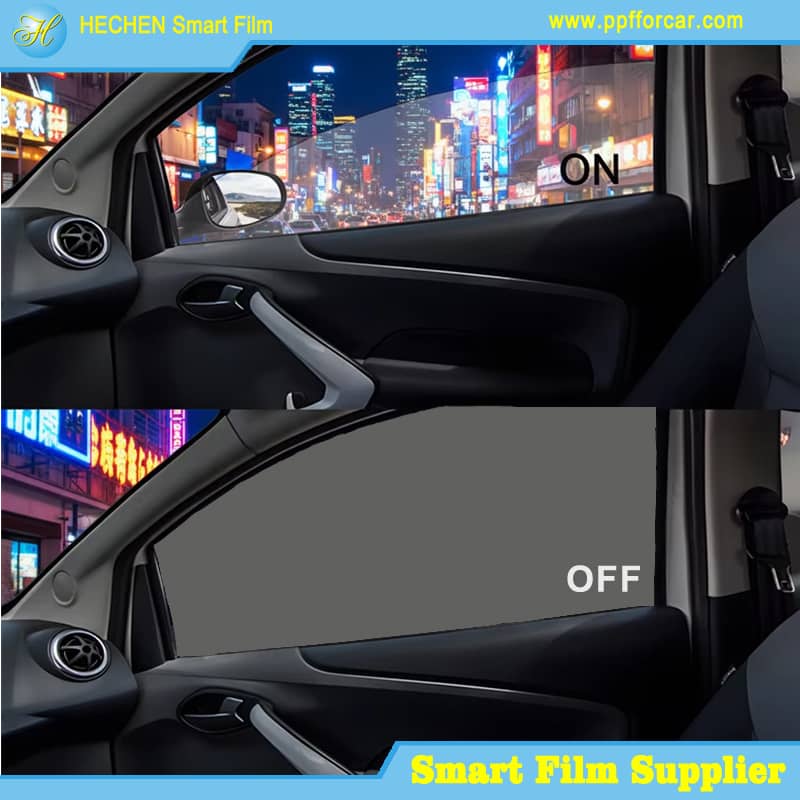
In the "Off" (opaque) state, the film diffuses incoming light, significantly reducing glare from headlights at night or direct sunlight, making for a more comfortable experience.
5. Technical Challenges and Considerations
Despite its impressive capabilities, switchable smart film is not without its challenges, which have limited its mass-market adoption.
The "Haze" Factor
In its clear ("On") state, PDLC film is not perfectly transparent. It typically exhibits a slight haze, usually between 2% and 5%. While this is barely perceptible to the naked eye, it is a physical characteristic of the light-scattering technology. For a driver looking through a windshield (where smart film is generally not recommended or legal), this haze could be a safety concern. For side and rear windows, it is usually unnoticeable.
Power Dependency
The default state of the film is opaque. To have clear windows, the system must be constantly powered. If the vehicle's electrical system fails or the fuse blows, the windows will revert to their opaque state. While generally safe, this is an important consideration for driver visibility.
Cost
The cost of materials and the highly specialized labor required for installation make switchable smart film significantly more expensive than even the highest-end traditional tint. A full-vehicle installation can cost several thousand dollars, placing it in the premium segment of the market.
Longevity and Durability
The automotive environment is harsh, with extreme temperature fluctuations, constant UV exposure, and vibration. While modern films are more robust than early generations, the long-term durability of the ITO coatings and the PDLC emulsion under these conditions is a consideration. The lifetime of a quality smart film is typically rated for many years, but it has not yet proven to be as "fit and forget" as a 20-year static tint.
Legal Compliance
Window tint laws vary widely by jurisdiction. Since the opacity of the film is variable, it can create a legal gray area. A car might pass inspection when the film is clear but be in violation when it is opaque. It is the owner's responsibility to ensure their usage complies with local regulations, particularly for front side windows.
6. The Future of Automotive Smart Glass
The technology is rapidly evolving. Current research and development are focused on addressing the existing limitations:
Dual-Function Films: New generations of smart film are integrating electrochromic technology with PDLC. This would allow the film not only to switch from clear to opaque but also to dim to a dark tint, providing better heat and glare control in the "clear" state.
Improved Clarity: Manufacturers are working to reduce the "haze" factor to near-zero, making the clear state indistinguishable from normal glass.
Plastic Substrates: Moving away from glass to more advanced, durable plastics for the film's base layers could improve longevity and ease of installation.
Wireless Control: Integration with vehicle CAN-Bus systems and IoT platforms will allow for automated control—for example, the windows could automatically turn opaque when the car is parked, or the roof could tint based on the intensity of the sun.
Conclusion
Switchable smart film represents a monumental leap forward from static window tinting. By harnessing the precise manipulation of liquid crystals, it offers a dynamic solution that marries privacy, comfort, and advanced technology. While challenges related to cost, installation complexity, and long-term durability remain, the benefits are undeniable. As the technology matures and becomes more accessible, it is poised to transition from a niche luxury feature to a standard expectation in modern vehicles, quite literally changing how we see the world through our car windows.
For more about a technical deep dive into switchable smart film for car window tinting, you can pay a visit to Hechen PDLC Smart Film Manufacturers for more info.