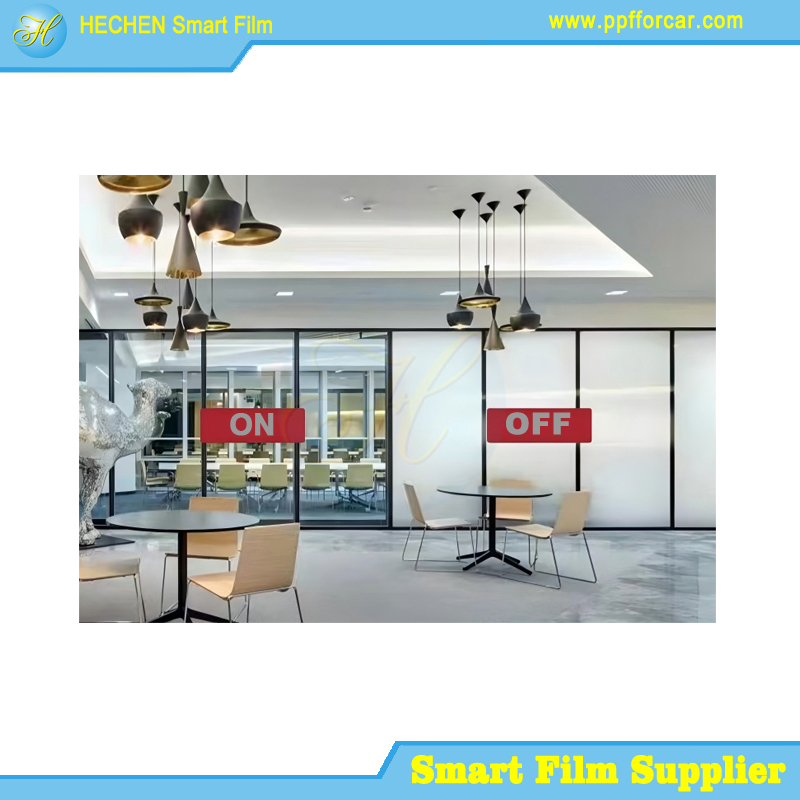
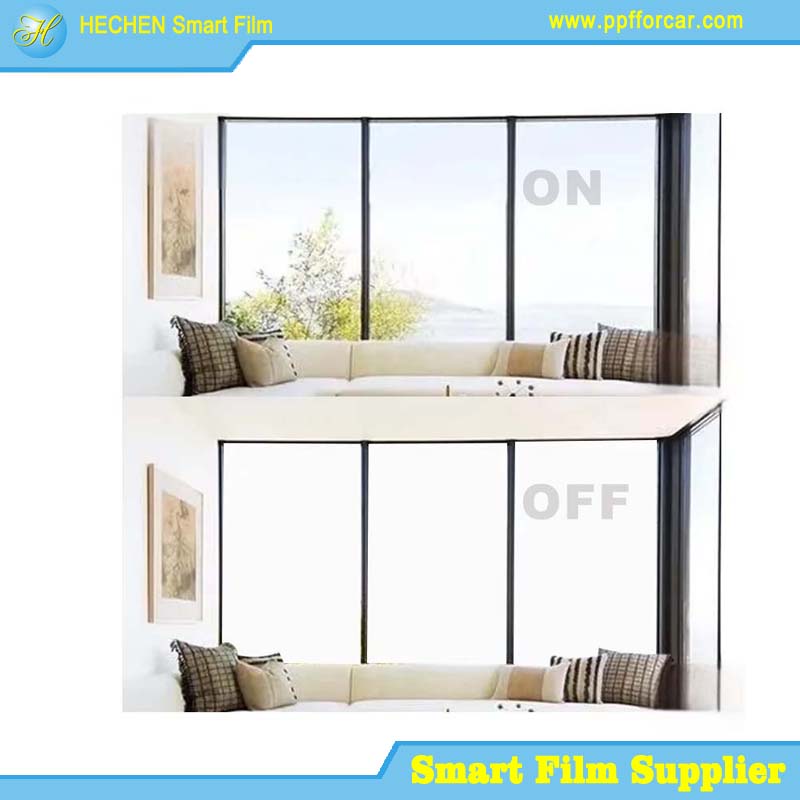
How Does SPD Smart Film Work in Cars?
As the automotive industry moves toward smarter, more connected, and energy-efficient vehicles, SPD Smart Film has become one of the most advanced glazing technologies available. Unlike traditional window tint, SPD smart film allows drivers and passengers to instantly adjust window transparency using electricity, providing superior comfort, glare reduction, and solar heat management.
Many premium automotive manufacturers are already integrating SPD smart glass technology into panoramic roofs, side windows, and sunroofs to improve driving comfort while reducing reliance on air conditioning.
So, how does SPD smart film work? What makes it different from conventional tint films or other smart glass technologies?
This technical guide explains the science behind automotive smart glazing, how SPD smart tint works, its electrical operating principles, performance advantages, and why it has become the preferred solution for luxury vehicles.
What Is Suspended Particle Device Technology?
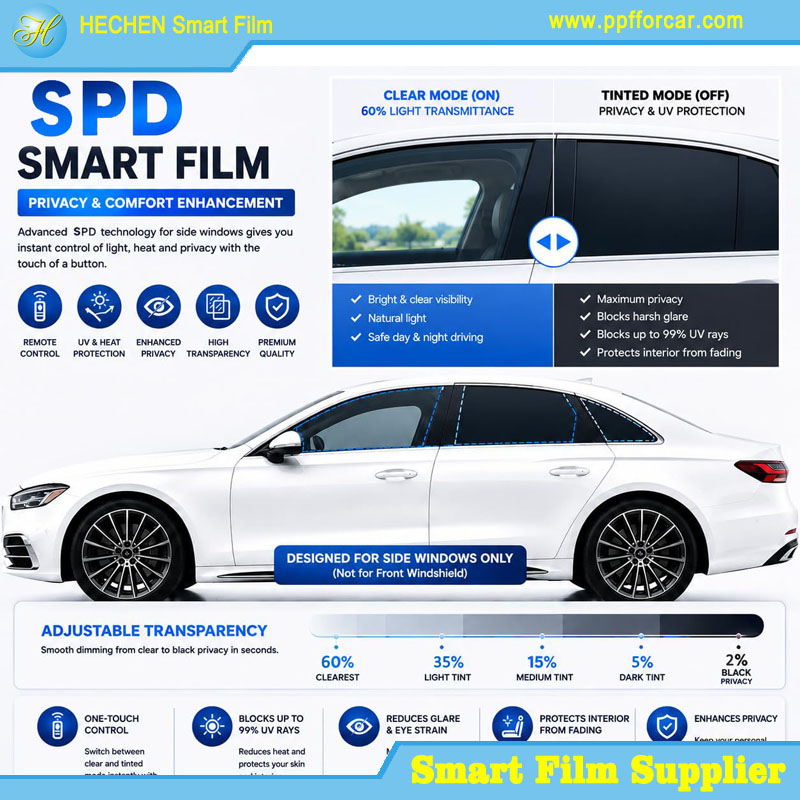
Suspended Particle Device (SPD) technology is an electrically controlled light management system that changes the transparency of glass or film by aligning microscopic light-absorbing particles.
Unlike adhesive window tint, SPD technology actively controls the amount of visible light and solar energy passing through automotive glass.
An SPD smart film typically consists of several layers:
PET protective layers
Conductive ITO (Indium Tin Oxide) coatings
SPD particle suspension
Laminating adhesive
Electrical busbars
At the heart of the system is a proprietary liquid suspension containing millions of microscopic particles. These particles respond almost instantly to an alternating electric field.
Without electricity, the particles are randomly oriented, absorbing and blocking incoming light, making the glass appear dark.
When voltage is applied, the particles align in the direction of the electric field, allowing light to pass through the material.
This process enables continuously adjustable tint rather than a simple ON/OFF switching effect.
Because the particles physically rotate rather than changing molecular states, SPD smart glass technology provides smooth transitions across multiple tint levels.
How Does SPD Smart Film Work?
Understanding how does SPD smart film work requires examining the interaction between electricity and suspended particles.
The process can be divided into four stages.
Step 1: No Power Applied
When no electrical current is supplied:
suspended particles are randomly dispersed
light is scattered and absorbed
visible light transmission (VLT) remains very low
glass appears dark blue or black
In this state:
glare is minimized
solar heat is significantly reduced
passenger privacy increases
Unlike ordinary tint film, the darkness comes from active particle orientation rather than permanent dye.
Step 2: AC Voltage Is Applied
When alternating current (AC) is supplied through the conductive ITO layer:
an electric field forms
microscopic particles rotate
particles align in parallel
This alignment dramatically increases light transmission.
Instead of scattering light, the particles now create transparent channels through which sunlight can pass.
Step 3: Adjustable Transparency
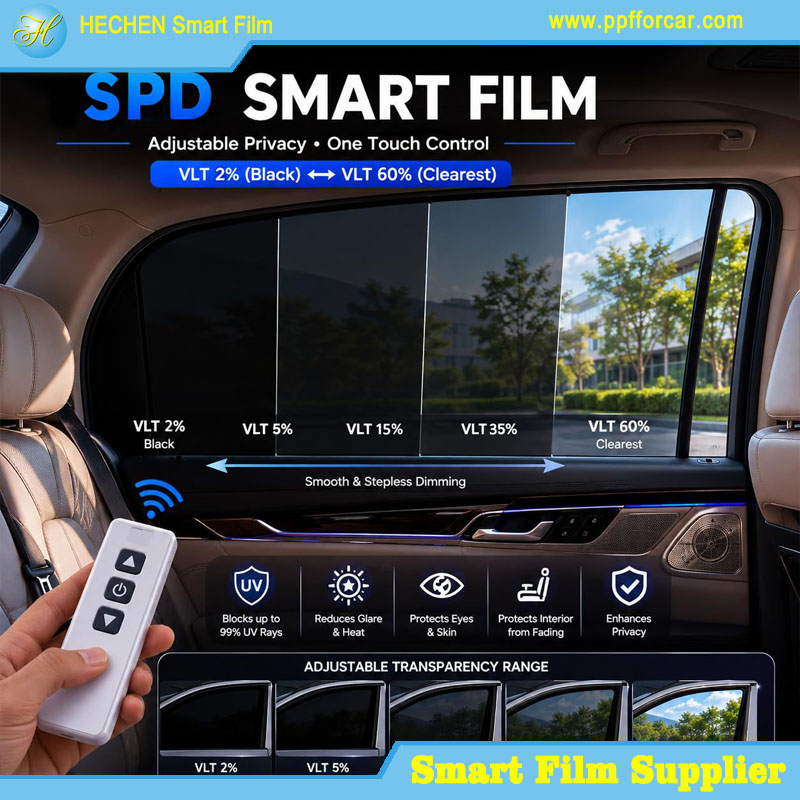
One of the greatest advantages of SPD technology is continuous adjustment.
By varying the applied voltage, users can choose nearly any tint level between dark and clear.
Typical visible light transmission ranges include:
| Tint Level | Approximate VLT |
|---|---|
| Dark | 1–5% |
| Medium | 15–25% |
| Light | 35–45% |
| Nearly Clear | 50–60% |
This variable tint capability makes SPD ideal for:
panoramic roofs
sunroofs
side windows
aircraft windows
yacht glazing
Unlike electrochromic glass, SPD changes occur almost instantly.
Step 4: Instant Response
As voltage changes:
particles continuously rotate
transparency adjusts smoothly
switching occurs within seconds
Passengers experience seamless transitions without flickering or visible distortion.
This explains how SPD smart tint works in modern vehicles.
How Light Transmission Is Controlled
Light transmission is the defining feature of SPD smart glass technology.
Instead of blocking sunlight permanently like dyed films, SPD dynamically regulates incoming light.
Three key mechanisms are involved.
Particle Alignment
Aligned particles allow visible light to pass directly through the glazing.
The higher the alignment efficiency, the greater the transparency.
Optical Absorption
When particles become randomly distributed, they absorb incoming light instead of transmitting it.
This reduces:
brightness
glare
solar radiation
Continuous Modulation
Unlike switchable privacy glass, SPD offers analog adjustment.
Users can continuously control:
brightness
transparency
solar gain
cabin comfort
Many luxury vehicles integrate SPD controls into:
touchscreen displays
roof control modules
voice assistants
smartphone applications
Solar Heat Rejection
An important function of automotive smart glazing is reducing solar heat.
SPD glazing can reject a significant portion of solar energy while maintaining outward visibility.
Benefits include:
cooler cabin temperatures
reduced air conditioner usage
improved passenger comfort
lower energy consumption in electric vehicles
Because electric vehicles rely heavily on battery efficiency, reducing HVAC load can contribute to extended driving range.
UV Protection
SPD smart film also blocks nearly all harmful ultraviolet radiation.
Typical UV rejection exceeds 99%.
Benefits include:
reduced dashboard fading
leather protection
interior color preservation
improved passenger skin protection
Unlike standard tint films that gradually degrade, laminated SPD systems maintain UV performance throughout their service life.
Glare Reduction
Direct sunlight causes visual fatigue during driving.
SPD smart film dynamically reduces glare by automatically darkening when sunlight intensity increases.
Applications include:
panoramic roofs
front sun visors
rear passenger glass
luxury limousine partitions
Drivers experience improved visibility without sacrificing outside views.
Power Consumption
Many buyers assume SPD requires substantial electrical power.
In reality, power consumption is relatively low.
SPD consumes electricity only to maintain particle alignment.
Typical automotive systems require only a few watts per square meter.
Characteristics include:
low operating current
AC power supply
stable voltage
long service life
When darker tint is desired, power demand decreases because particles naturally return to their random state after voltage reduction.
This makes SPD particularly attractive for electric and hybrid vehicles.
Tint Adjustment Process
One major advantage of how SPD smart tint works is its infinitely adjustable tint.
Unlike films with only "dark" and "clear" modes, SPD allows smooth brightness control.
The adjustment process typically follows these steps:
Manual Control
Users select tint level using:
dashboard controls
touchscreens
rotary switches
Automatic Sensors
Premium vehicles may integrate:
sunlight sensors
ambient light sensors
temperature sensors
The system automatically changes transparency according to outside conditions.
Intelligent Vehicle Integration
Modern vehicles can synchronize SPD glazing with:
climate control
seat cooling
navigation
driving modes
For example:
Sport Mode may increase transparency for better visibility.
Park Mode may darken windows for passenger comfort.
SPD vs PDLC Working Principle
Many people confuse SPD with PDLC because both are electrically switchable films.
However, their operating principles are fundamentally different.
| Feature | SPD Smart Film | PDLC Smart Film |
|---|---|---|
| Main Function | Variable tint | Privacy switching |
| Appearance OFF | Dark | Frosted |
| Appearance ON | Clear with adjustable tint | Transparent |
| Light Control | Continuous | On/Off |
| Privacy | Moderate | Excellent |
| Glare Reduction | Excellent | Limited |
| Solar Heat Control | Excellent | Moderate |
| Outdoor Visibility | Maintained | Maintained when ON |
| Best Application | Automotive glazing | Office partitions |
SPD Technology
Suspended particles rotate inside a liquid suspension.
Transparency depends on particle orientation.
Ideal for sunlight management.
PDLC Technology
Liquid crystals scatter light when unpowered.
Applying electricity aligns the crystals, making the film transparent.
PDLC focuses on privacy rather than solar control.
Why Luxury Cars Prefer SPD
Many premium automotive manufacturers select SPD because it delivers a superior balance between comfort, aesthetics, and energy efficiency.
Typical applications include:
panoramic glass roofs
executive rear cabins
premium sunroofs
luxury limousines
Luxury brands value SPD because it provides:
Better Passenger Comfort
Passengers enjoy reduced glare without losing scenic views.
Premium Appearance
Dark panoramic roofs create a modern, high-end design language.
Improved Thermal Performance
Less solar heat means:
lower cabin temperature
quieter HVAC operation
improved energy efficiency
Enhanced Driving Experience
Drivers experience:
reduced eye fatigue
better visibility
greater comfort during long trips
Smart Vehicle Integration
SPD integrates easily with modern vehicle electronics.
Possible control methods include:
touchscreens
smartphone apps
voice assistants
automatic sensors
These intelligent features align with the growing trend toward connected and software-defined vehicles.
Future of Automotive Smart Glazing
The market for automotive smart glazing continues to expand as manufacturers prioritize energy efficiency, passenger comfort, and intelligent vehicle design.
Future developments are expected to include:
AI-controlled adaptive tinting
integration with autonomous driving systems
larger panoramic glass roofs
lower power consumption
improved optical clarity
wider aftermarket availability
As electric vehicles become more common, SPD technology is likely to play an increasingly important role in reducing cabin heat and optimizing battery efficiency.
Conclusion
Understanding how does SPD smart film work helps explain why this technology is becoming a preferred solution for modern automotive glazing.
Unlike conventional window tint, SPD smart glass technology actively controls light transmission through electrically aligned suspended particles, enabling smooth, continuously adjustable tint levels. This delivers excellent glare reduction, solar heat control, UV protection, and enhanced passenger comfort without obstructing outward visibility.
Compared with traditional tint films and PDLC privacy films, SPD smart tint is specifically engineered for dynamic solar management, making it ideal for panoramic roofs, sunroofs, side windows, and other premium automotive smart glazing applications.
As luxury vehicles and electric cars continue to adopt intelligent glass technologies, SPD smart film is expected to become a key component in next-generation automotive design, combining comfort, efficiency, and sophisticated aesthetics in a single solution.
Recommended linking:
Everything You Need to Know About SPD Smart Film for Cars
Recommend related products: