Remote Control PDLC for Cars: Revolutionizing Privacy, Comfort, and Energy Efficiency
Remote Control PDLC for Cars: Revolutionizing Privacy, Comfort, and Energy Efficiency
The modern automobile is undergoing a transformation from a purely mechanical conveyance to a sophisticated, connected "smart device on wheels." This evolution extends beyond powertrains and infotainment to the very materials that constitute the vehicle's shell. Among the most innovative of these smart materials is Polymer Dispersed Liquid Crystal (PDLC) film, controlled remotely, which is redefining the functionality of automotive glazing. This technical article explores the principles, implementation, benefits, and future trajectory of remote-controlled PDLC car systems in the automotive industry, detailing how this technology is creating dynamic, adaptive windows and sunroofs that enhance privacy, thermal comfort, and energy management.
1. From Static Glass to Dynamic Smart Surfaces
Automotive glazing has traditionally served two primary, static functions: providing structural integrity and visibility. Tinting has offered a partial solution for privacy and solar glare reduction, but it is a fixed compromise, often illegal at certain darkness levels for front side windows. The advent of PDLC technology, long used in architectural and interior design, introduces a dynamic, on-demand solution. When integrated with a remote control system—encompassing physical fobs, in-dash buttons, smartphone apps, and eventually voice or gesture commands—PDLC empowers occupants to instantaneously alter the optical state of their windows and sunroofs. This shift from passive to active glazing marks a significant step towards fully customizable and intelligent vehicle cabins.
2. Technical Foundation: How PDLC Works
At its core, PDLC is a composite film sandwiched between two layers of conductive material (typically Indium Tin Oxide, ITO-coated polyester or glass). The film itself consists of microscopic liquid crystal droplets dispersed within a polymer matrix.
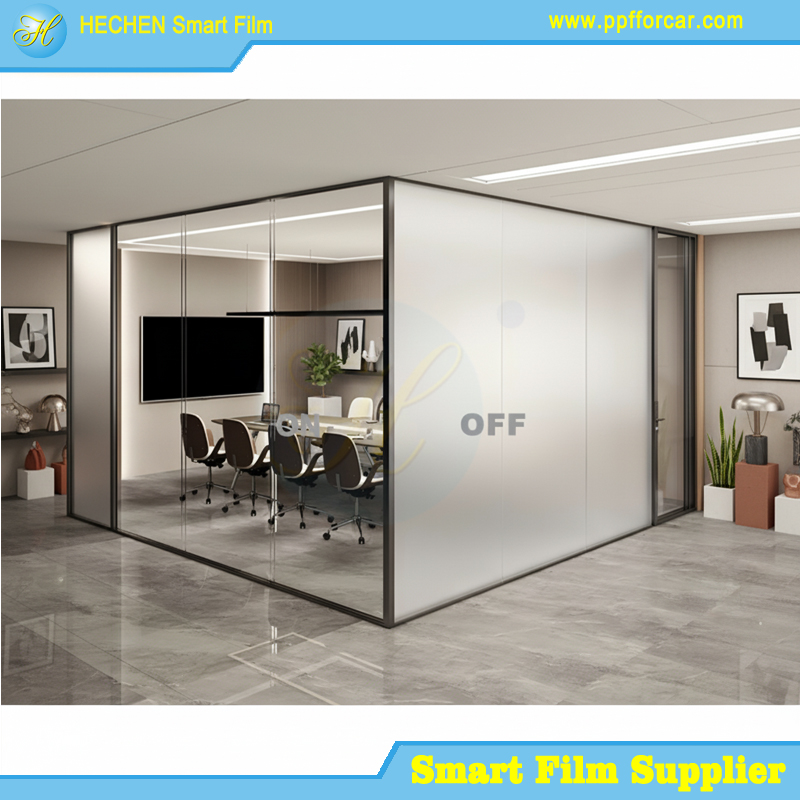
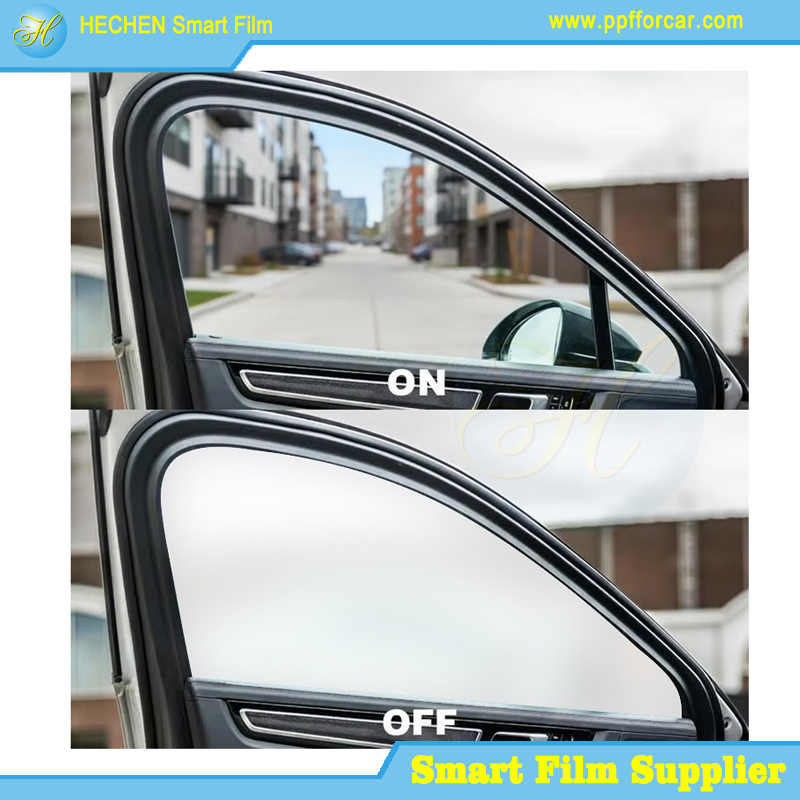
In the "Off" State (Opaque/Translucent): When no voltage is applied, the liquid crystals within the droplets are randomly oriented. Their refractive indices do not match that of the surrounding polymer, causing light to scatter at each droplet-polymer interface. This scattering effect gives the film a milky-white, translucent appearance, effectively providing privacy and diffusing light.
In the "On" State (Transparent): When an alternating current (AC) voltage (typically 50-110V AC, but at very low current) is applied across the conductive layers, an electric field is created. The liquid crystals align themselves parallel to the field. In this aligned state, the refractive index of the crystals matches that of the polymer more closely, allowing light to pass through with minimal scattering, rendering the film clear.
The transition is rapid (typically 0.1 to 1 second) and reversible. The "remote control" aspect is not directly controlling the film but the power supply that applies this voltage.
3. System Architecture of a Remote-Controlled Automotive PDLC System
A fully implemented remote control PDLC car system in a vehicle is a distributed electronic network.
The PDLC Element: The smart film laminate, integrated into the glass or polycarbonate panel.
The Inverter/Power Supply: A crucial safety component. It converts the vehicle's low-voltage DC (12V/48V) to the required high-voltage, low-current AC signal. Modern inverters are compact, efficient, and designed for automotive environmental standards (vibration, temperature extremes).
The Control Unit (ECU): A dedicated or integrated Electronic Control Unit manages the logic. It receives commands from input interfaces and sends precise signals to the inverter(s). It may also handle fail-safes and system diagnostics.
User Input Interfaces (The "Remote Control" Spectrum):
Hardwired Buttons: Dedicated physical switches on the door panel, center console, or overhead console for direct control.
Touchscreen HMI: Integration into the vehicle's main infotainment screen, allowing control via a software interface, often with zone selection (e.g., "all windows," "rear only," "sunroof").
Key Fob/Physical Remote: A button on the key fob to toggle the state before entering the vehicle, useful for privacy or pre-cooling.
Smartphone Application (Telematics): Through a connected vehicle platform (e.g., via 4G/5G or Bluetooth), users can control glazing from outside the vehicle. This is powerful for pre-conditioning—opaque the sunroof on a hot day while parked to reduce cabin temperature.
Voice Commands: Integrated with systems like Google Assistant, Alexa, or the native vehicle voice AI ("Hey BMW, make the sunroof opaque").
Gesture Control: Cameras detecting specific hand movements to trigger changes.
Automated Triggers: The system can be integrated with other vehicle sensors for autonomous operation:
GPS/Light Sensor: Auto-opaque the sunroof when the sun is at a high zenith angle.
Ignition State: Auto-clear all windows when the vehicle is put into drive for safety.
Proximity Lock/Unlock: Opaque windows upon locking for privacy; clear upon unlocking.
4. Automotive Applications and Use Cases
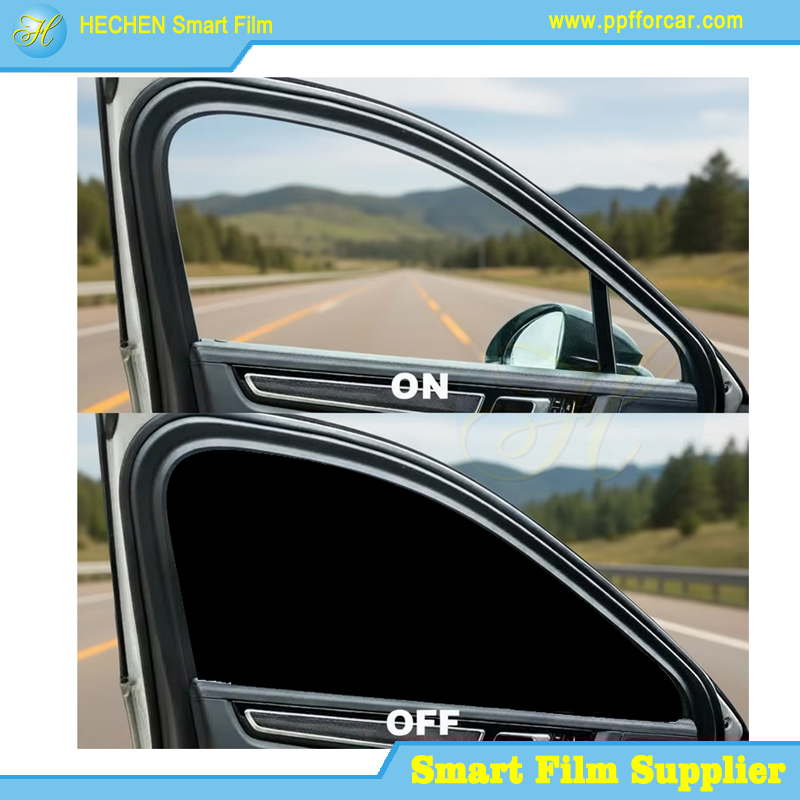
Sunroofs & Panoramic Roofs: The most prominent application. It transforms a large glass roof from a source of heat and glare into an adaptable element. Occupants can enjoy an open, airy feel when desired and instant shade when needed, without a mechanical blind.
Rear & Side Windows: Enhances passenger privacy in limousines, VIP transport, and premium SUVs. Rear-seat occupants can instantly create a private compartment. It also deters theft by obscuring the view of valuables inside a parked car.
Partitions: In ride-sharing or chauffeur-driven vehicles, an electrically controlled PDLC partition between driver and passengers can be toggled for privacy or communication.
Rear Windshields: While less common due to critical visibility requirements, partial application (top section) for glare reduction is possible.
Smart Mirrors: PDLC can be used in auto-dimming rearview and side mirrors, though electrochromic technology is more established here.
5. Technical Advantages and Benefits
Dynamic Privacy & Security: On-demand privacy is a primary benefit, eliminating the need for permanent, potentially illegal tints.
Thermal Comfort & Energy Efficiency: In its opaque state, PDLC film reflects a significant portion of solar radiant heat (Total Solar Energy Rejection can exceed 50%). This reduces the thermal load on the Vehicle Climate Control System, leading to lower energy consumption. In Electric Vehicles (EVs), this directly translates to extended driving range by reducing HVAC power draw.
Glare Reduction: Effectively mitigates glare from the sun and headlights, improving occupant comfort and safety.
Aesthetic & UX Enhancement: Adds a "wow" factor and a sense of technological sophistication. The smooth, instant transition is visually striking.
Weight & Space Savings vs. Mechanical Blinds: Replaces bulky, mechanical sunshades with a thin-film laminate, saving weight (crucial for EVs) and freeing up headliner space.
6. Challenges and Considerations
Power Consumption: While the film itself draws minimal power (a few watts per square meter) in its steady transparent or opaque state, the brief switching surge and the constant need for the inverter to be online require careful power management design.
Cost: PDLC film, coupled with the specialized inverter and integration, is significantly more expensive than standard glass or even electrochromic alternatives. It remains a premium feature.
Optical Clarity: In the clear state, PDLC film does not achieve the 100% optical clarity of untreated glass. There can be a slight haze or milky residual, especially with lower-quality films or large panels.
UV Stability & Longevity: Automotive environments are harsh. Prolonged exposure to high UV radiation and extreme temperatures can degrade the film over time (yellowing, delamination), requiring high-stability polymer and LC formulations.
Regulatory Compliance: For front side windows and windshields, regulations mandate high levels of constant visibility and light transmission (typically >70% in many regions). This makes PDLC application in these zones challenging, as the opaque state would be non-compliant for driving. Its use is therefore primarily for rear passenger and roof areas.
Haze in the Opaque State: The opaque state is translucent, not blackout. It diffuses light but doesn't create total darkness, which may be a limitation for some users.
7. The Future Outlook and Integration with Vehicle Ecosystems
The future of remote-control PDLC car lies in deeper integration and material science advancements:
Integration with V2X and Autonomous Driving: In self-driving vehicles, where occupant activities may vary (work, rest, entertainment), dynamic glazing becomes part of the "scene setting." Coupled with biometric sensors, it could auto-adjust based on occupant state (e.g., opaque for sleeping).
Advanced Energy Harvesting Integration: Combining PDLC with transparent photovoltaic cells in the glass could create a roof that not only manages heat but also generates electricity to power the system or supplement the low-voltage battery.
Dimmable Glass Alternatives: Suspended Particle Device (SPD) and Electrochromic (EC) glass offer different performance profiles (SPD offers variable tint levels from dark to clear; EC is slower but can go darker). The market may see competition or hybrid solutions depending on the application.
Improved Materials: Research into new liquid crystal modes and polymer matrices aims to reduce driving voltage, improve clarity, enhance UV stability, and lower cost.
"Digital Surface" Concept: PDLC is a stepping stone to windows as full-fledged displays. Future iterations could integrate transparent OLED or Micro-LED, turning windows into informational screens or entertainment displays when parked.
8. Conclusion
Remote-controlled PDLC technology represents a significant convergence of materials science, electronics, and user-centric design in the automotive sector. It transcends the traditional role of glass, transforming it into an active, responsive component of the vehicle's environmental control and comfort system. While challenges related to cost, clarity, and regulation for certain zones persist, the benefits in privacy, thermal management, energy efficiency, and aesthetic appeal are compelling. As the technology matures, costs decrease, and integration with broader vehicle connectivity and autonomy deepens, dynamic smart glazing is poised to evolve from a premium novelty into a standard, defining feature of the intelligent, comfortable, and efficient automobiles of the future. The ability to command one's immediate luminous environment with the press of a button or a simple voice command is more than a luxury; it is a fundamental enhancement to the in-car experience.
For more about the remote control PDLC for cars: revolutionizing privacy, comfort, and energy efficiency, you can pay a visit to Hechen PDLC Smart Film Manufacturers for more info.