What is the Core Electro-Optical Principle of PDLC Smart Window Film for Offices
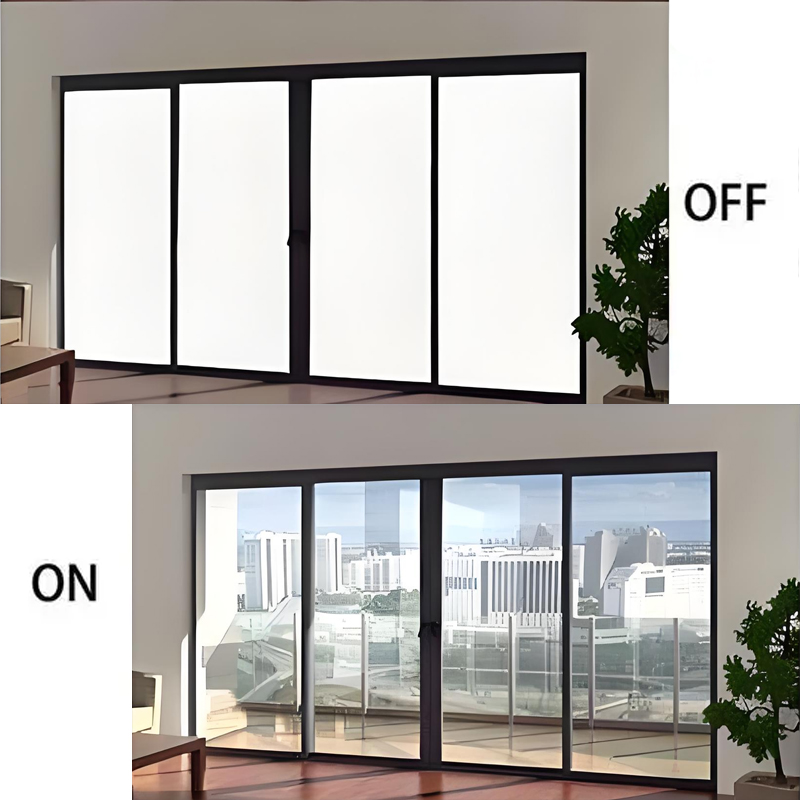
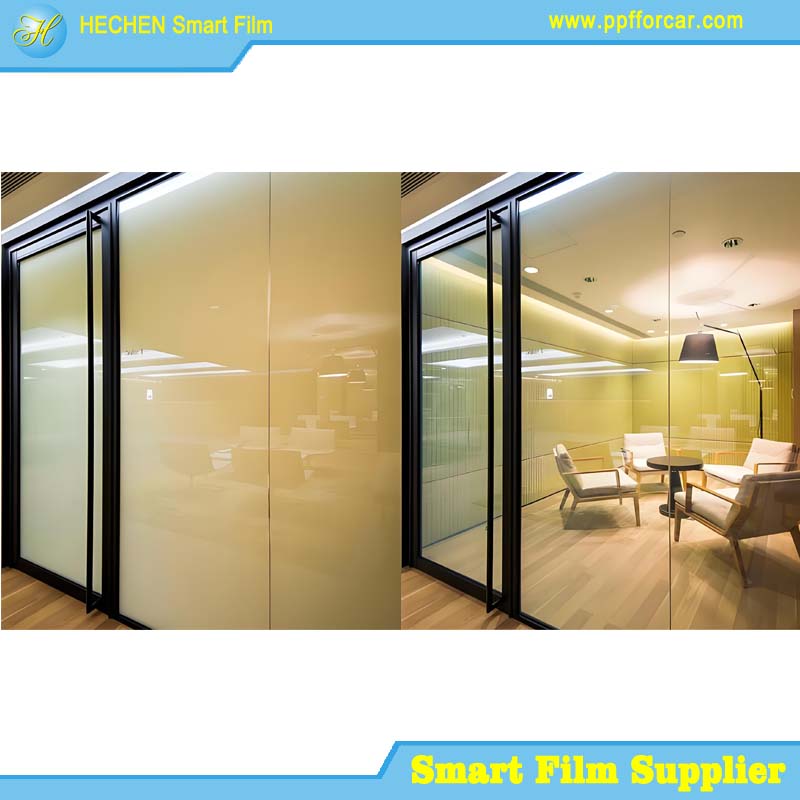
In modern office environments, where energy efficiency, privacy, and visual comfort are increasingly prioritized, Polymer Dispersed Liquid Crystal (PDLC) smart window films have emerged as a transformative technology. These films allow windows to switch dynamically between transparent and opaque states with the simple application of an electric field, offering on-demand control over light transmission, heat gain, and visibility. Unlike traditional blinds or static tints, PDLC films integrate seamlessly into glass surfaces, providing a sleek, futuristic solution that aligns with sustainable building practices. In offices, this means creating adaptable spaces—such as conference rooms that can instantly become private or open-plan areas that balance natural light with glare reduction—without compromising aesthetics or functionality.
The core appeal of PDLC smart window films lies in their electro-optical principle, which leverages the unique properties of liquid crystals embedded in a polymer matrix. This principle enables the film to respond to electrical stimuli, altering its optical properties in milliseconds. As global energy demands rise and buildings account for a significant portion of carbon emissions, PDLC films contribute to less energy-hungry structures by reducing the need for artificial lighting and air conditioning. For instance, in hot climates, these films can block up to 99% of UV rays and significantly cut solar heat gain, leading to potential energy savings of 15-30% in cooling costs. This article delves into the core electro-optical principle of PDLC smart window films, explores the specific physical processes governing the switch between transparent and opaque states, and examines their implications for office applications. By understanding these mechanisms, architects, facility managers, and engineers can better harness this technology for smarter, more efficient workspaces.
The Core Electro-Optical Principle of PDLC Smart Window Films
At the heart of PDLC smart window films is an electro-optical effect rooted in the behavior of liquid crystals (LCs) dispersed within a polymer matrix. Liquid crystals are mesophases—materials that exhibit properties between those of conventional liquids and solid crystals—characterized by elongated molecules that can align in response to external stimuli like electric fields. In PDLC films, these LC molecules are encapsulated as microscopic droplets (typically 1-10 micrometers in diameter) within a solid polymer host, forming a composite material sandwiched between two transparent conductive layers, often made of indium tin oxide (ITO).
The electro-optical principle operates on the modulation of light scattering through refractive index matching. When no electric field is applied, the LC droplets are randomly oriented, causing a mismatch in refractive indices between the LCs and the polymer. This mismatch scatters incident light, rendering the film opaque or translucent. Upon applying an alternating current (AC) voltage—typically 24-110 volts—the electric field aligns the LC molecules, aligning their refractive indices with the polymer's, allowing light to pass through unimpeded and making the film transparent. This switchable behavior is passive in the opaque state (no power required) and active in the transparent state, consuming minimal energy—about 5-10 watts per square meter when on.
PDLC films differ from other smart glass technologies, such as suspended particle devices (SPD) or electrochromic glass, in their scattering-based mechanism rather than absorption or reflection. While SPD aligns particles to control light transmission, PDLC relies on the birefringence of LCs—the difference in refractive index along different axes—which is exploited to control opacity without polarizers, simplifying the design and reducing costs. The principle is electro-optical because the optical state (transmittance) is directly modulated by an electrical input, with no mechanical parts involved, ensuring durability and rapid response times of less than 100 milliseconds.
In office settings, this principle enables versatile applications. For example, PDLC films can be integrated into partition walls or exterior windows, allowing instant privacy for meetings or reducing glare during video calls. Advanced variants, such as reverse-mode PDLC, invert the states—transparent when off and opaque when on—offering even lower energy use for normally clear windows. The technology's scalability, from small office panels to large facades, underscores its relevance in modern architecture, where it supports green building certifications like LEED by enhancing daylighting and thermal performance.
Physical Processes Determining the Opaque State
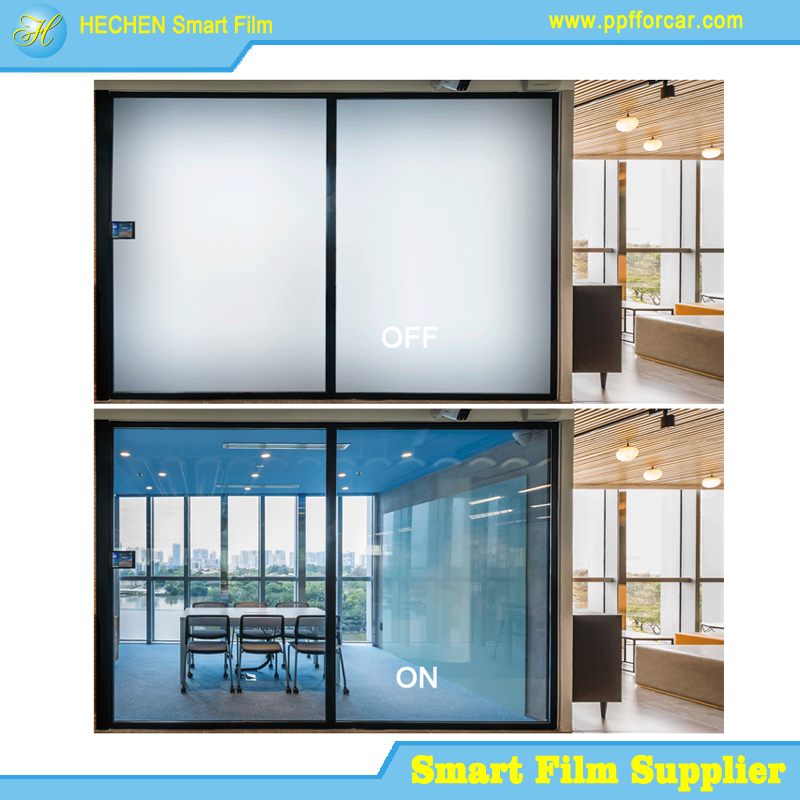
The opaque state of PDLC smart window films, which occurs in the absence of an electric field, is governed by light scattering processes driven by the random orientation of liquid crystal droplets. In this "off" state, the LC molecules within each droplet exhibit no preferred alignment due to thermal agitation and the confining geometry of the polymer matrix. The polymer, typically a UV-cured or thermally set material like polyvinyl butyral or acrylic, encapsulates these droplets, creating a heterogeneous medium where the ordinary refractive index of the LCs (n_o) differs from that of the polymer (n_p).
The key physical process here is Mie scattering or Rayleigh scattering, depending on droplet size relative to the wavelength of light. For droplets larger than the visible light wavelength (around 0.4-0.7 micrometers), Mie scattering dominates, where incident light rays are deflected at various angles due to the index mismatch. This results in diffuse transmission and reflection, making the film appear milky white or frosted, with visible transmittance as low as 4-25%. Smaller droplets enhance scattering efficiency, increasing opacity, but manufacturing controls droplet size to balance performance and cost.
Another critical process is the dielectric anisotropy of the LCs, denoted as Δε = ε_parallel - ε_perpendicular, where ε_parallel and ε_perpendicular are the dielectric constants along and perpendicular to the molecular axis. In the off state, without an external field, the torque on the molecules is zero, maintaining random orientation. This state is stable and energy-efficient, as no power is needed to sustain opacity, making it ideal for office privacy applications where windows remain frosted most of the time.
Environmental factors influence this process; for instance, temperature affects LC viscosity and alignment, with optimal performance between 0-60°C. In offices, this opaque state not only provides privacy but also serves as a projection surface or whiteboard, enhancing multifunctionality. However, excessive scattering can lead to haze, which premium PDLC films minimize to below 5% in the transparent state.
Physical Processes Determining the Transparent State
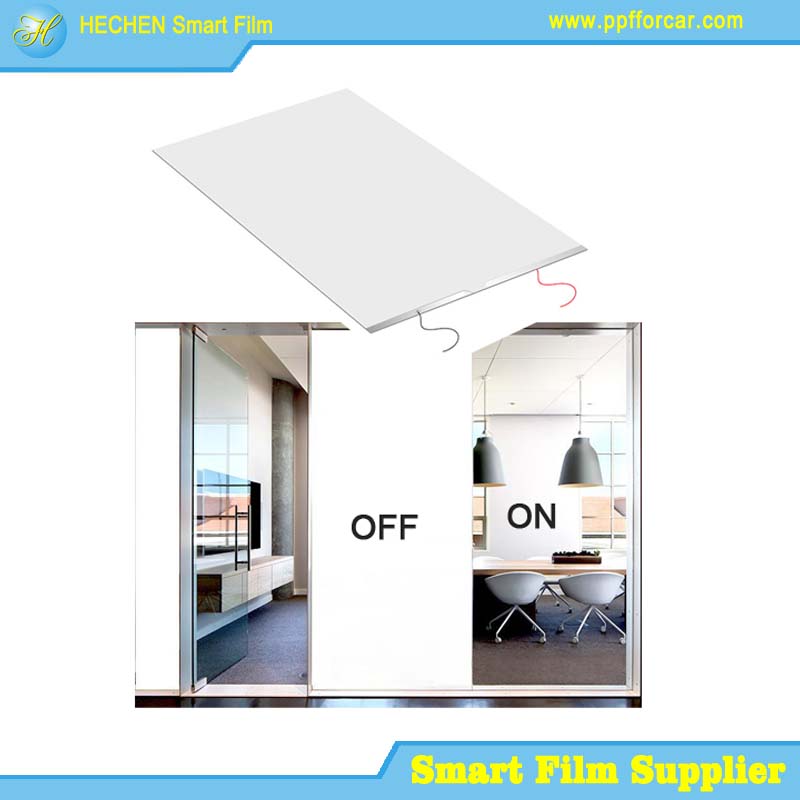
Switching to the transparent state involves applying an electric field, which induces alignment of the LC molecules through dielectric torque. When voltage is applied across the ITO electrodes, the electric field E generates a torque τ = p × E on the LC molecules, where p is the induced dipole moment. For positive dielectric anisotropy LCs (Δε > 0), commonly used in PDLC, molecules align parallel to the field, rotating to minimize energy.
The primary physical process is refractive index matching: in the aligned state, the effective refractive index of the LC droplets approaches n_p, reducing scattering. Light now transmits specularly, with transmittance reaching 50-80% in the visible spectrum. This alignment occurs rapidly, with response times governed by the Freedericksz transition threshold voltage V_th = π √(K / (ε_0 Δε)), where K is the elastic constant and ε_0 is the vacuum permittivity.
Viscoelastic properties play a role; lower viscosity LCs enable faster switching, while polymer morphology affects droplet shape—spherical for isotropic scattering, ellipsoidal for directional effects. In offices, this state allows natural light influx, improving occupant well-being and reducing lighting energy by 20-40%. Dimmable control via voltage variation offers intermediate states, blending privacy and visibility.
Reverse-mode PDLC inverts this: aligned (transparent) off-state via polymer stabilization, scattering when on. For standard PDLC, the on-state consumes power but enables dynamic adaptation.
Factors Influencing Switching Efficiency and Performance
Several physical parameters determine switching efficacy. Droplet size and density affect scattering: optimal 1-5 μm for high contrast. Voltage requirements (threshold ~5-10 V/μm) depend on Δε and film thickness (10-50 μm). Higher Δε lowers driving voltage, enhancing energy efficiency.
Doping with dyes or nanoparticles modifies properties; dye-doped PDLC improves contrast by absorbing scattered light. Thermal stability ensures consistent performance, with phase separation prevented by compatible polymers.
In offices, integration with sensors for automated switching optimizes energy, reducing CO2 emissions by up to 89 kg/m². Limitations include angular dependence—haze increases off-axis—and power needs, though low.
Applications and Benefits in Office Environments
In offices, PDLC smart window films transform spaces: instant privacy for pods, glare reduction in open areas, and energy savings via heat rejection (up to 90% IR blocked). They support hybrid work by enabling flexible layouts, with retrofit options for existing buildings.
Benefits include UV protection (99% blockage), acoustic insulation, and shatter resistance. Studies show improved productivity through better light control. Challenges: initial cost ($50-150/m²), but ROI via energy savings in 3-5 years.
Measurement and Standards for PDLC Performance
Performance is evaluated via standards like ASTM E2141 for haze and transmittance, using spectrophotometers. Switching speed tested per IEC 62896, ensuring <50 ms response. In offices, certifications validate energy impacts.
Future Developments and Challenges
Advancements include lower-voltage PDLC via nanomaterials, integration with IoT for smart buildings. Challenges: scalability, cost reduction, and environmental impact of materials.
Conclusion
The core electro-optical principle of PDLC smart window films—LC alignment in a polymer matrix under electric fields—enables seamless switching between states via scattering and index matching processes. In offices, this fosters efficient, adaptable spaces, driving sustainability. As technology evolves, PDLC will redefine workplace design.
For more about what is the core electro-optical principle of PDLC smart window film for offices, you can pay a visit to Hechen PDLC Smart Film Manufacturers for more info.