What is the Working Principle of the Core PDLC Liquid Crystal Layer in Self Sticky Dimming Film?
Self sticky dimming film, also known as switchable smart film or adhesive PDLC film, is a revolutionary material that transforms ordinary glass surfaces into dynamic, controllable elements. This technology allows users to switch between transparent and opaque states with the application of electricity, offering instant privacy, light control, and energy efficiency. At the heart of this film lies the core PDLC (Polymer Dispersed Liquid Crystal) liquid crystal layer, which is responsible for the electro-optical switching mechanism. This layer enables the film to alter its light transmission properties rapidly, making it ideal for applications in architecture, automotive, healthcare, and retail displays.
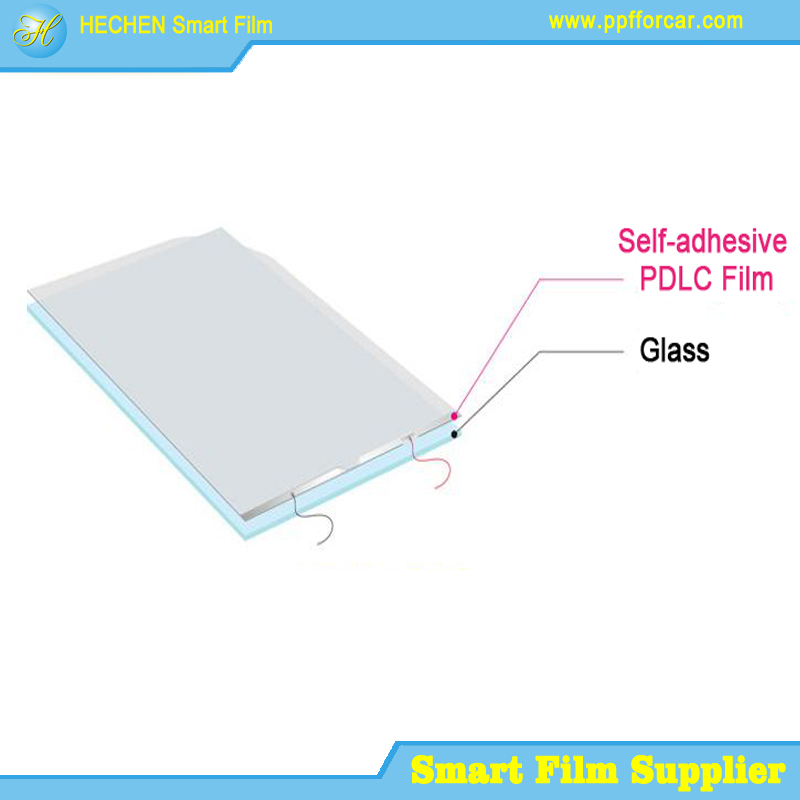
The self sticky variant features a pressure-sensitive adhesive backing, allowing easy application to existing glass without specialized equipment. The film's overall structure typically includes protective layers, conductive ITO (Indium Tin Oxide) films, and the central PDLC layer. Understanding the working principle of this core PDLC layer is essential for appreciating how the film functions and why it performs differently in energized and de-energized states.
This article explores the intricate workings of the PDLC liquid crystal layer, delving into its composition, operational mechanics, and the molecular-level changes that occur during state transitions. We will examine the differences in liquid crystal molecule arrangements between the energized (on) and de-energized (off) states, supported by scientific insights and practical implications. By the end, readers will gain a comprehensive understanding of this technology's principles, enabling informed decisions on its use in various environments.
The development of PDLC technology dates back to the 1980s, when researchers sought to combine the optical properties of liquid crystals with the structural stability of polymers. Early patents focused on encapsulating liquid crystals in polymer matrices to create flexible, switchable films. Today, advancements have refined the PDLC layer to achieve faster response times, higher contrast ratios, and broader temperature tolerances, making self sticky dimming film a staple in smart building materials.
Overview of PDLC Technology
Polymer Dispersed Liquid Crystal (PDLC) technology forms the backbone of self sticky dimming film. PDLC composites consist of micron-sized droplets of liquid crystals dispersed within a continuous polymer matrix. These droplets, typically 0.5-5 micrometers in diameter, are formed through phase separation processes during manufacturing. The polymer matrix provides mechanical support and flexibility, while the liquid crystals handle the light-modulating function.
In self sticky dimming film, the PDLC layer is sandwiched between two transparent conductive layers, usually ITO-coated PET (Polyethylene Terephthalate) films. This setup allows an electric field to be applied across the PDLC layer via a low-voltage power source (typically 24-110V AC). The adhesive layer on one side enables direct bonding to glass, simplifying installation compared to laminated smart glass.
PDLC films operate without polarizers, distinguishing them from traditional LCDs. This results in lower power consumption—around 3-5W per square meter when energized—and the ability to switch states in milliseconds. The technology's appeal lies in its bistable nature: it remains opaque when off and transparent when on, consuming power only in the transparent state for standard configurations.
Manufacturing methods for PDLC layers include polymerization-induced phase separation (PIPS), thermally induced phase separation (TIPS), and solvent-induced phase separation (SIPS). PIPS, the most common, involves mixing liquid crystals with monomers and initiators, then curing under UV light to induce droplet formation. These methods control droplet size and distribution, which directly impact optical performance.
Composition of the Core PDLC Liquid Crystal Layer
The core PDLC layer is a composite material where nematic liquid crystals—elongated molecules with rod-like shapes—are dispersed as droplets in a polymer network. Common liquid crystals used include E7 or SLC series, chosen for their high birefringence and wide nematic phase range. The polymer matrix is often acrylic-based, such as poly(methyl methacrylate) or urethane acrylates, providing transparency and durability.
Additives like dyes or nanoparticles can enhance properties; for instance, dichroic dyes create colored opacity, while SiO2 nanoparticles improve thermal stability. The refractive index of the polymer (typically around 1.5) is matched to the ordinary refractive index of the liquid crystals (n_o ≈ 1.5), but differs from the extraordinary index (n_e ≈ 1.7-1.8). This mismatch is key to the scattering effect in the off state.
The layer's thickness, usually 20-50 micrometers, balances switching speed and voltage requirements. Thinner layers switch faster but may require higher voltages. The droplets' shape—spherical or ellipsoidal—affects light scattering efficiency. In advanced formulations, cross-linking agents strengthen the polymer network, preventing droplet coalescence over time.
Working Principle of the Core PDLC Liquid Crystal Layer
The working principle of the PDLC layer revolves around the electro-optical response of liquid crystals to an applied electric field, modulating light transmission through scattering or alignment.
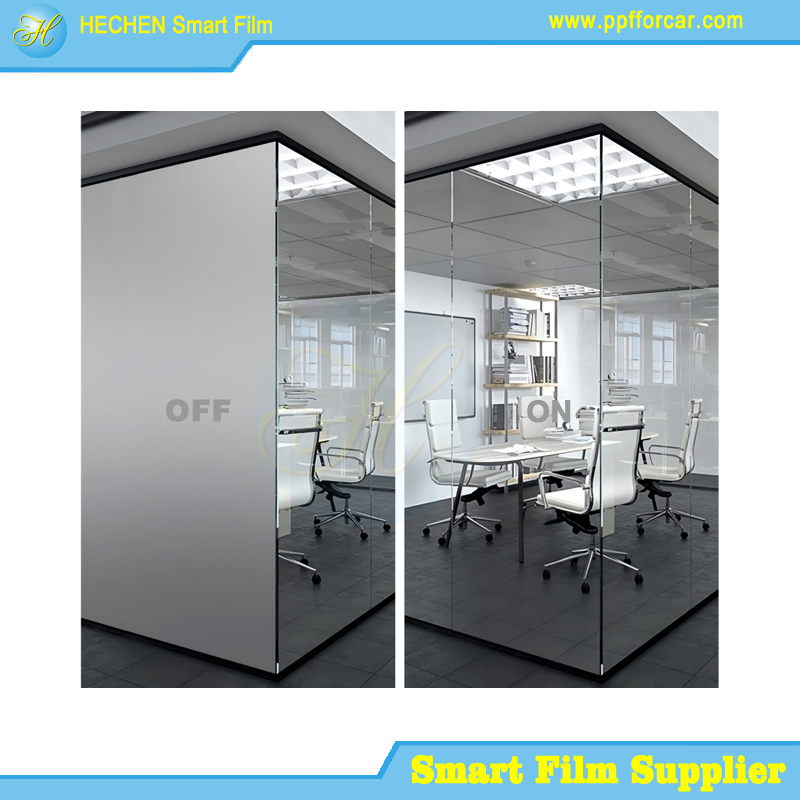
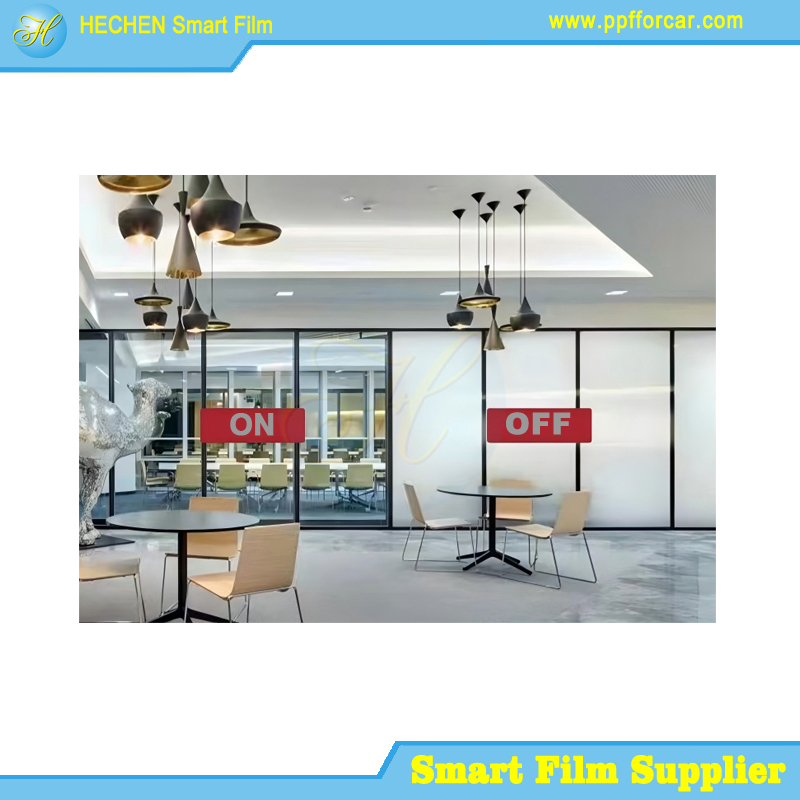
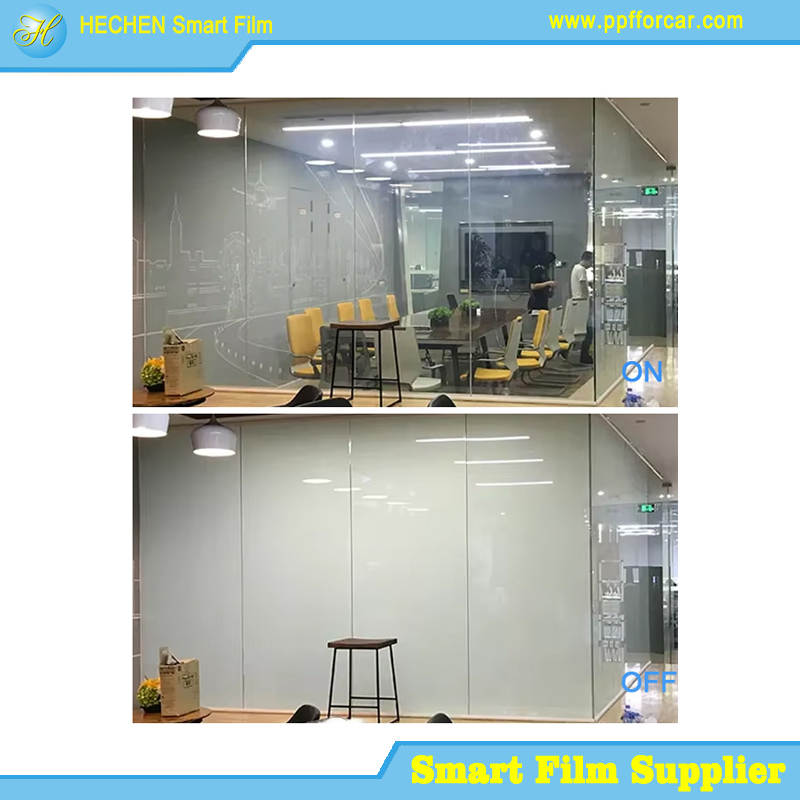
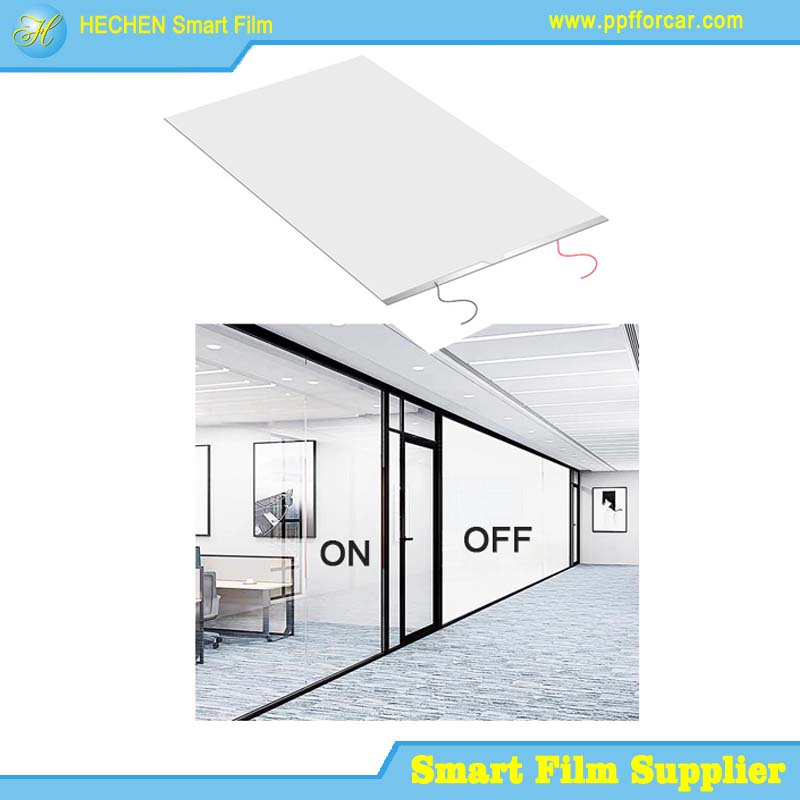
In the de-energized state (no voltage), the liquid crystal molecules within each droplet are randomly oriented due to thermal motion and anchoring forces at the droplet-polymer interface. This random arrangement causes a mismatch in refractive indices between the droplets and the surrounding polymer matrix. Incoming light rays encounter multiple index boundaries, leading to diffuse scattering in all directions. As a result, the film appears opaque or frosted, with visible light transmittance (VLT) as low as 1-5% and high haze (>90%). This state provides privacy by blocking direct visibility while allowing diffused light to pass, reducing glare without complete darkness.
When voltage is applied (energized state), an electric field forms across the conductive layers, exerting torque on the liquid crystal molecules due to their positive dielectric anisotropy. The molecules align parallel to the field direction, orienting their long axes perpendicular to the film's surface. In this aligned state, the effective refractive index of the droplets matches the polymer's index for normally incident light, minimizing scattering. Light passes through with high transmittance (70-85%) and low haze (<5%), rendering the film transparent.
The switching is reversible and rapid, with response times of 10-100 milliseconds, depending on droplet size and viscosity. Smaller droplets switch faster but scatter more efficiently in the off state. Power is only needed to maintain transparency; removing voltage returns the film to opacity via elastic relaxation.
This principle exploits the anisotropic properties of nematic liquid crystals: optical (birefringence) and dielectric (response to fields). The polymer matrix confines the crystals, enabling flexible films without leakage.
Molecular Arrangement in the De-Energized State
In the de-energized state, liquid crystal molecules exhibit a disordered arrangement within each droplet. Without an external field, molecules are influenced by surface anchoring at the droplet walls, where they tend to align tangentially or homeotropically depending on the polymer-LC interaction. However, within the droplet bulk, thermal energy causes random orientations, leading to a polydomain structure.
This randomness results in varying director fields (average molecular orientation) across droplets. Light interacting with these misaligned molecules experiences multiple refractions and reflections, causing Mie or Rayleigh scattering based on droplet size. For visible light (400-700nm), droplets around 1-2μm optimize scattering, making the film milky white.
Nuclear Magnetic Resonance (NMR) studies reveal that in this state, molecules exist in bulk, dissolved, or interfacial forms, with interfacial layers showing partial order due to polymer constraints. The overall effect is a high degree of light diffusion, ideal for privacy applications.
Molecular Arrangement in the Energized State
Upon energization, the electric field overcomes thermal disorder, aligning molecules along the field lines. Nematic crystals with positive dielectric anisotropy (Δε > 0) rotate to minimize energy, aligning their long axes parallel to the field. This creates a uniform director field within droplets, effectively making each droplet optically isotropic for perpendicular light.
The alignment matches n_o of the LC to the polymer's refractive index, allowing unimpeded light transmission. Scanning Electron Microscopy (SEM) images of energized films show elongated droplets, but molecular-level alignment is confirmed by electro-optical measurements showing saturation transmittance at threshold voltages (10-50V).
In discotic or other LC types, arrangements may differ, but standard PDLC uses rod-like nematics for this bipolar alignment.
Differences in Arrangement Between Energized and De-Energized States
The primary difference lies in order versus disorder. In the de-energized state, molecules are randomly oriented, leading to index mismatch and scattering. In the energized state, they are orderly aligned, matching indices for transparency.
Quantitatively, the order parameter (S) shifts from near zero (isotropic) off-state to 0.5-0.8 on-state, reflecting alignment degree. Response dynamics differ: off-to-on involves field-induced torque, while on-to-off relies on elastic relaxation, often slower.
Droplet morphology influences this; bipolar droplets (two poles) align faster than radial ones. In reverse-mode PDLCs, the off-state is transparent due to pre-aligned molecules, but standard self sticky films are normal-mode.
Temperature affects arrangements: high temperatures increase disorder, raising clearing points; low ones increase viscosity, slowing alignment.
Factors Affecting PDLC Layer Performance
Droplet size, LC concentration (30-50 wt%), polymer cross-linking, and applied voltage influence efficiency. Additives like rigid monomers enhance ageing resistance by stabilizing networks. Manufacturing variations, such as curing conditions, control morphology.
Applications of Self Sticky Dimming Film
In architecture, PDLC films create switchable partitions for offices, enhancing privacy. Automotive uses include sunroofs for glare control. Healthcare benefits from hygienic, touchless privacy screens. Retail displays use them for dynamic advertising.
Advantages and Limitations
Advantages: Instant switching, UV/IR blocking (up to 99%), energy savings. Limitations: Power requirement for transparency, angular dependence (haze increases off-axis), cost.
Future Developments
Research focuses on lower voltages, wider temperature ranges, and flexible substrates for wearables. Integration with IoT enables voice-activated control.
Conclusion
The core PDLC liquid crystal layer in self sticky dimming film operates on the principle of electric-field-induced alignment of liquid crystal molecules, switching between scattering opacity and aligned transparency. The de-energized state's random molecular arrangement contrasts sharply with the energized state's orderly alignment, enabling versatile light control. This technology's blend of science and practicality continues to drive innovations in smart materials, promising broader adoption in sustainable designs.
For more about what is the working principle of the core PDLC liquid crystal layer in self sticky dimming film, you can pay a visit to Hechen PDLC Smart Film Manufacturers for more info.