
How Does Smart Film Provide Privacy in Conference Rooms?
What Is Smart Film Conference Room Privacy?
Modern conference rooms often use transparent glass walls and partitions to create open, collaborative office environments. While glass improves natural lighting and visual connectivity, it can also expose sensitive meetings, presentations, and business discussions to people outside the room. Smart film conference room privacy technology provides an electrically controlled method of managing visual visibility without permanently covering the glass.
Smart film is a switchable functional film that can change its optical state when electrical power is applied or removed. The most widely used technology for this application is Polymer Dispersed Liquid Crystal (PDLC). PDLC privacy film is designed to switch between a transparent state and a translucent or opaque privacy state, depending on the product configuration.
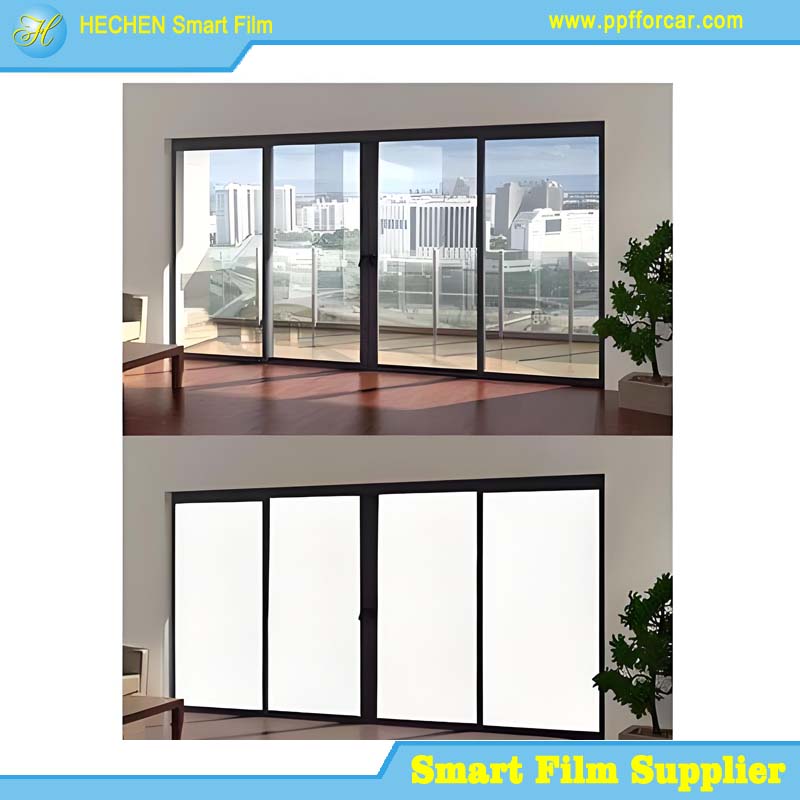
When integrated into conference room glass, smart film allows employees to control visibility according to different meeting requirements. For example, a glass-walled meeting room can remain transparent during collaborative activities and switch to privacy mode during confidential discussions.
This technology is suitable for corporate offices, executive boardrooms, financial institutions, healthcare facilities, law firms, and commercial buildings. However, smart film primarily addresses visual privacy. It does not automatically provide soundproofing, complete visual concealment of all silhouettes, or protection against electronic surveillance.
A properly designed system should consider the type of glass, film construction, electrical control method, optical performance, and installation conditions.
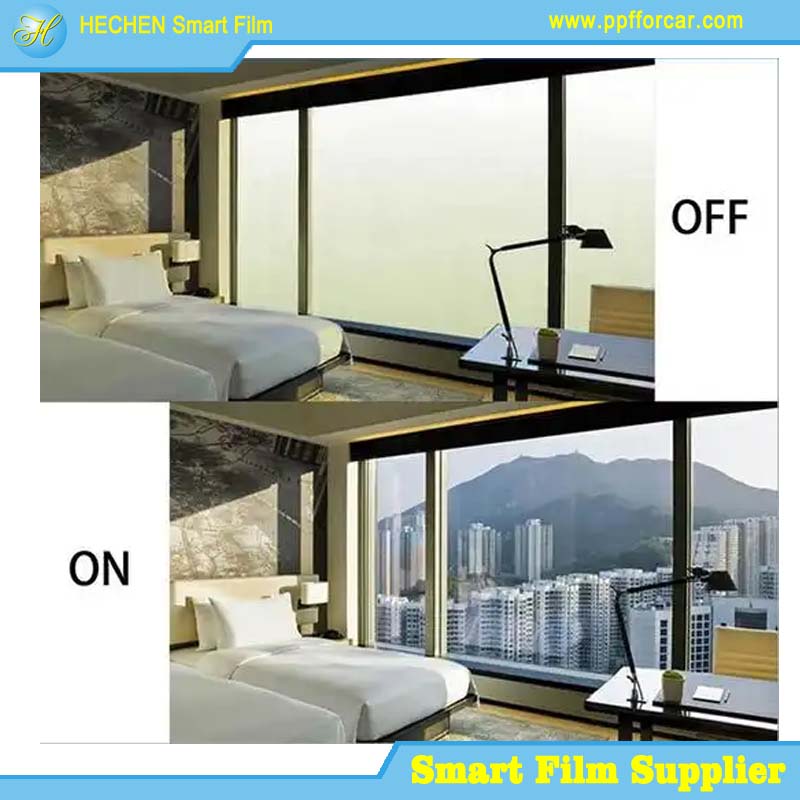
How PDLC Smart Film Works
Understanding how smart film works requires examining its internal structure and the behavior of liquid crystal materials under an electrical field.
PDLC smart film typically consists of several functional layers, including transparent conductive electrodes, a polymer matrix containing liquid crystals, and protective film substrates. The precise structure varies according to the manufacturer and product design.
1. Polymer-Dispersed Liquid Crystal Structure
In PDLC technology, microscopic liquid crystal droplets are dispersed within a polymer matrix. The liquid crystals have optical properties that depend on their orientation relative to incoming light.
The conductive layers apply an electrical field across the active PDLC layer. This field changes the orientation of the liquid crystals and therefore influences how light passes through the film.
The film's optical performance is determined by factors such as:
Liquid crystal and polymer formulation.
Conductive electrode structure.
Film thickness.
Electrical operating conditions.
Optical properties of the complete glazing system.
Different PDLC products may have different transparency, haze, switching speed, and power consumption characteristics.
2. Electrical Field and Light Transmission
When the film is powered under its specified operating conditions, the liquid crystals align more consistently with the applied electrical field. This reduces light scattering and produces a transparent or relatively clear appearance.
When the electrical field is removed, the liquid crystals become randomly oriented. Light is scattered through the film, creating a translucent or opaque appearance.
The actual result depends on the product's construction and optical specifications. Therefore, technical suppliers should provide measured performance data rather than relying only on general descriptions such as "fully clear" or "100% privacy."
3. Switching Mechanism
PDLC smart film is different from conventional window tint. Traditional tint generally has a fixed optical appearance, whereas switchable PDLC film is designed to change its optical state through electrical control.
The switching mechanism makes PDLC privacy film useful for meeting rooms where the required level of visibility changes throughout the working day.
For example:
Morning: Transparent mode for team collaboration.
Presentation: Privacy mode for focused viewing or projection, where supported.
Management meeting: Privacy mode for visual separation.
Open discussion: Transparent mode for office connectivity.
This flexibility is one of the main reasons businesses consider smart film for conference room privacy applications.
Transparent and Opaque Modes Explained
PDLC smart film typically operates in two primary optical states. Understanding these states helps buyers evaluate whether a product is suitable for their conference room project.
Transparent Mode
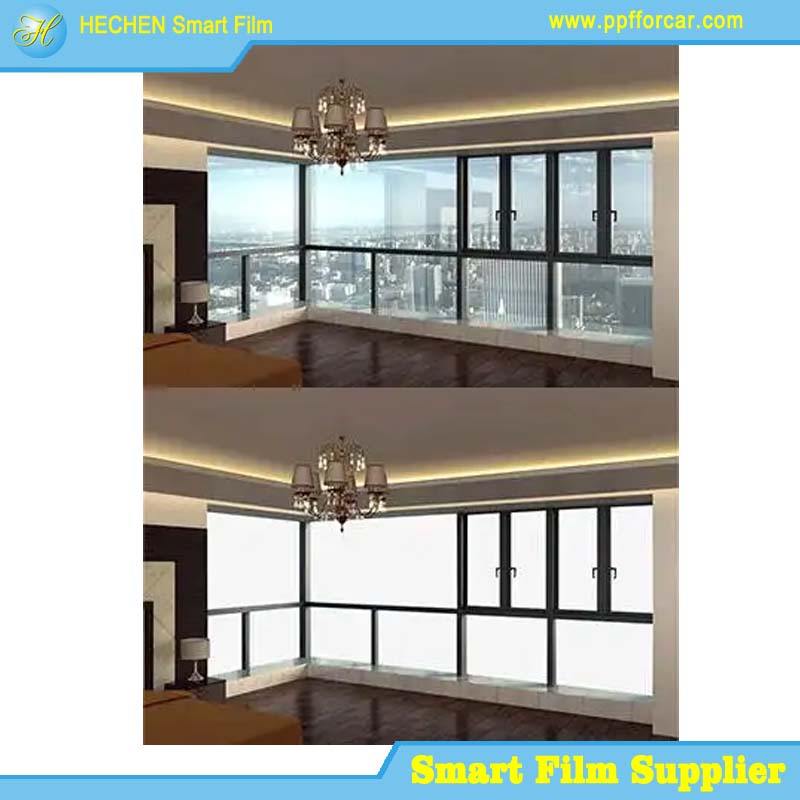
In transparent mode, electrical power is supplied to the conductive layer according to the manufacturer's specified voltage and operating conditions. The liquid crystals align, allowing more direct light transmission.
The glass can then provide visual connection between the meeting room and surrounding office space.
Potential applications include:
Open collaboration.
Natural daylight transmission.
Visual supervision.
Interior architectural design.
Presentations using suitable projection equipment.
The term "transparent" does not mean that every PDLC film has the same clarity as ordinary glass. Haze, light transmission, film size, glass composition, and viewing angle can influence the final appearance.
For commercial applications, buyers should compare visible light transmission (VLT), haze, and complete glass assembly performance.
Opaque or Privacy Mode
In privacy mode, electrical power is removed from the active PDLC layer, allowing the liquid crystals to adopt a less aligned state. Light scattering increases, creating a translucent or opaque appearance.
This helps reduce direct visual visibility into the conference room.
Common applications include:
Confidential business meetings.
Boardroom discussions.
HR interviews.
Legal consultations.
Financial planning.
Private client meetings.
PDLC privacy film should be evaluated according to the level of visual obstruction it provides. Some products may allow shadows or silhouettes to remain visible under certain lighting conditions.
A room that requires high confidentiality may need additional measures, such as acoustic treatment, appropriate door design, and controlled access.
Switching Response Time
Switching speed refers to the time required for the film to change between its optical states. The response time depends on the PDLC formulation, film size, temperature, electrical system, and operating conditions.
A manufacturer may specify separate switching times for transparent-to-privacy and privacy-to-transparent transitions.
For conference room applications, switching speed should be considered alongside uniformity, reliability, and the expected frequency of operation.
How Electrical Voltage Controls Privacy
The electrical system is a critical component of electric privacy film. PDLC film requires an appropriate power supply and control system to switch between its intended optical states.
Operating Voltage
Different PDLC products may operate at different AC voltage levels. The exact voltage must be confirmed through the manufacturer's technical documentation.
Using an incorrect voltage can result in:
Insufficient switching performance.
Uneven optical appearance.
Excessive electrical stress.
Damage to conductive components.
Reduced product service life.
Installers should never assume that all smart films use the same voltage specifications.
Transformer and Power Supply
A transformer or compatible power supply converts and supplies electricity to the PDLC film according to the system's requirements.
The selection process should consider:
Rated operating voltage.
Total active film area.
Power consumption.
Number of connected panels.
Control zones.
Electrical protection and installation requirements.
The supplier should confirm whether the transformer is suitable for the film's dimensions and intended operating conditions.
Control Zones
Large conference rooms may contain multiple glass panels or partitions. A control system can be configured to operate the panels together or independently, depending on the design.
For example, a boardroom with four glass walls may use separate zones for:
Entrance glass.
Presentation wall.
Side partitions.
Executive meeting area.
Independent control can provide more flexible privacy management, but it also increases the importance of correct wiring, controller compatibility, and system commissioning.
Smart Automation Integration
Some electric privacy film systems can be integrated with building automation systems or smart office controls. Available functions depend on the controller, transformer, communication interface, and system design.
Potential features may include scheduled switching, centralized control, or integration with compatible building management systems.
Before purchasing, buyers should confirm compatibility and avoid assuming that every PDLC product supports direct connection to a specific smart home or building automation platform.
Privacy Level and Visual Obstruction
Privacy performance is one of the most important considerations when choosing switchable privacy glass or PDLC film for conference rooms.
However, privacy is not a single standardized performance value. It depends on the optical characteristics of the film, the surrounding lighting environment, viewing distance, glass configuration, and the type of information that needs to be protected.
1. Haze and Light Scattering
Haze describes the proportion of transmitted light that is scattered rather than transmitted directly. Higher scattering in privacy mode generally reduces clear visibility through the film.
However, haze alone does not fully describe privacy performance. Buyers should also evaluate the appearance of objects, silhouettes, and contrast under realistic conditions.
Manufacturers should provide appropriate technical measurements and, where possible, physical samples.
2. Viewing Distance
A person standing close to a conference room window may observe more detail than someone standing farther away. The viewing angle and lighting conditions can also influence visibility.
For example, strong lighting inside a room may make silhouettes more noticeable even when the film is in privacy mode.
A product demonstration under realistic project conditions can help determine whether the selected film meets the intended privacy requirements.
3. Interior and Exterior Lighting
The difference between lighting levels inside and outside the conference room affects visual privacy.
A bright interior with people standing close to the glass may create more visible silhouettes than a room with balanced lighting.
Therefore, smart film should be evaluated alongside:
Interior lighting design.
Glass wall location.
Viewing distance.
Room occupancy.
Required privacy level.
Position of sensitive documents and screens.
4. Visual Privacy vs. Acoustic Privacy
PDLC privacy film controls light transmission and visual visibility. It does not inherently prevent conversations from being heard outside the room.
If a conference room is used for sensitive meetings, acoustic privacy may require additional solutions, including sound-absorbing materials, acoustic glass, sealed doors, or sound masking systems.
A comprehensive privacy strategy should address both visual and acoustic requirements.
Smart Film vs. Smart Glass: Key Differences
Although the terms "smart film" and "smart glass" are often used interchangeably in marketing, they typically refer to different physical configurations.
Smart Film
Smart film is a functional film that can be applied to a compatible existing glass surface, depending on the product type.
Self-adhesive PDLC film is often considered for retrofit applications where replacing the entire glass panel is not necessary.
Potential characteristics include:
Installation on selected existing glass.
Retrofit suitability.
Custom dimensions.
Electrical busbar connection.
Reduced need for complete glazing replacement.
The installation process requires careful glass preparation and compliance with the manufacturer's requirements.
Smart Glass
Smart glass generally refers to a glazing unit manufactured with an integrated switchable layer. In PDLC applications, the active layer is typically laminated between glass substrates.
Potential characteristics include:
Factory-integrated construction.
Custom architectural glazing.
New construction compatibility.
Different glass thickness and safety configurations.
Coordination with glazing contractors.
Comparison Table
Feature | Smart Film | Smart Glass |
|---|---|---|
Physical configuration | Applied film | Integrated glazing unit |
Typical application | Selected retrofit projects | New glazing or replacement |
Installation | Applied to compatible glass | Installed as a glass assembly |
Customization | Film dimensions and electrical design | Glass structure and dimensions |
Project coordination | Film installer and electrician | Glass manufacturer, installer, electrician |
Suitability | Depends on existing glass | Depends on architectural glazing requirements |
Neither option is universally suitable for every conference room. The selection should be based on project conditions, safety requirements, installation constraints, and long-term performance expectations.
Power Supply, Transformers, and Control Systems
A reliable electrical system is essential for the proper operation of PDLC privacy film. The film, transformer, wiring, and controller must be designed as a compatible system.
Power Consumption
PDLC film generally consumes electricity while operating in its transparent state. The actual power consumption depends on the film design, active area, operating voltage, and electrical conditions.
For example, a supplier may specify power consumption in watts per square meter. However, the stated value should be checked against the relevant testing conditions and product configuration.
When calculating system capacity, consider:
Total film area.
Number of panels.
Operating mode.
Rated power consumption.
Transformer capacity.
Electrical losses and system requirements.
Use the manufacturer's verified specifications for engineering calculations.
Transformer Sizing
Transformer sizing should be based on the actual electrical load and the manufacturer's recommendations. An incorrectly sized transformer can affect switching consistency and system reliability.
For larger conference rooms, the installer should consider whether multiple transformers, independent circuits, or separate control zones are required.
Wiring and Busbar Connections
Busbars provide electrical contact with the conductive layers of the smart film. Their design and placement depend on the film construction and panel dimensions.
Improper busbar installation may lead to:
Uneven switching.
Localized non-switching areas.
Electrical connection failure.
Damage during installation.
Installers should follow the supplier's wiring diagrams and installation instructions.
Safety and Electrical Compliance
Electrical connections should be completed by qualified professionals in accordance with applicable local regulations.
The complete system should be checked for appropriate insulation, protection, grounding where required, and compatibility with the building's electrical infrastructure.
Technical documentation should specify relevant installation limitations and commissioning procedures.
Factors Affecting Performance and Service Life
The performance and service life of PDLC privacy film depend on product quality, operating conditions, installation, and maintenance.
1. Product Quality
The formulation of the PDLC layer, electrode quality, substrate materials, and manufacturing consistency influence switching performance and durability.
When comparing suppliers, request technical data, product samples, warranty conditions, and relevant quality documentation.
2. Installation Quality
Even a high-quality smart film can experience performance issues if it is installed incorrectly.
Common installation-related problems include:
Contamination beneath the film.
Air bubbles.
Uneven adhesion.
Incorrect electrical connections.
Damage to the film or busbars.
Improper edge protection.
Professional installation and inspection can help reduce these risks.
3. Environmental Conditions
Temperature, humidity, UV exposure, mechanical stress, and cleaning methods may affect the long-term performance of smart film.
The allowable operating temperature and environmental limitations should be confirmed through the manufacturer's technical documentation.
The suitability of the film for exterior glass, high-moisture areas, or direct solar exposure must be evaluated individually.
4. Operating Frequency
Frequent switching may influence the electrical and mechanical demands placed on the system. The manufacturer's rated service life and operating recommendations should be considered when specifying the product.
Avoid making unsupported claims about a fixed number of switching cycles or a universal lifespan across all PDLC films.
5. Cleaning and Maintenance
Smart film should be cleaned using methods approved by the manufacturer. Excessive moisture, abrasive tools, harsh chemicals, or direct damage to the film edges may compromise the product.
For self-adhesive film, special care should be taken around electrical connection areas and exposed edges.
Regular inspection should focus on:
Film surface condition.
Edge adhesion.
Busbar integrity.
Switching uniformity.
Transformer and controller operation.
Frequently Asked Questions
1. How does smart film provide privacy in conference rooms?
Smart film provides controllable visual privacy by changing between transparent and translucent or opaque states. In PDLC systems, electrical power controls the orientation of liquid crystals, influencing how light passes through the film.
2. Does PDLC privacy film require electricity?
Yes, PDLC film generally requires electricity to maintain its transparent state. The exact power requirements depend on the product design and operating specifications.
3. Is smart film completely opaque in privacy mode?
Not necessarily. Privacy performance varies by product and lighting conditions. Some silhouettes or shapes may remain visible. Buyers should review haze, optical performance, and test samples before selecting a product.
4. Can smart film be installed on existing conference room glass?
Some self-adhesive PDLC films are designed for compatible existing glass. Installation suitability depends on the glass condition, dimensions, substrate compatibility, adhesive system, and electrical connection requirements.
5. What is the difference between PDLC film and switchable privacy glass?
PDLC film is a film-based solution that may be applied to compatible existing glass. Switchable privacy glass generally refers to an integrated glazing unit containing a switchable layer. Both can provide electrically controlled visual privacy, but their construction and installation requirements differ.
6. How do I select the correct transformer for electric privacy film?
The transformer should match the film's rated voltage, power consumption, active area, and system configuration. Always follow the manufacturer's electrical specifications and recommendations.
7. Can smart film be integrated with an office automation system?
Some systems support integration with compatible automation controls. Availability depends on the transformer, controller, communication interface, and product design. Confirm compatibility before purchasing.
8. How long does PDLC privacy film last?
Service life varies according to product construction, manufacturing quality, installation, environmental conditions, and operating practices. Ask the supplier for verified service-life data and warranty terms for the intended application.
9. Can smart film reduce conference room noise?
PDLC smart film primarily controls visual privacy and does not inherently provide acoustic insulation. Noise reduction requires suitable glass construction, room design, and acoustic solutions.
10. How can I test smart film before purchasing?
Request a product sample or demonstration. Evaluate transparent clarity, privacy appearance, switching consistency, electrical compatibility, and the supplier's technical documentation. For large commercial projects, consider testing under representative lighting and installation conditions.
Conclusion
Smart film conference room privacy technology provides a flexible method of managing visual visibility in modern office environments. Through PDLC technology, the film can switch between transparent and privacy states using an electrical control system.
The performance of a switchable privacy solution depends on more than the film itself. Optical characteristics, operating voltage, transformer selection, installation quality, environmental conditions, and maintenance all contribute to the final result.
For businesses evaluating PDLC privacy film, a reliable supplier should provide accurate specifications, installation guidance, samples, and suitable technical support. Buyers should also distinguish visual privacy from acoustic privacy and other security requirements.
Whether the project involves an existing glass meeting room or a new commercial glazing system, properly specified smart film can support flexible office privacy while maintaining a modern architectural appearance.
Looking for smart film for conference room privacy? Contact a professional smart film supplier to discuss your glass dimensions, optical requirements, electrical system, and customization needs. Request technical specifications and a product sample before placing a commercial order.
Recommended linking:
Smart Film for Conference Rooms: The Complete Privacy Solution for Modern Offices
Recommend related products:
Smart Film For Conference Rooms
