PDLC Smart Film for Office: How to Choose the Right Switchable Privacy Film
Modern offices increasingly use glass partitions, conference room walls, executive offices, and glass doors to create bright and flexible workspaces. However, conventional glass can create privacy challenges when confidential meetings, employee discussions, or management activities require visual separation.
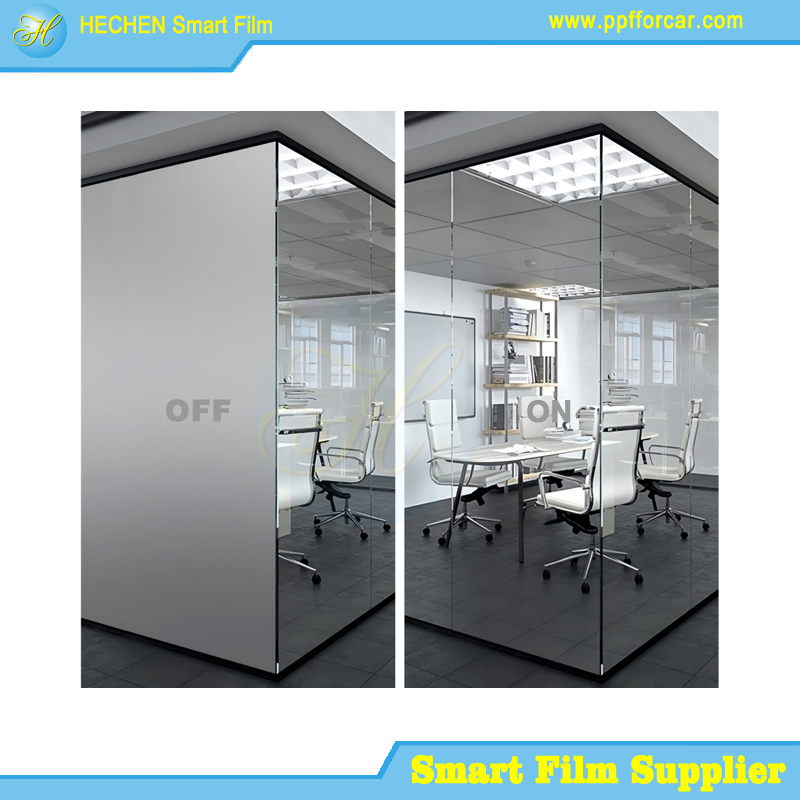
PDLC smart film for office applications provide a practical solution by allowing glass surfaces to switch between transparent and opaque states when electrical power is applied or removed. This switchable privacy technology can transform existing office glass into a dynamic privacy solution without replacing the entire glass panel.
For architects, contractors, facility managers, and commercial buyers, choosing the right commercial smart film requires more than simply comparing prices. Electrical specifications, optical performance, film construction, installation requirements, durability, certifications, and supplier capabilities should all be evaluated before placing an order.
This guide explains the key technical factors to consider when selecting PDLC smart film for commercial office projects.
What Is PDLC Smart Film?
PDLC stands for Polymer Dispersed Liquid Crystal. It is a type of electrically controlled privacy film designed to change its optical appearance according to the electrical field applied to the liquid crystal layer.
A typical PDLC film structure consists of several functional layers, including transparent conductive electrodes, a liquid crystal/polymer layer, protective layers, and, depending on the product, an adhesive layer for retrofit installation.
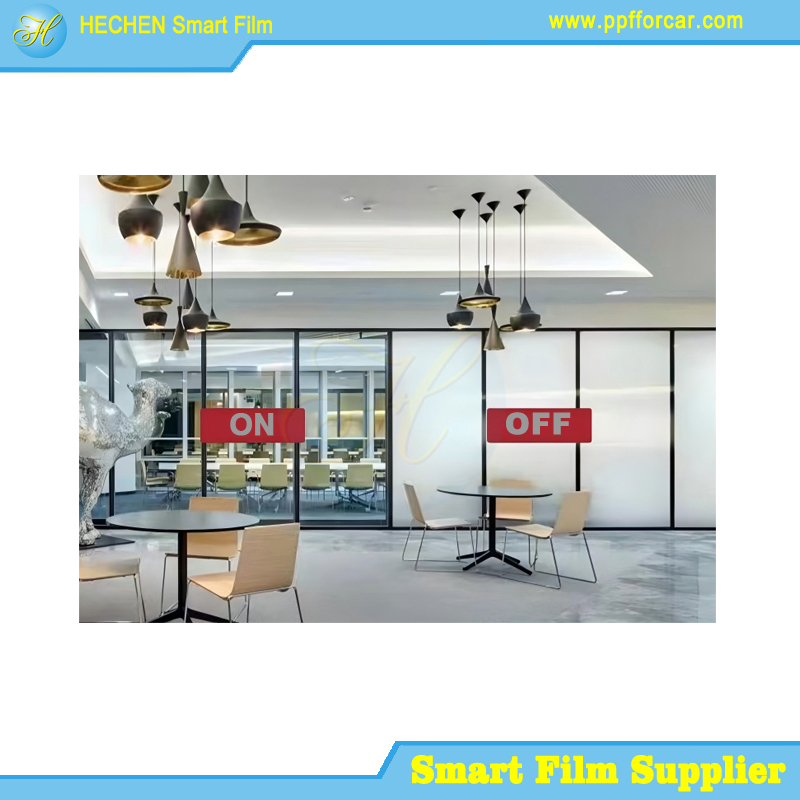
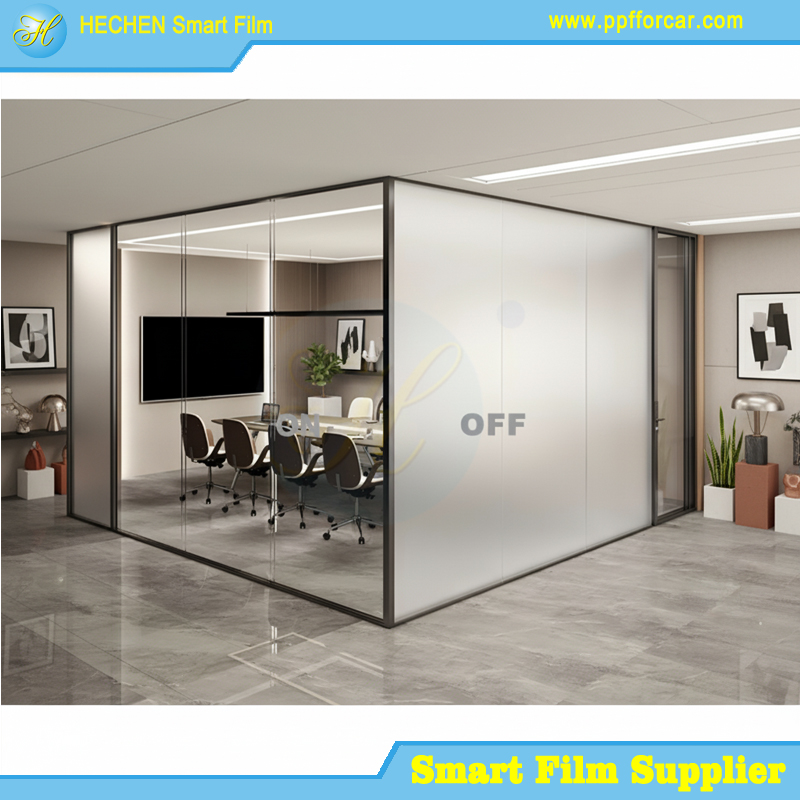
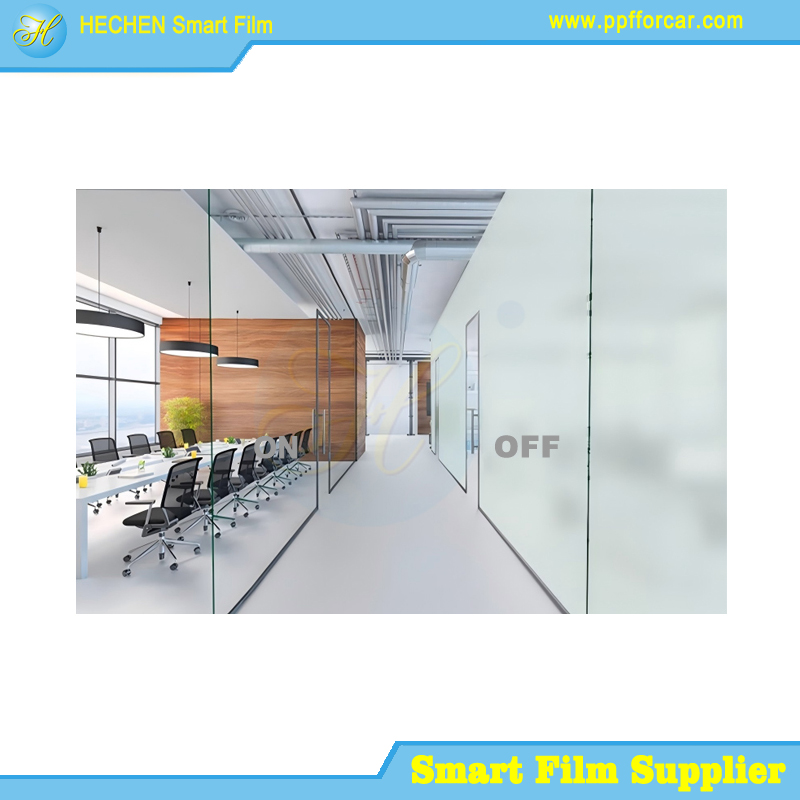
When power is switched on, the liquid crystal molecules align with the electrical field. Light can pass through the film more efficiently, making the glass appear transparent or highly clear.
When power is switched off, the liquid crystal molecules become randomly oriented. Light is scattered through the film, producing a frosted or translucent appearance that provides visual privacy.
This operating principle makes PDLC particularly suitable for offices where privacy requirements change throughout the day.
For example, a conference room can remain transparent when not in use, allowing natural light and visual connection with the surrounding workspace. When a confidential meeting begins, the switchable smart film can be activated to create instant visual privacy.
Unlike traditional blinds or curtains, PDLC technology does not require mechanical movement. Privacy can be controlled through a wall switch, remote controller, smart control system, or other compatible electrical control solution.
How PDLC Smart Film Works
The working principle of PDLC is based on electrically controlled light scattering.
A basic system normally includes three main components:
PDLC film
Power transformer or power supply
Control device
The transformer converts the available electrical input into the operating voltage required by the film. The control device then allows users to turn the film on or off.
Transparent State
When the electrical voltage is applied, the liquid crystal molecules align in a controlled direction.
This alignment reduces light scattering and allows more visible light to pass through the film.
The glass therefore appears transparent.
Privacy State
When the power is switched off, the liquid crystal molecules return to a random orientation.
The resulting light scattering creates a translucent or frosted appearance.
This is the primary privacy function of office privacy film.
Zoned Control
For large commercial projects, the glass does not necessarily need to operate as one single zone.
A large conference room, for example, can be divided into multiple electrical zones. Different sections can then be controlled independently.
This is particularly useful for:
Large conference rooms
Executive offices
Glass partitions
Training rooms
Reception areas
Multi-panel office walls
For smart building projects, PDLC control can also be integrated with centralized automation systems, depending on the electrical architecture and controller compatibility.
Key Smart Film Specifications for Office Projects
Selecting PDLC smart film for office applications requires careful evaluation of technical specifications. A film that looks attractive in a sample may not necessarily be suitable for a large commercial installation.
The following specifications should be evaluated before purchasing.
1. Visible Light Transmission
Visible Light Transmission, or VLT, indicates the amount of visible light passing through the film.
Higher transmission in the transparent state generally produces a clearer visual appearance.
Buyers should compare VLT values between suppliers using consistent test methods rather than relying only on product photographs.
2. Haze
Haze describes the amount of light scattering through the material.
A suitable PDLC film should provide an effective balance between transparency in the ON state and privacy in the OFF state.
For offices, excessive haze in the transparent state may reduce visibility and affect the appearance of premium glass partitions.
3. Operating Voltage
Operating voltage is a critical electrical specification.
The transformer must match the manufacturer's recommended voltage and electrical characteristics. Using an unsuitable power supply can negatively affect switching performance, operating stability, or product lifespan.
Commercial projects should therefore confirm:
Input voltage
Output voltage
Power consumption
Transformer capacity
Number of film panels per transformer
Wiring configuration
4. Film Thickness
Film thickness affects installation characteristics, handling, durability, and compatibility with different glass applications.
The appropriate thickness depends on the specific product construction and whether the film is designed for retrofit or laminated glass applications.
5. Switching Speed
Switching speed determines how quickly the film changes between its transparent and privacy states.
Fast switching is particularly valuable in meeting rooms, executive offices, and other spaces where privacy needs can change frequently.
6. Adhesive Quality
For retrofit applications, adhesive performance is extremely important.
The adhesive must provide reliable bonding to the glass surface while maintaining optical quality and long-term stability.
Poor surface preparation or low-quality adhesive can lead to bubbles, edge lifting, contamination, or other installation problems.
7. Durability and Service Life
Commercial office projects may require thousands of switching cycles during their service life.
Buyers should request documented cycle testing and product lifespan information from the manufacturer instead of relying only on general marketing claims.
Self-Adhesive vs Laminated PDLC Smart Film
One of the most important decisions when purchasing PDLC film for glass is choosing between self-adhesive film and laminated smart glass.
Self-Adhesive PDLC Smart Film
Self-adhesive PDLC film is designed primarily for retrofit applications.
It can be applied directly to suitable existing glass surfaces after proper cleaning and preparation.
Advantages include:
No need to replace existing glass
Faster retrofit installation
Lower construction disruption
Suitable for office partitions
Suitable for conference room glass
Flexible customization
Convenient for renovation projects
This makes self-adhesive smart film particularly attractive for existing commercial buildings.
Laminated PDLC Smart Glass
Laminated PDLC glass integrates the PDLC material between glass layers during glass manufacturing.
It is generally more appropriate for new construction, architectural glazing, doors, partitions, and projects where the complete glass assembly is being specified from the beginning.
Advantages can include:
Integrated construction
Better protection of the functional layer
Clean architectural appearance
Suitable for new glass systems
Greater integration with architectural glazing designs
The decision should therefore be based on the project stage.
For an existing office with installed glass, self-adhesive film may be more practical. For a new building project, laminated PDLC glass may provide a more integrated solution.

How to Choose Smart Film for Commercial Office Projects
Choosing the right commercial smart film requires evaluating both technical performance and project requirements.
Define the Application
First determine where the film will be installed.
Different applications may have different requirements:
Conference rooms require privacy and presentation functionality.
Executive offices require premium optical appearance.
Glass partitions require reliable adhesion and consistent appearance.
Glass doors require appropriate dimensions and edge protection.
Large projects require scalable electrical control.
Measure the Glass
Accurate measurements are essential before ordering.
Record:
Glass width
Glass height
Number of panels
Glass shape
Door locations
Required film orientation
Cable exit position
For large projects, a detailed glass schedule can significantly reduce installation errors.
Evaluate Optical Performance
Request samples before confirming a large order.
Evaluate the film under actual office lighting conditions, including:
Transparent-state clarity
Privacy-state appearance
Haze
Color neutrality
Edge appearance
Surface uniformity
Check Electrical Compatibility
Confirm the electrical requirements with the project electrician or contractor.
The supplier should provide technical information for transformer sizing, wiring, controller compatibility, and power requirements.
Consider Customization
Commercial projects often require customized film dimensions.
A professional supplier should be capable of providing:
Custom sizes
Irregular shapes
Multiple control zones
Custom cable positions
Logo or decorative patterns
Project-specific packaging
Customization capability becomes particularly important for large office installations.
How to Compare Smart Film Suppliers
Choosing the right smart film supplier is just as important as choosing the film itself.
A low product price does not necessarily represent the lowest total project cost.
Manufacturing Capability
Ask whether the supplier is a manufacturer, distributor, or trading company.
For large B2B projects, direct manufacturer support can provide advantages in:
Customization
Technical communication
Production scheduling
Quality control
OEM services
After-sales support
Product Consistency
Commercial installations often contain many glass panels.
The supplier should maintain consistent optical and electrical performance across production batches.
Ask about quality-control procedures for:
Film thickness
Optical performance
Electrical performance
Adhesive quality
Surface defects
Switching cycles
Technical Support
A reliable supplier should provide more than a product catalog.
Technical support may include:
Product selection
Glass measurement guidance
Electrical diagrams
Transformer selection
Installation instructions
Troubleshooting
Project engineering support
Samples and Testing
Before purchasing a large quantity, request samples.
Testing a sample allows the buyer to evaluate the product under actual project conditions.
Warranty and After-Sales Service
Review the warranty terms carefully.
Important points include:
Warranty period
Covered defects
Electrical component warranty
Installation-related limitations
Replacement procedures
Technical support
For international projects, after-sales communication and spare-component availability can also affect long-term project performance.
Total Project Cost
Finally, compare the complete project cost rather than only the film price.
A realistic evaluation should consider:
Film + Transformer + Controller + Accessories + Shipping + Installation + Technical Support
The supplier offering the lowest unit price may not always provide the lowest total cost of ownership.
FAQs
Is PDLC smart film suitable for office glass?
Yes. PDLC smart film for office applications can be used on suitable interior glass partitions, conference room walls, office doors, executive offices, and other architectural glass surfaces.
Can PDLC smart film be installed on existing glass?
Yes. Self-adhesive PDLC film is specifically designed for many retrofit applications. The existing glass must be properly measured, cleaned, and prepared before installation.
Does PDLC smart film require continuous power?
Typically, power is required to maintain the transparent state, while the film returns to its privacy state when power is removed. Exact electrical behavior depends on the specific product configuration.
Can office smart film be controlled remotely?
Yes. Depending on the control system, PDLC can be operated through wall switches, remote controls, centralized controllers, or compatible building automation systems.
Is PDLC smart film better than traditional blinds?
It depends on the project. PDLC provides instant electronic privacy without mechanical movement and preserves the clean appearance of glass. Blinds may be more economical in some applications. Project requirements should determine the best solution.
How long does PDLC smart film last?
Service life depends on product quality, electrical conditions, installation quality, environmental conditions, and switching frequency. Buyers should request documented lifespan and cycle-testing information from the supplier.
What should I ask a smart film supplier before ordering?
Ask for technical datasheets, samples, electrical specifications, certifications, warranty terms, customization capabilities, installation instructions, production lead time, and project references.
Can PDLC smart film be customized for large office projects?
Yes. Professional suppliers can typically provide customized dimensions, control zones, cable configurations, and other project-specific requirements. Customization should be confirmed before production.
Conclusion
Choosing PDLC smart film for office applications requires a comprehensive evaluation of optical performance, electrical specifications, construction type, installation requirements, certifications, durability, customization, and supplier capabilities.
For existing office glass, self-adhesive office privacy film can provide an efficient retrofit solution without replacing the glass. For new construction, laminated PDLC smart glass may offer a more integrated architectural solution.
The best approach is to define the application, measure the glass accurately, evaluate samples, verify technical specifications, confirm applicable certifications, and compare suppliers based on total project value rather than unit price alone.
For commercial office projects, working with an experienced smart film supplier can also simplify product selection, electrical planning, customization, installation, and after-sales support.
If you are planning an office partition, conference room, executive office, or large commercial glazing project, request product samples and technical specifications before placing a bulk order. A qualified supplier should be able to provide the documentation and engineering support required to evaluate whether its PDLC solution is suitable for your project.
Recommended linking:
Smart Film for Office: Complete Guide to Smart Privacy Glass for Modern Workspaces
Recommend related products: