Smart Film for Conference Rooms: The Smart Privacy Solution for Modern Offices
Modern corporate architecture heavily emphasizes transparency, open collaboration, and natural illumination. Interior glass partitions, floor-to-ceiling glass walls, and open-plan layouts have largely replaced traditional drywall construction in corporate headquarters worldwide. However, this architectural shift creates a fundamental challenge for workplace designers and facility managers: how to maintain open-plan aesthetics while providing instant visual confidentiality when sensitive meetings occur.
Installing smart film for conference rooms delivers an elegant, high-tech answer to this dilemma. By utilizing Polymer-Dispersed Liquid Crystal (PDLC) technology, self-adhesive smart privacy film transforms standard clear glass panels into dynamic, switchable privacy barriers in milliseconds. This comprehensive technical guide explores how conference room smart film operates, its architectural benefits, projection capabilities, installation procedures, costs, and key comparisons against traditional window treatments.
Why Conference Rooms Need On-Demand Privacy
Conference rooms are the operational nerve centers of modern organizations. They host high-stakes board meetings, confidential HR reviews, client negotiations, intellectual property workshops, and strategic planning sessions. In fully transparent glass environments, these activities face persistent privacy challenges:
Visual Data Exposure: High-resolution presentation displays, financial dashboards, and whiteboards containing proprietary data are easily visible to employees or visitors walking down adjacent hallways.
Constant Visual Distractions: Exterior movement and hallway foot traffic frequently disrupt meeting attendees, leading to reduced focus and compromised meeting productivity.
Static vs. Dynamic Workspace Needs: Traditional privacy solutions like frosted decorative vinyl or frosted glass permanently obstruct sightlines, eliminating the light-sharing and expansive feel of open architecture even when the room is empty.
Hygiene and Maintenance Concerns: Fabric drapes and horizontal blinds collect dust, allergens, and fingerprints, requiring constant cleaning and maintenance that disrupts office workflows.
An on-demand privacy solution allows facility managers to preserve an expansive, light-filled atmosphere during standard working hours while granting meeting participants instant, total privacy at the press of a button.
How Smart Film Creates Instant Conference Room Privacy
The core technology powering smart privacy film for conference rooms is Polymer-Dispersed Liquid Crystal (PDLC). A standard PDLC film structure consists of a micro-droplet matrix of liquid crystals suspended within an optical polymer curing layer, sandwiched between two flexible, transparent conductive films coated with Indium Tin Oxide (ITO).
The Physical Phase Transition Mechanics
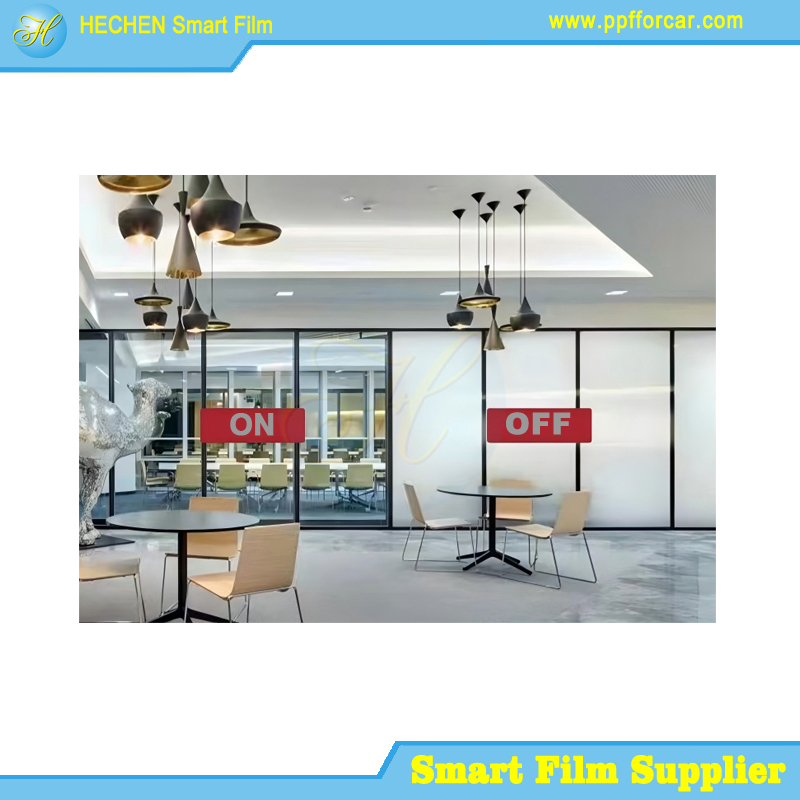
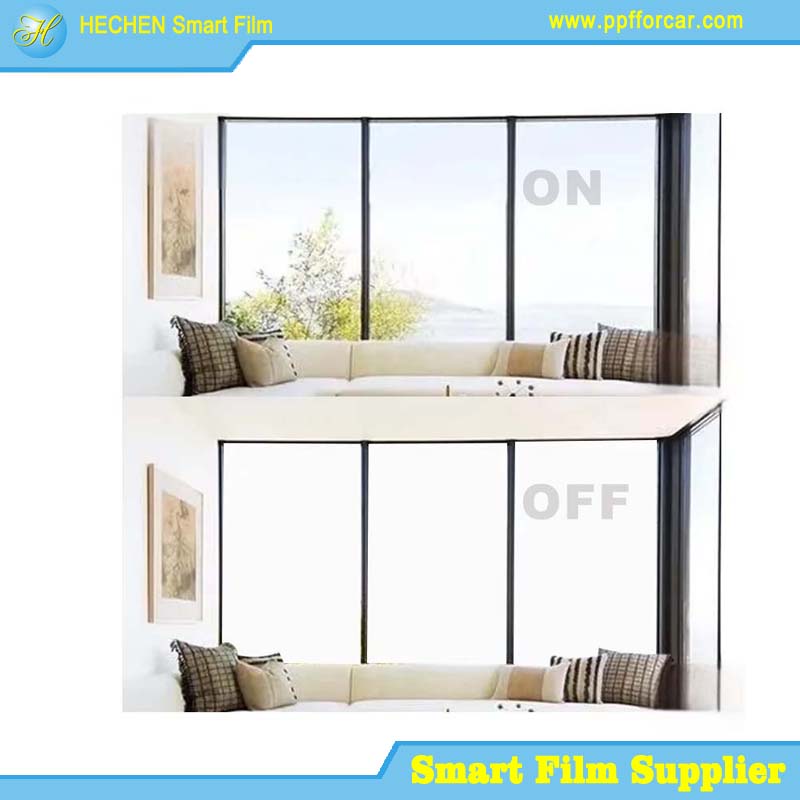
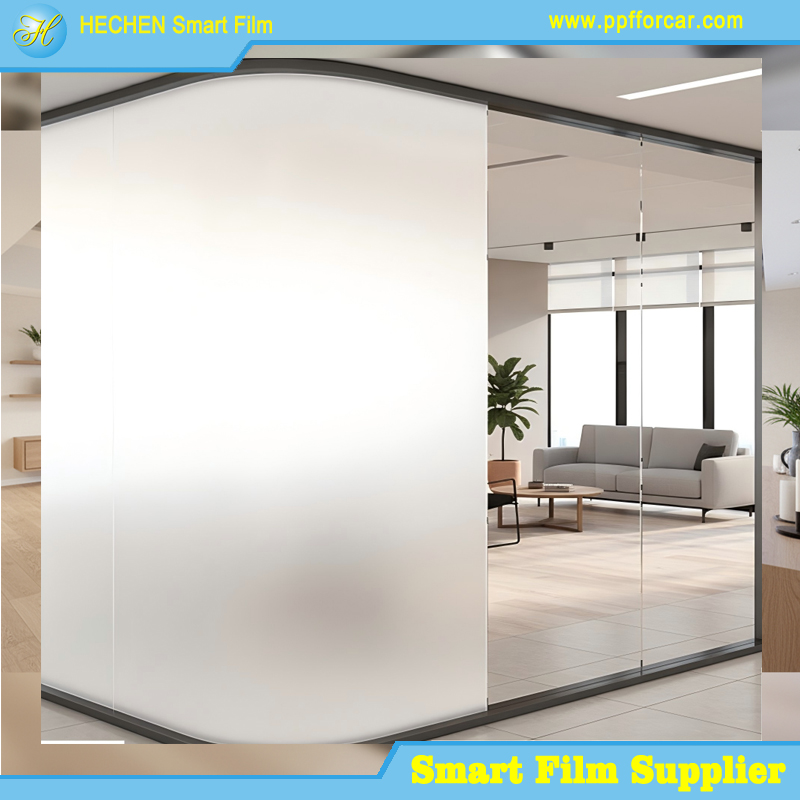
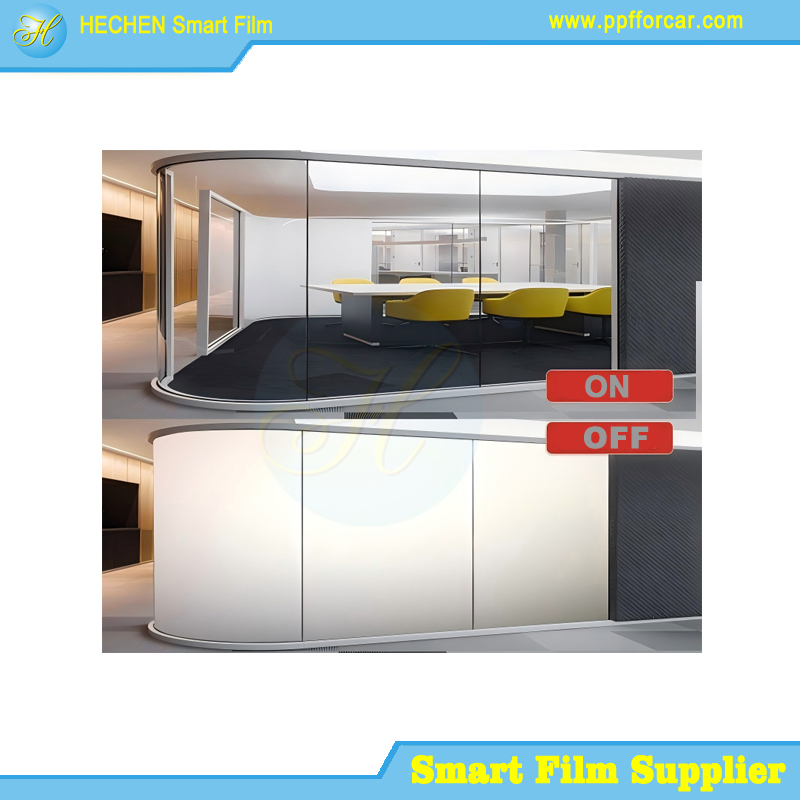
OFF State (Opaque / Frosted): When no electrical voltage is applied to the ITO layers, the liquid crystal droplets inside the polymer matrix are randomly oriented. Incoming ambient light rays strike these randomly arranged crystals and refract in multiple directions, scattering light. The glass appears milky white and opaque, blocking visual clarity while maintaining roughly 70–80% parallel light transmittance so the space remains illuminated.
ON State (Transparent / Clear): When an AC power source passes electricity through the conductive ITO layers (typically 48V–60V AC), an electric field forms across the PDLC matrix. This field forces the liquid crystal molecules to instantly align parallel to each other and perpendicular to the glass surface. Light rays pass directly through without scattering, rendering the film optically clear within less than 100 milliseconds.
Electrical and Performance Specifications
Operating Voltage: 48V AC to 60V AC (via step-down dedicated transformer)
Power Consumption: ~3.5W to 5.0W per square meter in the ON (clear) state; 0W in the OFF (opaque) state
Switching Speed: < 100 ms (OFF to ON) / < 200 ms (ON to OFF)
UV Rejection: > 99% in both ON and OFF states, protecting interior furniture and displays from sun degradation
Infrared (IR) Rejection: Up to 80% in the opaque state, assisting in zone thermal regulation and HVAC energy optimization
Smart Film for Glass Conference Room Walls
Integrating a PDLC smart film conference room system into existing architectural glass walls provides an ideal retrofit strategy. Unlike replacing existing partitions with factory-laminated smart glass conference room assemblies—which requires extensive structural teardowns, glazier labor, and operational downtime—self-adhesive smart film applies directly onto pre-existing tempered or laminated glass panels.
Architectural Controls and Automation Integration
Modern switchable glass for meeting rooms integrates seamlessly with corporate smart building management systems (BMS) and AV control networks:
Wall Switches & RF Remotes: Hardwired wireless touchpads mounted outside or inside meeting rooms.
Automated Scheduling & Occupancy Sensors: Motion sensors or calendar integrations (e.g., enterprise scheduling tools) automatically energize the film to clear when a room is unbooked and trigger opaque mode when a scheduled meeting commences.
Centralized AV Systems: Direct RS-485, relay, or IP-based control through commercial automation platforms allow meeting leaders to trigger "Presentation Mode" (dimming overhead lights, lowering screens, and energizing privacy film simultaneously).
Smart Film as a Projection Screen
A unique technical advantage of using privacy film for conference rooms is its dual functionality as a high-performance rear-projection screen when switched to its opaque (OFF) state.
Because the liquid crystal droplets scatter light uniformly across the film's surface, a projector placed inside the conference room can beam video content, presentations, or video conferencing feeds onto the glass wall, visible to viewers located either inside or outside the room.
Technical Advantages for Display Applications
180-Degree Viewing Angle: Eliminates viewing color shifts or brightness falloffs common on standard flat-panel displays when viewed from off-axis angles.
Elimination of Screen Hotspots: The uniform optical scattering properties prevent harsh projector lens hot-spotting, creating smooth, saturated image reproduction.
Space Optimization: Eliminates the physical footprint and visual clutter of motorized drop-down projection screens or large fixed monitor mounts on perimeter walls.
Smart Film vs Blinds for Conference Rooms
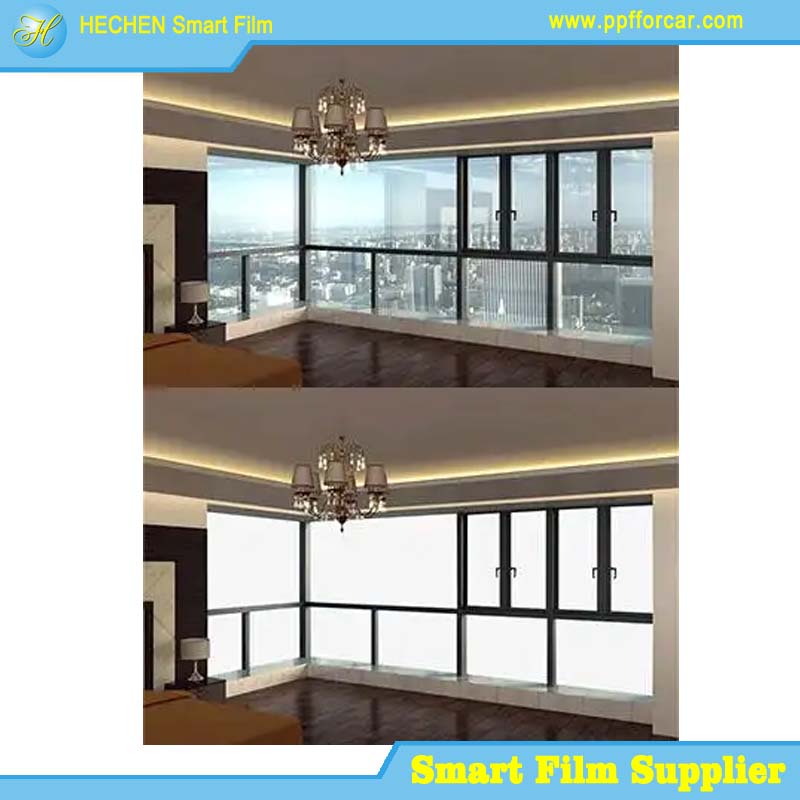
Facilities managers often compare smart film against traditional window treatments such as motorized roller shades, horizontal mini-blinds, or factory-laminated smart glass. The table below outlines key technical and operational parameters:
| Performance Metric | PDLC Smart Privacy Film | Traditional Blinds / Drapes | Motorized Roller Shades | Smart Glass (Factory Laminated) |
| Switching Speed | Instant (<100 ms) | Manual (10–30 sec) | Mechanical (10–20 sec) | Instant (<100 ms) |
| Retrofit Feasibility | High (Applies to existing glass) | High | High | Low (Requires glass replacement) |
| Maintenance & Cleaning | Simple glass wipe-down | High (Dust & slat cleaning) | Moderate (Fabric cleaning) | Simple glass wipe-down |
| Light Transmission (Opaque) | High (~75–80% light pass-through) | Low to zero | Varies by fabric opacity | High (~75–80% light pass-through) |
| Rear Projection Capability | Yes (Excellent optical surface) | No | Limited (Specialty fabrics only) | Yes |
| Acoustic Dampening Impact | Slight (Adhesive layer absorption) | Minimal | Minimal | High (Double-laminated glass) |
| Durability / Lifetime | >10–15 years (>80,000 hrs) | Mechanical wear prone | Motor / track wear prone | >10–15 years (>80,000 hrs) |
Traditional blinds collect dust and debris, requiring recurring manual maintenance while disrupting the clean aesthetic of modern architectural glass. Motorized shades involve moving mechanical parts that are subject to jam-ups and motor failures over time. Smart film provides a non-mechanical, solid-state solution with zero moving parts, drastically reducing long-term facilities maintenance overhead.
How to Install Smart Film on Conference Room Glass
Installing self-adhesive smart film onto conference room partitions requires precision, cleanroom-like surface preparation, and certified electrical connections to ensure long-term optical clarity and electrical safety.
Step 1: Glass Inspection and Surface Preparation
The glass substrate must be thoroughly inspected for chips, deep scratches, or structural defects. The surface undergoes multi-stage cleaning using isopropyl alcohol (IPA) and deionized water, followed by lint-free microfiber wiping and squeegee passes to eliminate dust micro-particles, grease, and silicon contaminants.
Step 2: Precision Measuring and Trimming
The smart film is pre-cut using laser or CNC machinery, leaving a 1.0mm to 2.0mm expansion margin along all perimeter glass edges. This edge clearance prevents friction against frame gaskets and accommodates natural thermal expansion/contraction of the glass without inducing film delamination.
Step 3: Dry Lamination Application
Unlike standard tint films that use wet soapy-water solutions during application, self-adhesive PDLC film utilizes a dry lamination method equipped with an ultra-clear pressure-sensitive adhesive (PSA) layer:
The protective release liner is peeled back incrementally.
The film is aligned precisely along the top edge of the glass partition.
A heavy rubber roller or specialized applicator squeegee applies uniform pressure, pressing out trapped air from center to edges to eliminate micro-bubbles.
Step 4: Busbar Wiring and Electrodes
Conductive copper busbars run along the top or side margins of the film panel.
Wire leads are soldered to the factory-installed copper busbars using low-temperature electrical solder.
Wiring is carefully routed inside the mullion channels or hidden behind perimeter architectural trim pieces.
All connections route back to a dedicated step-down PDLC power supply (e.g., converting 110V/220V AC input to 48V/60V AC output).
Step 5: Edge Sealing and Curing
To prevent moisture, cleaning agents, and atmospheric oxygen from ingress into the exposed ITO layers along the film perimeter, a specialized high-grade neutral-cure non-acidic structural silicone sealant is applied along all four edges. Standard acidic silicones must never be used, as acetic acid causes permanent oxidation and yellowing of the conductive ITO layer.
Conference Room Smart Film Cost
Evaluating the total cost of implementing smart film for conference rooms involves analyzing material costs, installation labor, electrical infrastructure, and long-term energy savings.
Price Breakdown per Square Foot
Material Costs: High-grade commercial PDLC film typically ranges between $25 to $55 per square foot, depending on optical clarity rating, wide-format custom roll widths, and UV/IR filtering capabilities.
Power Supplies & Control Hardware: Dedicated power transformers, wireless receivers, and smart switches add approximately $200 to $600 per channel/zone.
Installation & Electrical Labor: Professional installation by certified window film specialists and licensed electricians typically adds $10 to $20 per square foot, depending on ceiling heights, wiring complexity, and job site access parameters.
Return on Investment (ROI) and Economic Advantages
While initial capital expenditure for smart film exceeds that of basic manual blinds, the lifetime cost structure favors smart film across several key domains:
Reduced Facilities Maintenance: Eliminates ongoing commercial laundering, blind slat repairs, and dust-mitigation labor expenses over an estimated 10- to 15-year service life.
HVAC Energy Savings: In opaque mode, PDLC film blocks a substantial portion of infrared solar heat gain, reducing localized air conditioning load in glass-enclosed meeting spaces exposed to direct exterior or atrium sunlight.
Real Estate Flexibility: Enables multi-functional spatial design, allowing one conference area to easily serve as an open collaborative zone, a private presentation suite, or an interactive display wall without needing permanent wall construction.
FAQs
How does a switchable glass for meeting rooms film operate during power outages?
PDLC smart film operates on a "fail-safe" default mechanism. When power is cut or lost during an electrical outage, the film automatically defaults to its OFF (opaque/frosted) state, maintaining complete visual privacy for the room.
Is smart film for conference rooms difficult to retrofit onto existing glass partitions?
No. Smart film features an integrated high-clarity pressure-sensitive adhesive backing specifically designed for retrofit applications onto existing smooth tempered or laminated interior glass walls, requiring zero replacement of existing glazing framing.
Does privacy film for conference rooms completely block light?
No. PDLC smart film provides visual privacy by scattering direct light rays, not by absorbing or blocking light completely. In its opaque (OFF) state, the film permits approximately 75% to 80% of total ambient light to pass through, keeping adjacent office hallways bright and naturally lit while completely obscuring sharp images and sightlines.
Can conference room smart film be integrated with automated smart office systems?
Yes. The power supplies driving PDLC smart film can connect directly to building automation systems, wall switches, Occupancy/AV controllers, motion sensors, RF remote controls, or smartphone apps via relay channels or smart switches.
How long does PDLC smart film last in a high-use commercial environment?
Commercial-grade PDLC film is rated for over 80,000 to 100,000 active operating hours in the ON state and features an expected operational lifespan exceeding 10 to 15 years under standard indoor commercial office conditions.
Recommended linking:
Smart Film for Office: Complete Guide to Smart Privacy Glass for Modern Workspaces
Recommend related products:
Switchable PDLC Film For Office