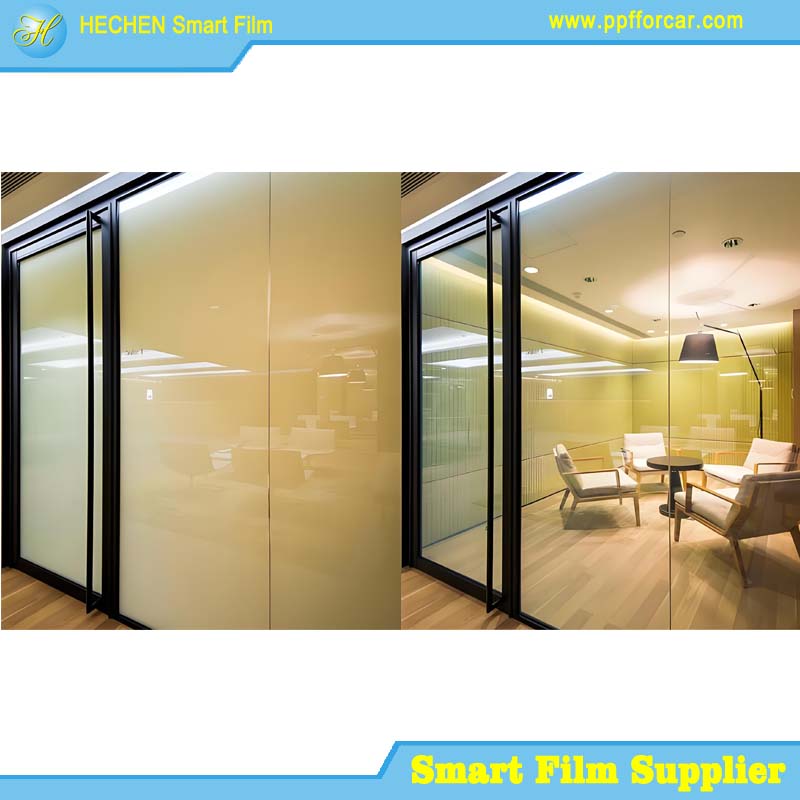
Smart Film vs. Traditional Privacy Solutions for Conference Rooms
Modern offices increasingly use glass walls and partitions to create bright, open, and collaborative workspaces. However, transparent conference rooms can create a significant privacy challenge. Business negotiations, financial discussions, employee interviews, legal consultations, and confidential presentations may be visible to people outside the room.
For this reason, businesses need effective conference room privacy solutions that can balance visual privacy, natural daylight, architectural design, and operational flexibility.
Traditional solutions such as blinds, curtains, frosted glass, and conventional privacy film remain widely used. However, switchable technologies such as PDLC smart film and switchable privacy glass provide an additional option for businesses that require privacy on demand.
The right solution depends on the project requirements. Factors such as existing glass, privacy expectations, daylight requirements, installation conditions, budget, maintenance, and control requirements should all be considered.
This guide compares smart film with traditional conference room privacy solutions and explains how businesses can select the most appropriate technology for different office projects.
Why Businesses Need Flexible Conference Room Privacy
Conference rooms serve many different purposes throughout the working day. A meeting room may be transparent and open during a team collaboration session but require privacy several hours later for an executive meeting.
Traditional fixed privacy solutions cannot always accommodate this changing requirement.
For example, permanently frosted glass provides continuous visual obscurity, even when privacy is not required. Blinds and curtains can provide adjustable privacy, but they introduce additional mechanical or fabric components and can change the visual appearance of a glass partition.
A modern conference room privacy solution should ideally address several requirements:
On-demand visual privacy
Flexible visibility control
Natural daylight transmission
Modern architectural appearance
Compatibility with existing or new glass
Easy operation
Reliable long-term performance
Appropriate installation and maintenance requirements
This is where switchable privacy technologies can become attractive.
However, visual privacy should not be confused with acoustic privacy. A privacy film can reduce visibility through glass but does not automatically prevent conversations from being heard outside the room.
For highly confidential meetings, visual privacy should therefore be combined with appropriate acoustic design, controlled access, and organizational security procedures.
Smart Film for Conference Room Privacy
Smart film is a switchable film designed to change its optical state when an electrical field is applied or removed. One of the most common technologies is Polymer Dispersed Liquid Crystal (PDLC).
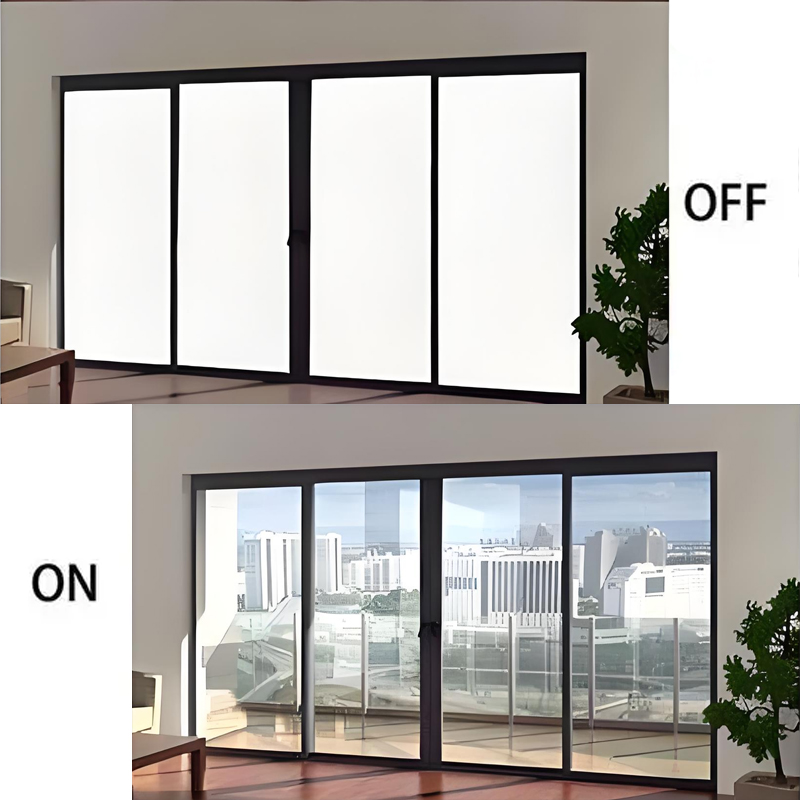
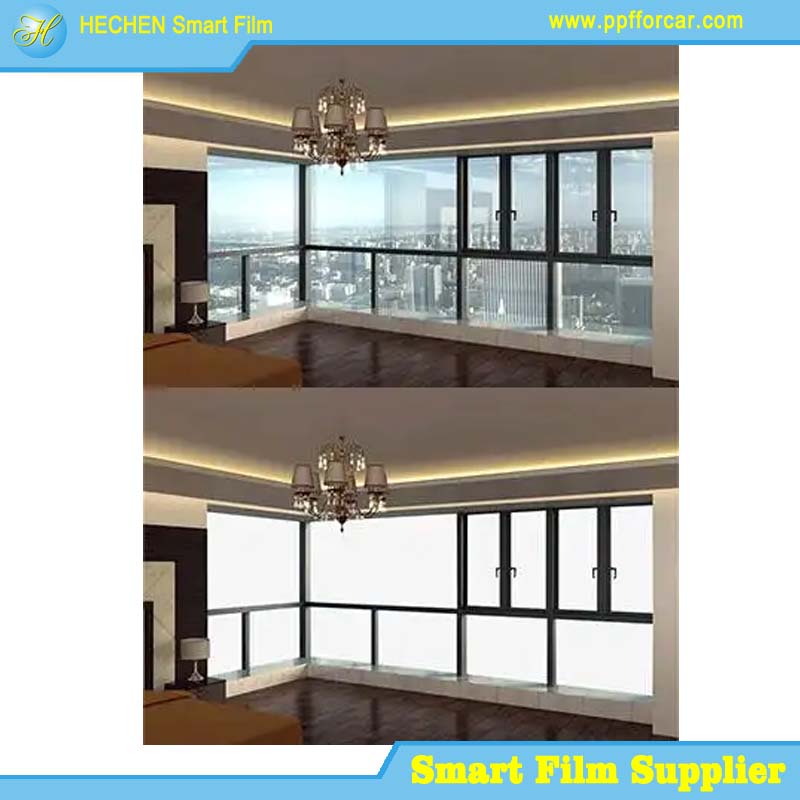
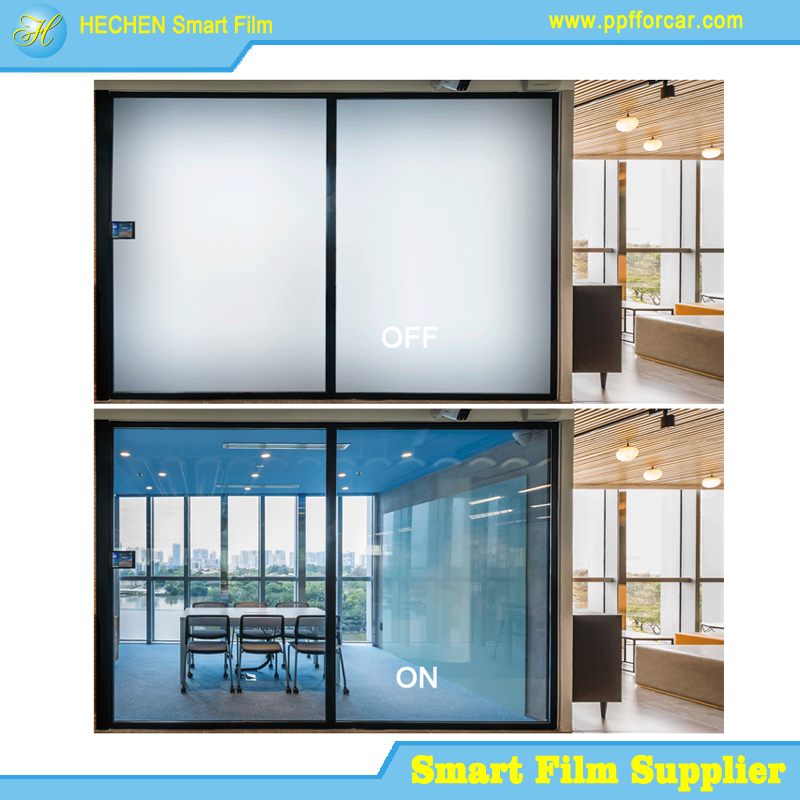
In a typical PDLC system, the film can switch between a transparent state and a translucent or opaque privacy state.
When the system is powered according to its specified operating conditions, the liquid crystals align and allow more direct light transmission. When power is removed, the liquid crystals become randomly oriented and scatter light, producing a privacy appearance.
This makes smart film suitable for conference rooms where visibility requirements change throughout the day.
Typical applications include:
Executive conference rooms
Boardrooms
Glass meeting rooms
HR interview rooms
Legal consultation rooms
Financial meeting rooms
Training rooms
Healthcare consultation areas
Key advantages of smart film
On-demand privacy: Users can change the visual state without manually moving a curtain or blind.
Modern appearance: The technology maintains the glass-based architectural concept while adding an electronic privacy function.
Retrofit potential: Self-adhesive smart film can be installed on selected existing glass surfaces, subject to compatibility.
Flexible control: Depending on the system, users can operate the film using wall switches, remote controls, or compatible automation systems.
Multiple control zones: Large conference rooms can potentially divide glass panels into separate zones.
However, smart film also requires electrical infrastructure, including appropriate wiring, busbars, and a compatible transformer or power supply. Therefore, installation planning is more complex than for conventional non-electrical privacy films.
Smart Film vs. Blinds and Curtains
One of the most common comparisons is smart film vs blinds or curtains.
Blinds are a familiar privacy solution and can provide adjustable visual coverage. Curtains offer similar functionality and may also contribute to interior decoration and acoustic absorption.
However, the physical operation of blinds and curtains differs significantly from switchable film.
| Feature | Smart Film | Blinds | Curtains |
|---|---|---|---|
| Privacy control | Electronic | Manual or motorized | Manual or motorized |
| Appearance | Integrated with glass | Additional window covering | Additional fabric layer |
| Daylight control | Depends on film/glazing | Adjustable | Adjustable |
| Electrical requirement | Usually required | Only for motorized systems | Only for motorized systems |
| Moving components | No conventional mechanical slats | Yes | Yes |
| Retrofit potential | Possible with suitable glass | Usually possible | Usually possible |
| Maintenance | Film and electrical system | Mechanical components | Fabric cleaning |
| Architectural appearance | Minimalist | Visible window covering | Decorative covering |
When smart film may be preferable
Smart film can be attractive when the design objective is to preserve a clean glass appearance while providing rapid visual privacy control.
For example, a modern corporate office may want its conference room to remain visually connected to the surrounding workspace when not occupied. When a confidential meeting begins, the glass can switch to privacy mode.
When blinds may be preferable
Blinds can be a better choice when the project requires adjustable daylight and solar control in addition to privacy.
Some blinds can also provide different levels of opening rather than simply transparent and privacy states.
Therefore, the decision should not be based solely on privacy.
Smart Film vs. Frosted Glass
Another important comparison is smart glass vs frosted glass.
Frosted glass provides permanent visual diffusion. It can be manufactured with a textured surface or combined with a conventional frosted privacy film.
Its main advantage is simplicity.
There is no transformer, electrical wiring, controller, or switching mechanism.
However, permanent frosting means that the glass cannot easily return to a fully transparent state.
Smart film provides a different approach.
When the PDLC system is in transparent mode, the glass can provide visual connectivity. When privacy is required, the film changes to its privacy state.
| Feature | Smart Film / PDLC | Frosted Glass |
|---|---|---|
| Privacy | Switchable | Permanent |
| Transparency | Available in transparent mode | Limited |
| Electrical system | Required | Not required |
| Control | Electronic | Fixed |
| Retrofit | Possible with adhesive film | Possible with frosted film |
| Design flexibility | High | Moderate |
| Maintenance | Electrical + surface care | Basic surface care |
| Best application | On-demand privacy | Permanent privacy |
Smart glass vs frosted glass: which is better?
Neither technology is universally better.
Frosted glass may be appropriate when a conference room always requires privacy and there is no need for transparency.
Switchable privacy glass or smart film is more appropriate when the room needs to alternate between open visibility and visual privacy.
For example, a company may want a meeting room to remain transparent during normal office hours but switch to privacy mode during executive meetings.
In this scenario, the switchable solution provides greater operational flexibility.
Smart Film vs. Traditional Privacy Film
Conventional office privacy film is another popular solution for meeting rooms.
Traditional privacy films can create:
Frosted effects
Decorative patterns
Partial obscurity
Company branding
Graphic designs
Permanent visual separation
These films are generally easier to install than electrically controlled smart film because they do not require a transformer or electrical connection.
However, traditional privacy film normally provides a fixed visual effect.
Once applied, it cannot electronically change from opaque to transparent.
Smart film introduces an additional electrical control layer.
This makes PDLC technology more suitable when privacy requirements vary during the working day.
Traditional privacy film may be better when:
The project has a limited budget.
Permanent privacy is acceptable.
Electrical wiring is undesirable.
No switching function is required.
Decorative branding is important.
Smart film may be better when:
On-demand privacy is important.
Glass transparency is required at certain times.
The office has a modern architectural design.
Users need centralized or remote control.
The conference room has multiple privacy requirements.
From a technical perspective, the two technologies solve different problems. Traditional film is primarily a passive visual privacy material, while PDLC smart film is an electrically controlled optical system.
Privacy, Daylight, and Design Considerations
Privacy is only one factor when selecting a conference room glazing solution.
Daylight
Glass partitions are often used to transfer daylight from perimeter areas into interior spaces.
Permanent privacy materials may reduce direct visibility but can also change how light is distributed.
Smart film can provide a transparent mode when visual openness is desired and a privacy mode when confidentiality is required.
However, smart film should not automatically be considered a high-performance solar control product. UV rejection, infrared rejection, visible light transmission, and solar heat gain depend on the complete glazing system.
These specifications should be verified through technical documentation.
Interior Design
A glass conference room can create a visually spacious office environment.
Smart film maintains this glass-based design while adding an electronic privacy function.
For architects and interior designers, this can be useful when the project aims for:
Minimalist design
Flexible office layouts
Modern corporate interiors
Glass meeting rooms
Executive spaces
Privacy Level
The required level of privacy should also be clearly defined.
Visual privacy can range from simply reducing direct visibility to creating a highly diffused appearance.
Lighting conditions, viewing distance, film haze, glass construction, and room layout all influence the final result.
A product sample should therefore be evaluated under realistic project conditions.
Cost Factors for Different Conference Room Solutions
Cost is often one of the most important considerations when comparing conference room privacy solutions.
However, the purchase price of the privacy material is only one component of total project cost.
A complete cost evaluation should consider:
Material cost
Glass replacement or retrofit cost
Installation labor
Electrical wiring
Transformer or power supply
Controllers
Control zones
Building integration
Maintenance
Expected service life
Replacement requirements
Smart Film Cost
Smart film usually has a higher initial system cost than conventional frosted film because it includes the PDLC film and electrical components.
However, retrofit installation can potentially avoid the cost of replacing an entire glass partition when the existing glass is compatible.
Frosted Film Cost
Conventional privacy film is generally simpler because it does not require electrical equipment.
It may therefore provide a lower initial project cost when permanent privacy is sufficient.
Blinds and Curtains
Blinds and curtains vary significantly in price depending on material, size, motorization, control systems, and installation.
Motorized systems may require electrical infrastructure and automation integration.
Smart Glass
Integrated smart glass can have a higher project cost because the switchable technology is incorporated into the complete glazing assembly.
It may nevertheless be appropriate for new construction where glazing is being specified from the beginning.
For accurate commercial budgeting, suppliers should provide project-specific quotations rather than relying on generic price-per-square-meter estimates.
Which Solution Fits Different Office Projects?
Different office environments require different conference room privacy solutions.
Project 1: Existing Glass Conference Room
For a company renovating an existing office, self-adhesive smart film may be an attractive retrofit option if the glass is compatible.
Traditional privacy film is another option when permanent privacy is sufficient.
Project 2: New Corporate Headquarters
For a new building, architects can evaluate laminated smart glass during the glazing design stage.
This allows electrical requirements and control zones to be integrated into the building design from the beginning.
Project 3: Budget-Conscious Office
If the primary objective is simply to prevent visibility through glass, conventional frosted film may offer a practical solution.
There is no need for a transformer or control system.
Project 4: Executive Boardroom
A boardroom may benefit from switchable privacy glass or smart film because privacy requirements can change between meetings.
The ability to switch between transparency and privacy can support both open collaboration and confidential discussions.
Project 5: Flexible Workspace
Flexible offices often change how rooms are used throughout the day.
Switchable privacy technology can allow one room to serve as:
Open collaboration space
Private meeting room
Presentation room
Training room
Executive meeting area
In this situation, flexibility may justify the additional investment in a smart privacy system.
Frequently Asked Questions
Is smart film better than blinds for conference rooms?
Smart film can be preferable when the main requirement is fast electronic visual privacy while maintaining a minimalist glass appearance. Blinds may be preferable when adjustable shading and daylight control are equally important.
What is the difference between smart glass and frosted glass?
Smart glass can change its optical state electronically, while conventional frosted glass normally provides permanent visual diffusion. Smart glass is therefore better suited to applications requiring on-demand privacy.
Can office privacy film be installed on existing glass?
Yes, many conventional privacy films and certain self-adhesive smart films can be installed on existing compatible glass. The glass condition and product specifications should be checked before installation.
Does smart film completely block visibility?
Privacy performance varies by product and lighting conditions. PDLC film primarily reduces direct visual visibility, but silhouettes or shapes may remain visible in certain conditions.
Does smart film require electricity?
PDLC smart film generally requires electricity to operate its transparent state. The exact voltage and power consumption depend on the manufacturer's specifications.
Which conference room privacy solution is the cheapest?
Conventional privacy film or frosting is generally simpler than electrically controlled solutions. However, total cost depends on installation, glass replacement, project size, and required functionality.
Can smart film be installed on existing conference room glass?
Yes, selected self-adhesive PDLC films are designed for retrofit applications. The glass must meet the film manufacturer's compatibility and installation requirements.
Can smart film be integrated with office automation?
Some systems support wall switches, remote controls, and compatible building automation systems. The exact integration capability depends on the transformer, controller, and smart film system.
Does smart film provide soundproofing?
No. Smart film primarily provides visual privacy. Acoustic privacy requires appropriate glass, doors, wall construction, acoustic treatment, or sound masking systems.
How should businesses choose between smart film and traditional privacy solutions?
Start by identifying whether privacy needs to be permanent or switchable. Then evaluate glass type, daylight requirements, architectural design, electrical availability, installation conditions, budget, maintenance, and control requirements.
Conclusion
Choosing the right conference room privacy solutions requires more than comparing the initial price of different privacy materials. Businesses should evaluate how frequently privacy is required, whether transparency is also important, how the glass is used, and whether electrical control is available.
Traditional solutions such as blinds, curtains, frosted glass, and conventional office privacy film remain practical for many applications. They are particularly suitable when permanent or manually adjustable privacy is sufficient.
By contrast, smart film and switchable privacy glass provide electronically controlled visual privacy. They are particularly valuable for modern offices where the same conference room must alternate between transparent collaboration and private meetings.
For retrofit projects, self-adhesive smart film can provide an option for upgrading existing compatible glass. For new construction, laminated smart glass can be incorporated into the glazing design from the beginning.
Ultimately, the best solution depends on the project's privacy requirements, architecture, budget, installation conditions, and operational goals.
For commercial projects, businesses should request technical specifications, samples, installation guidance, and project-specific quotations before making a final decision. Comparing the complete system rather than only the film or glass price will provide a more accurate assessment of long-term value.
Recommended linking:
Smart Film for Conference Rooms: The Complete Privacy Solution for Modern Offices
Recommend related products:
Smart Film For Conference Rooms