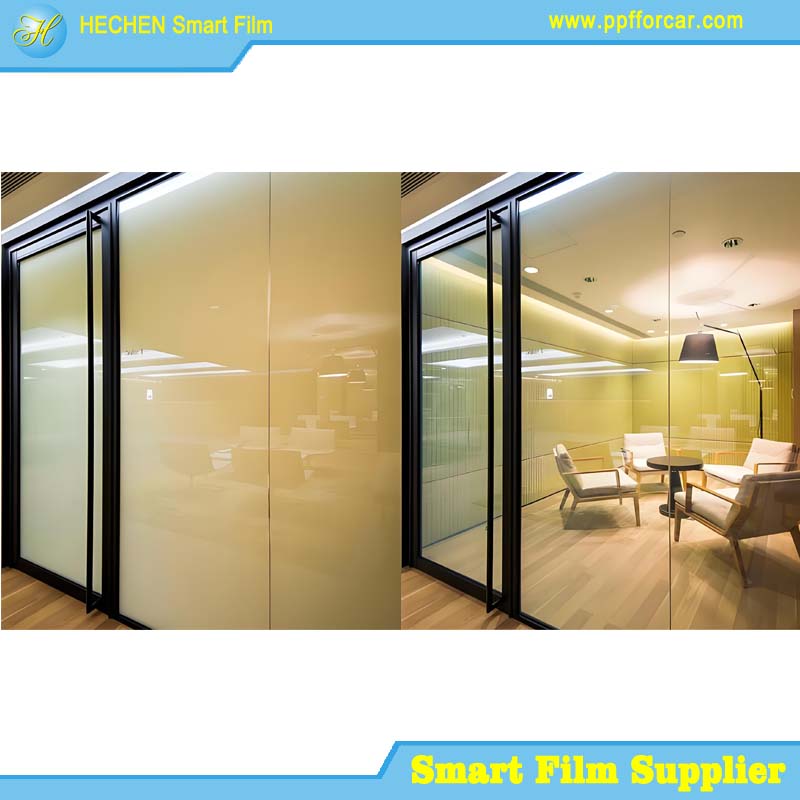
PDLC Smart Film for Windows & Partitions: Privacy Solutions for Modern Homes
Polymer Dispersed Liquid Crystal (PDLC) smart film offers residential architects and homeowners an electrically switchable glazing solution that transforms transparent windows or glass partitions into translucent, light-scattering privacy screens at the flip of a switch. Unlike traditional blinds, curtains, or frosted glass, PDLC technology provides instant, maintenance-free, and design-flexible privacy control. This article examines the operating principles, residential application scenarios (bathrooms, bedroom windows, open-plan dividers, kitchen splashbacks, and exterior glazing), installation methodologies, control strategies, energy performance, and long-term durability of PDLC smart film. Emphasis is placed on technical specifications, integration with home automation, and comparative advantages over conventional privacy treatments, without reference to specific commercial products or brands.
1. Introduction
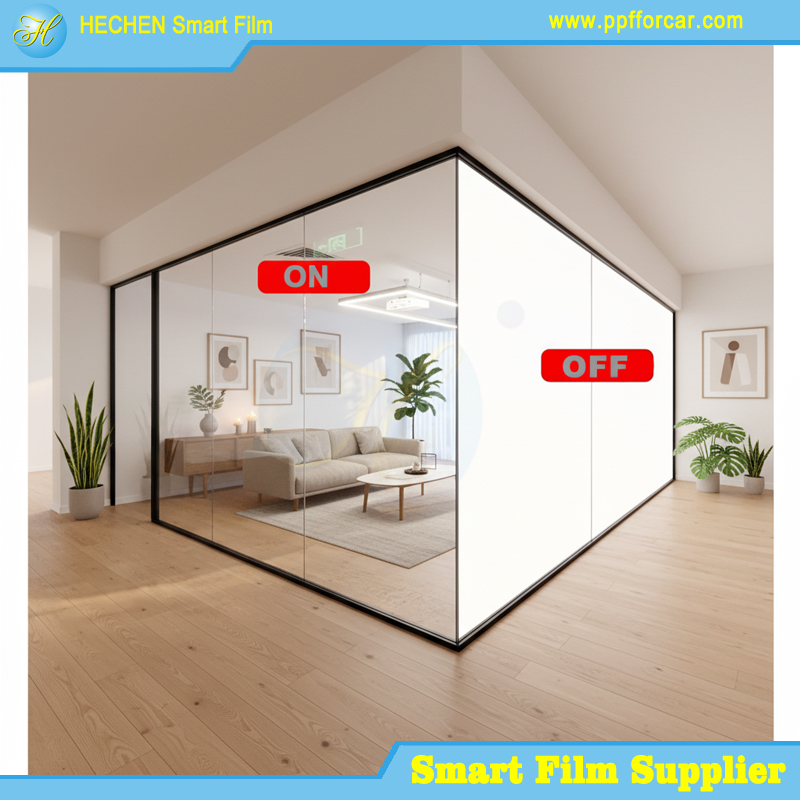
Modern residential design increasingly favors open floor plans, abundant natural light, and visual connectivity between living zones. However, privacy remains a fundamental requirement—especially in bathrooms, bedrooms, and ground-floor areas facing public thoroughfares. Traditional solutions such as curtains, roller blinds, Venetian blinds, or permanently frosted glass involve trade-offs: curtains accumulate dust and require cleaning; blinds have mechanical parts that fail; frosted glass admits light but permanently blocks views. Motorized shades add convenience but still occupy space and require periodic maintenance.
PDLC (Polymer Dispersed Liquid Crystal) smart film provides an elegant alternative. When integrated into laminated glass or applied as a retrofittable adhesive film, it enables on-demand switching between transparent (clear) and opaque (translucent white) states. The transition occurs in milliseconds, consumes minimal power only in the transparent state, and offers a completely smooth, cleanable surface. This article provides a comprehensive technical overview of PDLC smart film tailored to modern homes, covering materials science, application methods, and practical design considerations.
2. Operating Principles of PDLC Smart Film
2.1 Material Composition
PDLC film is a multilayer composite typically 0.2–0.4 mm thick. Its functional layer consists of micron-sized droplets of liquid crystal dispersed within a solid polymer matrix. This mixture is sandwiched between two flexible polyester substrates coated with transparent conductive material—usually indium tin oxide (ITO). The entire assembly is protected by hard coatings or, for architectural glass, laminated between two glass panes using polyvinyl butyral (PVB) or ethylene-vinyl acetate (EVA) interlayers.
For retrofit applications, self-adhesive PDLC film is available: a pressure-sensitive adhesive layer allows application onto existing clear glass, with a protective topcoat. However, laminated glass construction offers superior durability, UV protection, and safety (impact resistance).
2.2 Switching Mechanism
The optical behavior arises from refractive index mismatch. Liquid crystal molecules possess two refractive indices: ordinary (n_o ~1.5) and extraordinary (n_e ~1.7). The surrounding polymer matrix is formulated to match n_o.
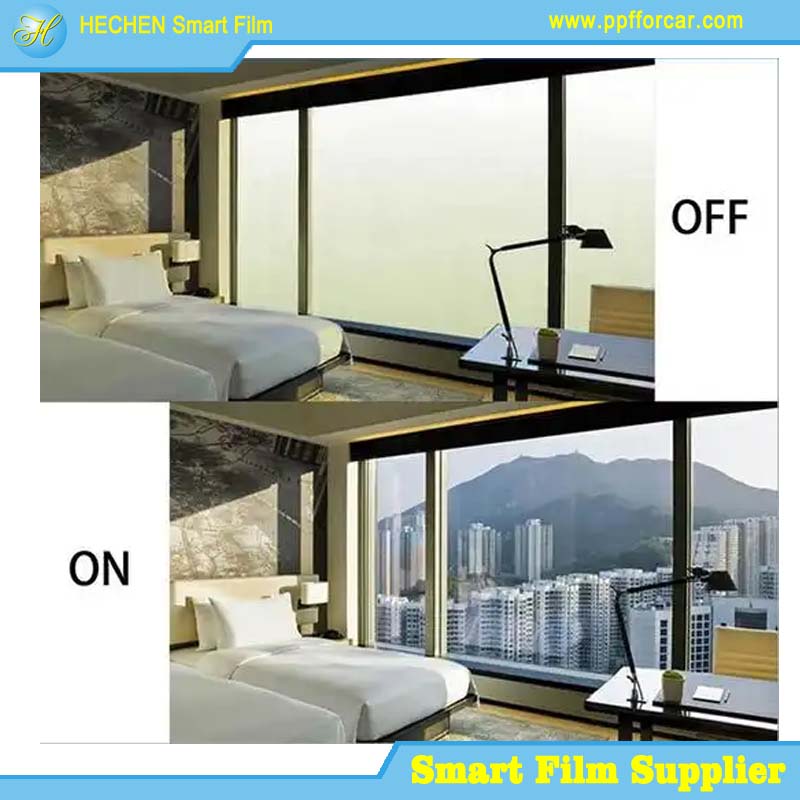
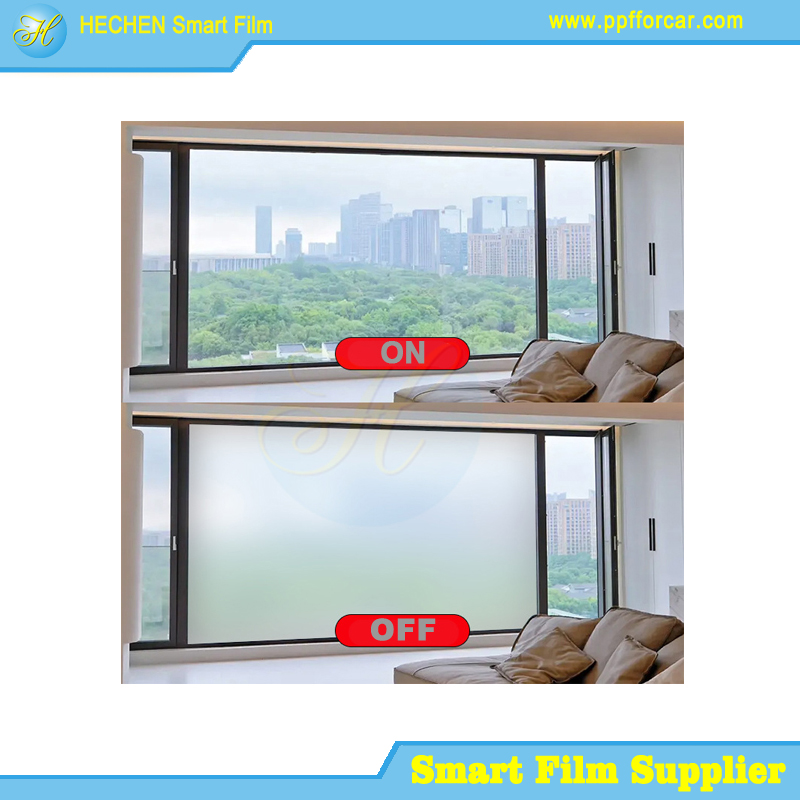
Off-state (no voltage): Liquid crystal droplets are randomly oriented. Light encounters multiple refractive index discontinuities (n_e vs. n_o of polymer), resulting in strong scattering. The film appears milky white, with haze >90% and direct transmittance <10%. Visible light transmittance (diffuse) is approximately 60–70%, so the space remains brightly lit but without clear image transmission.
On-state (voltage applied): An alternating current electric field (typically 40–70 V AC, 50/60 Hz) aligns liquid crystal molecules parallel to the field. Their extraordinary index now matches the polymer’s index, eliminating scattering. The film becomes transparent, with haze <5% and clear visible transmittance of 70–80%.
Switching time ranges from 10 to 100 milliseconds. The film consumes power only in the transparent state (typically 3–5 W/m²). In the opaque state, power consumption is zero, making it energy-neutral for privacy periods.
2.3 Key Technical Specifications for Residential Use
| Parameter | Typical Value |
|---|---|
| Operating voltage | 40–70 V AC |
| Power consumption (on-state) | 3–5 W/m² |
| Switching time | <100 ms |
| Off-state haze | >90% |
| On-state haze | <5% |
| Visible transmittance (on) | 70–80% |
| Visible transmittance (off, diffuse) | 60–70% |
| UV blockage (with interlayer) | >99% |
| Operating temperature | -10°C to 70°C |
| Switching cycles | >50,000 |
| Thickness (film only) | 0.2–0.4 mm |
3. Residential Application Scenarios
3.1 Bathroom Windows and Shower Enclosures
Bathrooms require both daylight and privacy. Traditional solutions include frosted glass (permanent privacy but no views) or blinds (moisture-prone and unsanitary). PDLC smart film on a bathroom window or glass shower wall offers the best of both: during daytime, the homeowner can set the film to transparent, enjoy the outside view and natural light; at night or during use, a switch renders it opaque. Because PDLC film is fully sealed (especially in laminated glass), it resists humidity and is easily wiped clean. For shower enclosures, the smooth surface prevents mold growth around edges—unlike curtain tracks or blind mechanisms.
3.2 Bedroom Windows Facing Streets or Neighbors
Ground-floor bedrooms or urban apartments often sacrifice view for privacy. PDLC film on bedroom windows eliminates the need for heavy drapes. During the day, keep the film transparent for daylight and outdoor connection; after dusk, switch to opaque to prevent passersby from seeing inside. Unlike blinds, PDLC does not block the window opening when opaque—diffused daylight still enters, maintaining a bright room. For bedrooms requiring blackout darkness for sleep, note that PDLC in opaque state scatters light but does not block it completely; a small percentage of light (30–40% diffuse transmittance) still passes through. For total blackout, an additional roller blind or blackout curtain behind the PDLC glass may be necessary.
3.3 Open-Plan Room Dividers and Partition Walls
Modern homes often combine living, dining, and kitchen zones in a single open space. PDLC glass partitions allow flexible subdivision: when transparency is desired (e.g., entertaining guests, supervising children), the partition remains clear; when privacy is needed (e.g., a home office corner, a guest sleeping area, or a messy kitchen during cooking), it switches to opaque. Sliding PDLC glass doors can separate a home theater from a living room—opaque state blocks visual distraction while transmitting sound (acoustic insulation is limited unless laminated with acoustic PVB interlayers).
3.4 Kitchen Splashbacks and Cabinet Doors
An innovative residential use is PDLC film on glass splashbacks or upper cabinet doors. A clear splashback can switch to opaque to hide dirty dishes or cooking utensils when guests arrive. Similarly, glass-fronted cabinets containing less aesthetically arranged items can become opaque at the touch of a button. This application requires the film to withstand occasional heat near ovens; standard PDLC has an upper operating limit of 70°C, so it should not be placed directly behind a gas burner. Induction cooktop backsplashes are generally safe.
3.5 Exterior Windows with Solar Control (Limited)
While PDLC is not primarily a solar control device, its opaque state reduces direct glare by scattering incident sunlight. This can be beneficial for west-facing windows in the afternoon. However, because scattering does not significantly reduce total solar heat gain (the scattered light is absorbed and re-radiated as heat), PDLC alone will not keep a room cool. For energy-efficient homes, PDLC should be combined with low-emissivity (low-E) coatings on the glass surface or used as the inner pane of an insulated glass unit (IGU) with argon fill.
3.6 Interior Closet or Wardrobe Doors
Glass wardrobe doors with PDLC film allow homeowners to see clothing selections when transparent, but switch to opaque to hide clutter. This adds a high-tech aesthetic while maintaining flexibility.
4. Installation Methods
4.1 Laminated PDLC Glass (New Construction or Full Replacement)
The most durable and aesthetically pleasing method is factory-laminated PDLC film between two tempered glass panes. The finished unit (typically 6 mm glass + 0.38 mm PVB + PDLC film + 0.38 mm PVB + 6 mm glass) has a total thickness of approximately 12.5–13 mm. This laminated glass can be framed in standard window or door profiles. Electrical connections are made via thin, flat busbars attached to the ITO layers at the glass edge, with wires exiting through the frame. For insulating glass units (double-glazed), the PDLC laminate is sealed as one pane, with a second clear pane separated by a spacer and inert gas.
Advantages: Superior UV protection (PVB blocks >99% UV), impact resistance (safety glass), no exposed film edges, long lifespan (>10 years).
Disadvantages: Higher initial cost; requires professional installation and structural support for heavier glass.
4.2 Retrofit Self-Adhesive PDLC Film
For existing windows, self-adhesive PDLC film (approximately 0.3 mm thick) can be applied directly to clean, smooth glass. The film has a peel-and-stick adhesive layer on one side and a protective hard coating on the other. Electrical connections require attaching busbars (supplied with the film) to two edges, then wiring to a driver. This method is suitable for DIY or small-scale retrofit, but the exposed edges are vulnerable to peeling, moisture ingress, and mechanical damage. Lifespan is typically 3–7 years.
Advantages: Lower material cost; no need to replace window frames.
Disadvantages: Less durable; visible busbars and wires; potential for bubbles or dust during installation; lower UV resistance (yellowing over time).
4.3 Power Supply and Wiring
PDLC film requires an AC driver (electronic power supply) that converts mains 110/230 V AC to 40–70 V AC. Each driver can handle a certain area (typically 5–20 m² depending on capacitance). Multiple film panels can be connected in parallel to a single driver, provided total capacitance does not exceed driver rating. Wiring must be concealed within walls, frames, or surface-mounted raceways. For sliding partitions, flexible flat cables or spring-loaded contacts are used.
Safety note: The low voltage output (40–70 V AC) is considered safe for dry indoor locations, but proper insulation and grounding are still required per local electrical codes.
5. Control Strategies for Homes
5.1 Basic Wall Switch
A simple momentary or latching wall switch connected to the driver provides manual on/off control. Some switches include a status indicator LED. For bathrooms, a humidity-sensing switch can automatically set the film to opaque when shower steam is detected (preventing visibility from outside).
5.2 Remote Controls
Infrared or radio frequency (RF) handheld remotes allow control from anywhere in the room. Multiple film zones (e.g., bathroom window, bedroom window, living room partition) can be addressed independently.
5.3 Smart Home Integration
PDLC drivers with dry contact inputs (or Wi-Fi/Zigbee modules) can integrate with home automation systems. Example automations:
"Good morning" scene: Bedroom window film becomes transparent at 7 AM.
"Movie mode" scene: Living room partition switches to opaque and lights dim.
"Away mode": All exterior window films switch to opaque for privacy when house is unoccupied.
Voice control via smart assistants (e.g., "Set bathroom window to privacy mode").
5.4 Occupancy and Light Sensors
For energy saving, a room occupancy sensor can set the film to transparent only when the room is occupied and daylight is sufficient (to reduce unnecessary power draw). However, power consumption is low, so this is optional.
5.5 Dimming and Intermediate States
True analog dimming (partial opacity) is not possible with standard PDLC because the liquid crystal droplets either align or not. However, pulse-width modulation (PWM) can create an intermediate appearance by rapidly switching between on and off states (e.g., 50% duty cycle). This reduces privacy effectiveness and may shorten film life due to continuous switching. Most residential applications use binary (on/off) control.
6. Energy and Daylighting Performance
6.1 Power Consumption
A typical 2 m² bathroom window consumes approximately 6–10 watts when transparent. If the film is transparent for 12 hours per day, annual energy use is about 26–44 kWh—equivalent to running an LED light bulb continuously for 3 months. In opaque state, consumption is zero. Compared to motorized blinds (which require power only during movement, not holding position), PDLC uses more energy if kept transparent continuously. However, for privacy-dominant applications where the film is opaque most of the time (e.g., bedroom at night, bathroom during use), total energy is negligible.
6.2 Daylight Transmission
In opaque state, PDLC film transmits 60–70% of incident light as diffuse illumination. This means a room remains bright without direct glare or visible images. For spaces like bathrooms, this level of daylight is sufficient for most tasks. In transparent state, 70–80% visible transmission is slightly lower than clear glass (≈90%) due to the ITO and polymer layers, but the difference is barely perceptible.
6.3 Solar Heat Gain
The solar heat gain coefficient (SHGC) of PDLC film is approximately 0.50–0.65 in transparent state and 0.60–0.75 in opaque state. The increase in opaque state occurs because scattered light is absorbed and re-radiated as long-wave infrared. Thus, PDLC is not a cooling aid. For homes in hot climates, external shading or low-E glass is still necessary. PDLC's primary benefit is privacy, not energy efficiency.
6.4 Insulation (U-Value)
PDLC film itself has negligible thermal resistance (R-value ≈ 0.1 m²·K/W). When laminated into insulated glass units (e.g., double glazing with 12 mm argon gap), overall U-values of 1.1–1.4 W/m²·K are achievable—comparable to standard low-E double glazing.
7. Maintenance and Durability
7.1 Cleaning
Laminated PDLC glass is cleaned exactly like standard glass: non-abrasive cloth, mild detergent, and water. Avoid ammonia-based cleaners (they can attack edge seals over years) and abrasive pads (scratch ITO or polymer). Retrofit adhesive film requires extra care—do not use solvents, as they may penetrate edges.
7.2 Lifespan and Degradation
High-quality laminated PDLC glass maintains performance for 10–15 years in indoor residential conditions. Degradation modes include:
Yellowing: Caused by UV exposure; mitigated by UV-absorbing PVB interlayers.
Increased haze in transparent state: Occurs after many switching cycles (>50,000) due to polymer fatigue.
Delamination: Rare in factory-laminated units; more common in retrofit film exposed to moisture.
Busbar corrosion: Copper busbars can oxidize if edge seals fail.
7.3 Troubleshooting Common Issues
| Issue | Likely Cause | Solution |
|---|---|---|
| Film remains opaque | No power, driver failure, loose connection | Check mains, replace driver, inspect wiring |
| Film remains clear | Short circuit, driver stuck on | Check for wiring short, replace driver |
| Partial switching (edges clear, center opaque) | Insufficient voltage (long cable runs) | Use thicker wires, move driver closer |
| Visible spots or bubbles (retrofit film) | Dust during installation, adhesive failure | Replace film; professional installation recommended |
8. Limitations and Design Considerations
8.1 Viewing Angle Dependence
PDLC transparency degrades at oblique angles. When viewed from >60° off normal, even the "transparent" state appears hazy. For windows viewed predominantly from a seated position or at an angle, this may be noticeable. Designers should orient PDLC partitions perpendicular to primary sightlines.
8.2 Not a Blackout Solution
As noted, opaque PDLC transmits 30–40% of light diffusely. For bedrooms requiring complete darkness for sleep (e.g., shift workers, nurseries), an additional blackout curtain or blind is necessary behind the PDLC glass. Alternatively, combine PDLC with a second layer of dark tinted glass.
8.3 Temperature Limits
Operating range is -10°C to 70°C. In uninsulated exterior windows in cold climates, the film may become sluggish below -10°C (switching time increases to seconds, but eventually works). Above 70°C (e.g., behind a black curtain in direct summer sun), the polymer can degrade permanently. Ensure adequate ventilation and avoid placing PDLC in sealed, sun-heated cavities.
8.4 Cost Considerations
Laminated PDLC glass costs approximately 3–5 times more than standard clear tempered glass. Retrofit film costs about 1.5–2 times high-quality window film. However, when accounting for the elimination of blinds, curtains, and their maintenance, the lifecycle cost can be competitive for high-end homes.
8.5 Electrical Safety
While output voltage is low, installation must be performed by a qualified electrician in many jurisdictions, especially for in-wall wiring. Use only certified drivers with overload protection.
9. Comparison with Alternative Privacy Solutions
| Solution | Privacy Control | Daylight | Maintenance | Aesthetics | Cost |
|---|---|---|---|---|---|
| PDLC film | Instant, electric | Diffuse or clear | Low (cleaning only) | High-tech, seamless | Medium-high |
| Frosted glass | Permanent | Diffuse only | Low | Fixed | Medium |
| Roller blinds | Manual or motorized | Block or admit | High (dust, mechanism) | Traditional | Low-medium |
| Venetian blinds | Adjustable slats | Patterned | High (cleaning slats) | Traditional | Low |
| Switchable smart glass (other tech) | Varies | Varies | Low | Seamless | High |
PDLC uniquely offers on-demand clear-to-opaque switching with no moving parts, zero maintenance beyond cleaning, and a completely flat surface.
10. Future Developments
Research continues into:
Lower voltage PDLC (12–24 V DC): Simplifies integration with solar panels and battery systems.
Self-adhesive films with extended outdoor durability: UV-stable adhesives and hard coatings for exterior retrofit.
PDLC with integrated low-E coatings: Combining privacy switching with thermal insulation in a single film.
Flexible and curved PDLC: For domed skylights or curved glass partitions.
Conclusion
PDLC smart film offers a compelling privacy solution for modern homes, particularly in bathrooms, bedroom windows, open-plan partitions, and glass cabinet doors. Its instant switching, low power consumption, and seamless integration with glass surfaces address the limitations of traditional blinds and fixed frosted glass. While not a replacement for blackout curtains or low-E glazing, PDLC excels where on-demand visual privacy without mechanical complexity is desired. With proper installation (preferably laminated glass for durability) and smart home integration, PDLC technology enhances both functionality and aesthetic appeal. Homeowners and architects should consider viewing angle limitations, temperature ranges, and the need for professional electrical work, but the overall value proposition—combining daylight, views, and privacy in one switchable surface—positions PDLC as a key technology in next-generation residential design.
For more about PDLC Smart Film for Windows & Partitions: Privacy Solutions for Modern Homes. Everything you need to know, you can pay a visit to https://www.ppfforcar.com/product/PDLC-Smart-Film/ for more info.